Where possibilities
begin
Gain new perspectives for your digital transformation. You can follow the blogs on this page to get latest information.
Effective Data Room Management Strategies for CFOs During Post-Merger Integration Phases
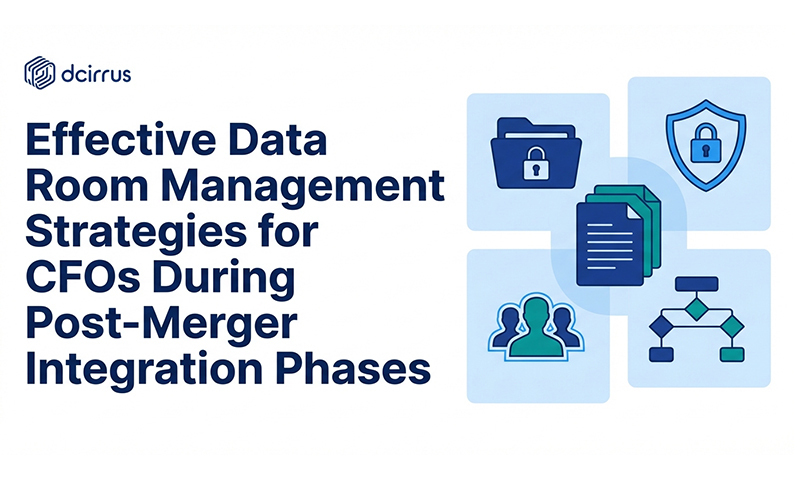
Post-merger integration (PMI) is where value is either captured or quietly lost. For CFOs, the virtual data room isn’t just a deal artifact from due diligence anymore. It becomes the operating system for integration governance: controlling access to sensitive financial information, keeping decisions auditable, and aligning cross-functional teams around a single source of truth.
In this guide I’ll focus on CFO-specific data room management strategies you can apply across PMI phases to reduce risk, improve coordination, and maintain stakeholder confidence.
What is the CFO’s role in post-merger integration data room management?
As CFO, you’re accountable for financial integrity, compliance readiness, and the pace at which integration decisions can be made with confidence. Data room management sits at that intersection.
Your role? Set governance. Define what “good” looks like for access control, documentation standards, reporting, and escalation paths. Your integration management office (IMO), steering committee, and functional integration teams may execute day to day. But the CFO typically owns the risk posture and the reporting expectations that the VDR must support.
A well-governed data room helps you reduce leakage risk around forecasts, pricing, customer contracts, and payroll data. It creates an audit-ready record of who accessed what, when (and why). It keeps integration planning aligned across Finance, IT integration, Legal, HR, and Compliance. And it improves transparency for executives, boards, auditors, lenders, and investors when appropriate.
Common challenges CFOs face managing virtual data rooms during PMI
CFOs face predictable problems once the integration process accelerates.
Permission sprawl. Access expands from a tight deal team to functional integration teams, external advisors, and sometimes interim operators. Without discipline, you lose control fast.
Version confusion. Multiple versions of financial models, synergy tracking sheets, and policy documents circulate. That creates disagreements over “the latest” and slows decisions when you need speed most.
Sensitivity conflicts. Finance needs speed; Legal needs controls; IT needs workable identity and device policies; business owners want broad visibility. These tensions don’t resolve themselves.
Audit and compliance pressure. Regulators, external auditors, and internal audit may require defensible trails (especially if the transaction triggers new reporting obligations). An email-based Q&A system won’t cut it.
Q&A overload. Stakeholder questions multiply post-close. Without a structured approach, answers get fragmented across inboxes and meetings. Teams act on inconsistent information.
Cross-border constraints. Data localization and regional privacy obligations can limit where files are stored and who can access certain categories of data. Not every problem is solvable with “just share it.”
How CFO, IT, Legal, and Compliance teams collaborate on data room governance
PMI data room governance works best as a shared operating model rather than a finance-only admin task. A practical structure:
- CFO (you): Sets risk thresholds, approves access principles, defines reporting cadence, and owns escalations tied to financial exposure
- IT / Security: Implements authentication standards, device-level controls, IP restrictions, and security monitoring practices
- Legal: Defines what can be shared, when clean team approaches are required, and how privilege and confidentiality need to be protected
- Compliance / Internal Audit: Confirms audit trail sufficiency, retention expectations, and alignment with applicable regulations
- IMO: Coordinates workflows, ensures functional teams follow naming/structure standards, and maintains execution discipline
The key operating rule: if it matters to integration decisions, it lives in the VDR with the right access controls and audit trail. Simple in theory. In practice it’s messier, but that’s the target.
Core data room management strategies for CFOs in post-merger integration
CFO-led data room management is less about uploading documents and more about establishing controls that keep integration moving without compromising confidentiality.
How to establish granular access controls and permission governance
Permissions are your first line of defense and one of the fastest ways to reduce PMI friction. Instead of “add everyone, fix later,” define a permission governance model that can scale.
Common CFO-friendly practices include role-based access by function (separate Finance, Tax, HR, IT integration, Sales Ops, and Legal materials into controlled areas). Need-to-know segmentation gives access to the minimum set of folders and files required for a stakeholder’s workstream. Time-bound access uses windows aligned to PMI phases—Day 1 prep, Day 1–30, Day 30–60, Day 60–100, Day 100+—then removes access that’s no longer required.
External party constraints limit advisors, consultants, and third parties to specific folders and require explicit approvals for expansions. Where supported, device-level and location controls can require device approval and consider IP restrictions for high-sensitivity categories.
From a CFO standpoint the governance win is consistency. The same access logic should apply whether the user is an IMO lead, a finance manager, outside counsel, or an integration clean team member.
Security protocols to implement: DRM, watermarking, and multi-factor authentication
PMI increases the volume of confidential materials and the number of people touching them. That’s exactly when basic file-sharing behaviors create unacceptable risk.
A CFO-driven security baseline often includes Digital Rights Management (DRM) to enforce document-level restrictions so users can’t print, copy, or forward sensitive files. Where possible apply expiration dates to downloads so information doesn’t live forever on unmanaged endpoints.
Customizable watermarking uses dynamic watermarks that identify the viewer and access context (username, timestamp, or IP address, for example). This discourages intentional leakage and reduces mishandling.
Multi-factor authentication (MFA/2FA) requires an additional authentication factor for all users. Elevate requirements for high-risk folders like forecast models, customer pricing, and compensation data.
Encryption in transit and at rest should use 256-bit AES encryption for storage and transfer. Treat this as a CFO requirement, not an IT nice-to-have.
Enterprise virtual data room solutions provide these controls at a granular level without slowing down legitimate work. Worth the investment.
Organizing and structuring financial documents for clarity and compliance
A VDR that’s secure but disorganized still slows integration. CFOs should push for an information architecture that supports both speed and audit readiness.
Structure by workstream and decision use, not by whoever uploaded the file. For finance-heavy PMI that typically means clear separation between historical financials and audit materials, current reporting packages and close calendars, synergy goals and tracking, tax/treasury/banking, contracts that drive revenue recognition or liabilities, and policies/controls/compliance evidence.
Operational standards to enforce? Consistent naming conventions (decide how you’ll label entity, period, version, and status like Draft/Final/Approved). Version control discipline stores working drafts in controlled areas and publishes approved versions in a clearly labeled “final” location. Indexing and metadata hygiene makes documents easy to find by tagging them consistently, especially when integration teams are under time pressure.
The CFO benefit: fewer delays caused by “where is it?” and fewer mistakes caused by “I used the wrong version.”
Managing Q&A and secure stakeholder communications within the data room
PMI generates a high volume of questions about accounting policies, working capital assumptions, carve-out constraints, customer contracts, and integration costs. If those answers live in email threads you lose control of both accuracy and auditability.
Instead, treat Q&A as a governed workflow Centralize questions in the VDR’s Q&A or discussion tools rather than inboxes. Assign owners (Finance, Legal, IT integration, HR) with due dates. Require source citations by linking back to the relevant file or folder. Publish “official answers” so stakeholders don’t rely on forwarded messages or partial context. Keep an auditable history of questions, answers, and supporting documents.
This supports faster decision-making and reduces the chance that different teams act on inconsistent guidance. Pretty straightforward once you commit to the discipline.
How virtual data room analytics and AI drive PMI financial outcomes
Once the VDR is governed properly you can use it for more than storage. CFOs can treat it as an integration signal system: showing where reviews are stuck, where compliance evidence is thin, and which workstreams are falling behind.
Monitoring PMI progress and compliance via VDR analytics dashboards
VDR analytics can be turned into practical PMI management inputs when you map them to finance leadership needs. Useful signals include user activity by workstream (who is engaging with which integration areas like IT integration vs. finance close readiness?) and document engagement (which key files are being viewed and which are being ignored, often a sign of misalignment or a communication gap).
Permission and access changes show spikes in access requests that can indicate scope creep or emerging dependency risks. Audit trail completeness confirms whether document access and changes are being tracked consistently across sensitive folders. Q&A throughput tracks open questions by owner, average time to answer, and recurring themes that indicate confusion or missing documentation.
The CFO value is early detection. Instead of hearing late that a workstream is blocked you can see bottlenecks forming and address them through the IMO and steering committee.
Accelerating financial due diligence with AI-powered document intelligence
Even after close, finance teams continue to do “due diligence-like” work during PMI. Validating contract terms. Identifying liabilities. Confirming policy alignment. Reconciling reporting differences. AI-powered document intelligence can reduce manual searching and repetitive review.
Capabilities often relevant to CFO workflows? Automated indexing and categorization reduces time spent organizing large file sets from multiple entities. Metadata and full-text search helps teams find key terms across thousands of documents without relying on perfect naming. Clause recognition supports faster review of contract language tied to revenue, liabilities, termination rights, or change-of-control terms. AI-assisted redaction helps protect sensitive information when sharing across broader integration teams or when clean team boundaries are required.
This is especially helpful when integration clean teams are used near-close to handle competitively sensitive information while maintaining legal and operational boundaries.
Measuring the ROI and operational impact of effective data room management
PMI leaders often know a VDR “helps” but CFOs need a way to evaluate whether the data room is improving integration execution and reducing risk.
How to quantify cost and timeline reduction in PMI through optimized data rooms
Instead of claiming a single ROI number, track a small set of defensible metrics that connect data room operations to integration efficiency.
Cycle time to answer Q&A measures time from question opened to approved answer posted. Time to locate critical documents gets measured through internal sampling or team feedback during key milestones. Rework volume counts the number of times teams revise memos or decisions due to incorrect or outdated source documents.
Access request turnaround time tracks time to approve or deny access expansions (especially for external parties). Audit readiness indicators measure completeness of audit trails, ability to export access history, and documented version control for key finance deliverables. Milestone readiness tracks on-time completion of finance integration milestones such as reporting alignment, close calendar integration, and synergy tracking cadence.
This gives you a balanced view: productivity, control, and execution health. Not perfect but a lot better than “it feels faster.”
Common pitfalls to avoid in CFO data room governance during PMI
A few predictable mistakes undermine otherwise solid PMI plans. CFOs can avoid them with clear policies and ownership.
Treating the VDR as a static archive slows you down because PMI requires active workflows, not just storage. Over-permissioning early creates broad access that’s hard to unwind and increases leakage risk. Under-investing in structure means a messy folder system becomes a hidden tax on every workstream.
Letting email become the “real” system undermines your audit trail (if Q&A and approvals happen outside the VDR your audit trail becomes incomplete). Failing to define escalation paths leaves teams without a fast, defined route to CFO/Legal/Compliance decisions when sensitive access decisions arise. Ignoring clean team needs risks violations because competitively sensitive data often requires special access models to stay within legal boundaries.
Integrating data room management into broader PMI financial governance
The VDR should support your broader finance governance model during post-acquisition integration. That means connecting it to how you plan, forecast, report, and communicate. Not treating it as a separate “M&A tool.”
Aligning data room workflows with finance dashboards and scenario planning
CFOs can make the VDR more actionable by aligning it with finance operating rhythms. Use standardized folders for each reporting cycle so integration teams know where to find the latest packages. Link synergy tracking documentation to the materials that justify assumptions (contracts, headcount plans, procurement terms). Ensure scenario planning inputs are traceable back to source documents stored in the data room. Export indexes and usage reports when needed to support internal status reporting and executive visibility.
The goal is traceability. When someone challenges a number you can quickly show the underlying documentation and decision history.
Building investor and stakeholder confidence via transparent data room practices
After a merger confidence depends on transparency and control. The CFO can use data room practices to reinforce both by maintaining clean, role-appropriate access for boards, lenders, auditors, and selected stakeholders. Use audit trails to demonstrate disciplined handling of sensitive materials. Publish approved “source of truth” documents for key updates like synergy goals, integration milestones, and finance policy alignment. Reduce rumor and uncertainty by ensuring stakeholders see consistent, governed information.
This is not about oversharing. It’s about professionalizing access and making governance visible.
CFO data room governance checklist for post-merger integration
Use this checklist to pressure-test whether your PMI data room is governed like a CFO-controlled system:
- Define a CFO-approved permission model based on roles, workstreams, and sensitivity tiers
- Implement time-bound access aligned to PMI phases and remove access that is no longer needed
- Require MFA/2FA for all users and elevate controls for high-sensitivity areas
- Apply DRM controls to restrict printing, copying, and forwarding where appropriate
- Use dynamic watermarking to deter leakage and reinforce accountability
- Establish a finance-first document taxonomy with consistent naming and clear “final vs draft” separation
- Enforce version control standards for models, reporting packages, and policy documents
- Centralize Q&A inside the VDR with owners, deadlines, and published “official answers”
- Use audit trails as a governance asset by reviewing access logs and permission changes regularly
- Define escalation paths for sensitive access requests and policy exceptions
- Set up analytics reporting that aligns with PMI KPIs (bottlenecks, Q&A throughput, engagement)
- Plan for clean team workflows where competitively sensitive data requires special handling
- Create a handoff plan so data room administration changes do not disrupt PMI execution
FAQ
What are the best practices for CFOs managing virtual data rooms during post-merger integration?
Focus on governance first. Role-based permissions, security controls (MFA, DRM, watermarking), disciplined document structure, centralized Q&A, and routine audit trail review. The CFO’s win is a VDR that supports fast decisions without weakening confidentiality or compliance.
How can CFOs enforce granular access controls and security protocols in data rooms?
Start with a permission model by workstream and sensitivity tier then implement MFA/2FA, device-level approvals where available, and restrictions like DRM and watermarking on critical documents. Make access expansion an approval workflow, not an informal request.
What types of analytics and reports should CFOs use to monitor PMI progress via virtual data rooms?
Track Q&A throughput, document engagement on critical integration materials, access and permission change activity, and audit trail completeness. Use these signals to spot bottlenecks early and to manage workstreams through the IMO and steering committee.
How does AI-powered document intelligence improve financial due diligence post-merger?
It reduces manual effort by improving search, automating indexing and categorization, supporting clause recognition in contracts, and enabling faster redaction when sharing needs to be controlled. This helps finance teams move quicker while maintaining process discipline.
What common pitfalls should CFOs avoid in data room management during PMI?
Avoid over-permissioning, messy folder structures, unmanaged versioning, and allowing email to become the real system of record. Also avoid ignoring clean team requirements when competitively sensitive data needs special access boundaries.
How can CFOs use data room management to maintain investor confidence after a merger?
Use the VDR to provide controlled transparency with clear “approved” documentation, consistent stakeholder communications, and defensible audit trails. Confidence improves when stakeholders see disciplined governance and can trust the integrity of shared information.
What are the key ROI metrics CFOs should track to evaluate data room effectiveness in PMI?
Use operational metrics tied to execution quality. Q&A cycle time, time to locate critical documents, rework caused by version confusion, access request turnaround time, audit readiness indicators, and on-time completion of finance integration milestones.
Ready to secure your transactions?
Book a free demo of DCirrus Virtual Data Room today and experience enterprise-grade data protection with encryption, access controls, and compliance-ready localization.
Latest Posts