Controlling the Narrative: How a VDR Mitigates Risk During the IPO Quiet Period
One wrong email can unravel the quiet period you’ve managed for weeks. A draft sent to the wrong investor or a financial model forwarded outside the room can compromise everything in hours. Your deal lead feels this pressure constantly. Too many stakeholders. Too many document versions. Too many channels running at once.
“Being careful” doesn’t scale under this kind of operational load. Email discipline breaks down when your team is juggling multiple workstreams at midnight. This is a systems problem, not a people problem.
This article gives you a practical VDR checklist with seven controls to lock down document access and communications during the quiet period. You’ll also get a look at role assignments and common failure modes, so you can stop incidents before they start.
Why Is the IPO Quiet Period a “Narrative Control” Problem, Not Just a Legal Rule?
The quiet period legally restricts what your team can say publicly about the company. No promotional statements. No selective disclosures. No communications that could condition the market before the offering is registered. Breaking those rules, even accidentally, can lead to regulatory scrutiny or a delayed timeline.
But the legal rule isn’t the hardest part. The real challenge is managing the operational risk. You have underwriters, auditors, legal counsel, and potential investors all needing documents. Drafts circulate and versions multiply. Questions get answered over email, sometimes inconsistently.
When information moves through uncontrolled channels, the risk is reputational and procedural. You could face premature disclosure of financials, inconsistent answers creating a selective disclosure issue, or stale documents circulating after material updates. The quiet period doesn’t just restrict what you say. It demands you control how everything moves.
What Does a Quiet-Period-Safe Workflow Need to Control?
You reduce quiet-period risk by controlling five surfaces. Miss one, and you’re exposed.
- Need-to-know access: Ensure people can only see the documents relevant to their role. This prevents premature or selective disclosure.
- Distribution containment: Control what happens when files leave the VDR. Downloads and prints are where “in the room” becomes “in the wild.”
- Version truth: Maintain one current version of every document, visible to everyone who needs it. This stops outdated drafts from circulating.
- Q&A traceability: Log and attribute every question and answer. This creates a defensible record and prevents inconsistent responses.
- Monitoring and auditability: Maintain continuous visibility into who accessed what and when. Your audit log becomes an early-warning system, not just a post-incident report.
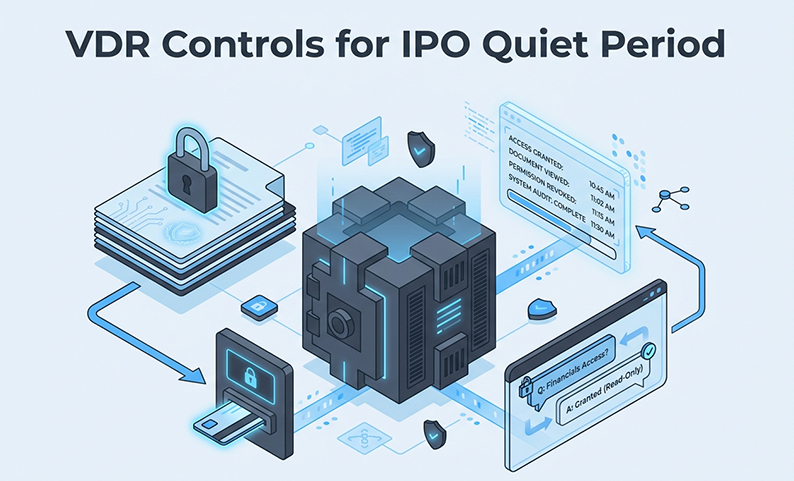
A purpose-built VDR enforces all five of these controls in one platform, closing the gaps left by patching together email and shared drives. But a platform alone isn’t enough. The controls only work if they are configured and actively managed from day one.
What Is the Quiet-Period VDR Checklist (7 Controls) You Should Enforce from Day One?
A VDR mitigates quiet-period risk only when it enforces specific controls. Build this checklist before you invite your first external stakeholder.
1. Role-based permissions at folder and file level
- Segment access by stakeholder type (underwriters, counsel, auditors). Each gets a distinct permission group.
- Apply a least-privilege policy by default. If a role doesn’t need it, they don’t see it.
- Review group assignments before every major deal stage.
2. Strong authentication and perimeter controls
- Require two-factor authentication (2FA) for all users. No exceptions.
- Enable IP address restrictions for high-sensitivity folders.
- Use device-level approval to prevent access from unrecognized endpoints.
3. Time-bound access and instant revocation
- Tie access windows to deal stages. Don’t leave permissions open-ended.
- Revoke access immediately when an advisor’s role ends.
- Audit the active user list weekly. Stale access is a common failure.
4. Controlled viewing and download rules
- Enable viewer-only mode for documents where a download is unnecessary.
- Restrict printing and downloads to the minimum required for each role.
- Set expiry dates on downloaded files so they become unusable after a defined period.
- Apply user-specific watermarks (login, IP, timestamp) to every viewed, downloaded, or printed document.
- Watermarks deter leaks and provide forensic identification if one occurs.
6. Version control discipline
- Maintain a single current version of every critical document.
- Use clear, enforced naming conventions. Prohibit informal names like “final_v7b.”
- Archive old versions so history is preserved but not accessible to external parties.
7. Centralized Q&A with logging
- Replace all email-based Q&A with a structured, in-platform workflow.
- Log every question, response, and status change.
- Allow no answers outside the platform.
Shared drives and email fail here because they lack granular permissions, a defensible audit trail, and security features like watermarking or access revocation on distributed files.
How Do You Keep Q&A from Becoming a Quiet-Period Liability?
Email Q&A is the most common source of selective disclosure risk. When questions come in through different channels and get answered by different people, you get inconsistent responses and no audit trail.
The fix is structural. Force all diligence communications into one system with defined ownership.
Lightweight Q&A governance model:
- Q&A Owner (deal lead): Receives, triages, and routes all incoming questions.
- Legal Approver (counsel): Reviews and approves all responses before publishing.
- No side-channel rule: Any question asked by email gets redirected to the platform. No informal answers.
A workable response flow: Ask → Triage → Draft response → Legal review → Publish in platform → Archive
An integrated VDR Q&A tool keeps this workflow inside the data room. Every question is linked to the relevant document, and every response is timestamped. The platform gives counsel a clean, trackable interface for review without chasing email threads.
How Do You Prevent Leaks Once Documents Are Downloaded or Printed?
Assume someone will try to take documents outside the room. This isn’t pessimism; it’s realism. Your security plan should be designed around it.
Prevent:
- Restrict downloads and printing to only the roles where it’s necessary. Default to viewer-only.
- Use DRM controls to set expiry dates on downloaded files, making them inaccessible after a defined window.
Deter:
- Apply dynamic watermarks with the user’s login, IP address, and timestamp to every document. Every copy will carry identifying information, no matter where it ends up.
Investigate:
- Use audit trails to reconstruct who accessed which documents, when, and from where. A VDR should maintain comprehensive, exportable logs of all user actions.
No tool can stop someone from taking a picture of a screen. But these controls dramatically reduce the blast radius of a leak and give you a defensible record of every access point.
Who Owns What: How Do You Operationalize Counsel’s Rules Inside the VDR?
Platform visibility without human ownership is just a record of incidents you didn’t catch in time. Monitoring only works when someone is accountable for acting on what the logs show.
Role assignments:
- VDR Admin: Configures permissions, manages groups, and executes access revocations.
- Deal Lead: Enforces policies with all stakeholders and is the first escalation point.
- Legal Counsel: Owns communication rules and approves Q&A responses.
- Analyst Team: Maintains document hygiene, including version control and naming.
Operational rhythm:
- Daily: Review access changes and flagged activity. Check the Q&A queue.
- Weekly: Conduct a full permission audit against the current stakeholder list. Look for bulk downloads or off-hours access.
A VDR’s audit trails and reporting tools give your team a practical way to maintain this rhythm, catching anomalies before they become incidents.
What Are the Most Common Quiet-Period Failure Modes-and How Do You Catch Them Early?
Most quiet-period incidents are simple process slips, not sophisticated attacks. They happen when teams move fast without enforced controls.
Common failure modes:
- Over-permissioned groups: Access granted broadly “to save time” and never trimmed.
- Stale versions circulating: Multiple “final” versions with no single source of truth.
- Side-channel Q&A: Bankers answering questions over email, creating undocumented disclosures.
- Unmonitored downloads: Bulk exports happening without anyone reviewing the activity log.
- Slow offboarding: Advisors retaining access for days or weeks after their role has ended.
Early-warning checks:
- Run a permission audit at every deal stage transition.
- Enforce strict naming conventions for financials and disclosure drafts.
- Review activity logs for anomalies like bulk downloads or access at unusual hours.
- Document your escalation steps for a fast, consistent response.
Summary and Next Steps: What’s the Single Highest-Priority Control to Implement?
The quiet period is an operational control problem. Legal guidance alone doesn’t protect you. The team that succeeds is the one that operationalizes counsel’s rules through a VDR with enforced permissions, controlled Q&A, and active monitoring.
If you are starting an IPO process, implement the seven-control checklist before your first external stakeholder is invited. Then, align your deal lead and legal counsel on Q&A ownership and permission rules on day one, not after the first question lands in an inbox.
FAQ
What is “gun-jumping” in the IPO process (in plain English)? Gun-jumping is any communication that could promote investor interest in the offering before the registration is effective. Intent doesn’t matter. An enthusiastic press release or an informal investor call can qualify. The SEC takes it seriously, with consequences ranging from waiting periods to rescission rights for buyers.
Can we use Google Drive or Dropbox for IPO diligence if we “lock it down”? Consumer file-sharing tools lack the granular permissions, immutable audit trails, and security features (like DRM and watermarking) that IPO diligence requires. Using them means patching together workarounds, creating the security gaps a VDR is built to close. When a single access event can trigger a regulatory issue, your infrastructure matters.
What VDR activity should we monitor most closely during the quiet period? Prioritize bulk downloads, access from unrecognized IP addresses, users accessing documents outside their defined role, and off-hours activity. These patterns don’t always signal a breach, but they are signals worth investigating before they escalate.
How should we handle version control for financials and disclosure drafts? Maintain a single, clearly labeled current version in the VDR. Archive previous versions so they are preserved but not externally accessible. Enforce a naming convention before anyone uploads so there are no informal suffixes like “v2_FINAL_revised.”
Do underwriters, auditors, and counsel need different permission groups? Yes. This is one of the most important configurations to get right. Each party has a different scope of legitimate access. Grouping them into one broad permission set is a common mistake. The baseline rule is least-privilege access by role.
How long should we retain audit logs and Q&A records? Align with legal counsel on the minimums for your transaction, as requirements vary. Most deal teams retain complete audit trails and Q&A records for several years post-closing to support any potential regulatory review.
What should we do immediately if we suspect a data room leak? Act on suspicion; don’t wait for confirmation. Immediately revoke access for the suspected user or group. Export the full audit log for the relevant time window. Notify legal counsel before taking further steps, and document every action you take.
Want to Run a Quiet-Period-Safe IPO Process Without Email Chaos or Permission Sprawl?
DCirrus VDR is built for exactly this scenario, with granular permissions, DRM controls, dynamic watermarking, integrated Q&A, and audit-ready reporting in a single platform. See how it works in practice.
A purpose-built VDR enforces all five of these controls in one platform, closing the gaps left by patching together email and shared drives.
Latest Posts