The Decision Checklist: How to Evaluate AI Features in a VDR Before an IPO
The DRHP clock is running. You have 10+ external parties—counsel, auditors, underwriters, registrars—all needing access to thousands of documents, and zero tolerance for a leak or a missing log. That’s the IPO reality.
The problem with buying an “AI VDR” on demo strength is you can end up with impressive features that don’t fit your workflow, opaque pricing, and governance gaps that only surface when a regulator asks questions.
This article gives you a 10-point decision checklist with a weighted scorecard and specific “prove it” pilot questions. The goal is to help you evaluate AI features in a VDR against IPO outcomes (like faster diligence, fewer compliance gaps, and cleaner collaboration), not just AI hype.
What Makes “AI Features” IPO-Ready (Not Just Demo-Ready)?
IPO-ready AI in a VDR should accelerate key tasks like ingestion, retrieval, redaction, and Q&A. But it must do this without weakening your permissions, audit trails, or data controls.
That’s a narrow definition on purpose. In regulated diligence, there’s no room for black-box outputs. Every AI action needs a human validation checkpoint. It must be something a reviewer approves, a log captures, and counsel can defend.
Ask vendors these three questions before you go any further:
- Where does AI act? Upload/indexing, search, redaction, clause detection, or just in the demo?
- What’s logged? If an AI suggestion is accepted or rejected, does it appear in the audit trail?
- What’s reversible? Can a reviewer override, correct, or restore without creating a compliance gap?
If the answers are vague, the AI isn’t IPO-ready.
How Should You Score AI in a VDR? (A Simple Weighted Rubric You Can Use Today)
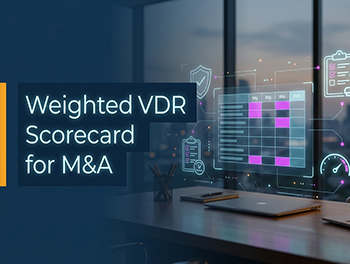
Don’t compare vendors by feature count. Score them by IPO impact. Use this method: rate each criterion 0–5, multiply by its weight, and total out of 100.
| Criterion | Weight | Max Score |
|---|---|---|
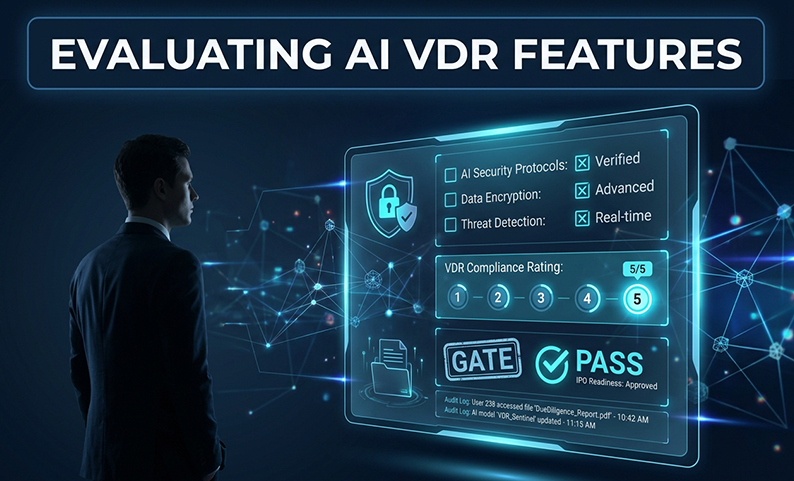
| Security + permissions + auditability | Gate | Pass/Fail first |
| Timeline compression (setup + retrieval) | 30% | 15 |
| Compliance risk reduction | 25% | 12.5 |
| Multi-party usability and adoption | 25% | 12.5 |
| Pricing predictability | 20% | 10 |
Rule: Gate first, then score. If a vendor fails the security/auditability gate, remove them from the shortlist. It doesn’t matter how strong their AI looks.
What Are the “Gate” Requirements You Should Treat as Pass/Fail?
A vendor must clear every one of these before AI scoring even begins:
- Granular folder/file-level permissions; role-based access for external parties
- MFA/2FA; device-level approval; IP address restrictions
- Dynamic watermarking with user identity and timestamp
- DRM controls: restrict print, copy, share; file expiry on downloads
- Comprehensive, exportable audit trails with IP/device context
- Data residency options (India-based hosting where required)
Weakness in any of these makes AI upside irrelevant in an IPO context.
Checklist Items #1–3: Can the VDR Securely Control Access (and Prove It) Across 10+ Parties?
The best AI feature is useless if you can’t enforce least-privilege access and produce complete, exportable audit evidence. These three items are your security baseline and the foundation for everything else.
1. DRM-level controls (beyond “view-only”)
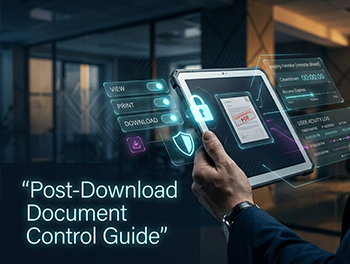
View-only is not enough. You need document-level controls that prevent print, copy, and share. You also need expiry on downloaded files and the ability to revoke access after download where applicable. In an IPO, insider trading leakage risk is real, and your VDR controls need to reflect that.
- Test: attempt to print or screenshot a restricted document as an external-party user
- Verify file expiry triggers on a downloaded document after a set date
2. Granular permissions and access context
Every external party (counsel, auditor, underwriter) should see only what their role requires. Role-based folder and file permissions, combined with device approvals and IP restrictions, are the mechanism.
- Test: create three distinct roles (e.g., legal counsel, financial auditor, underwriter); restrict a sensitive clause document to one role; verify the others cannot access it
DCirrus VDR supports DRM, dynamic watermarking (with user login, IP, and timestamp), granular access controls, and 2FA with device-level approval. This is the kind of baseline that supports safe AI adoption rather than undermining it.
3. Audit trail completeness
Your audit export needs to show user actions, timestamps, IP/device context, and Q&A history. It should be exportable in a format you can include in compliance packs and post-mortems.
- Test: pull an audit export after running the role/permission test above; confirm it captures every action with full context
Checklist Items #4–6: Does AI Reduce Setup and Review Time in the First 7 Days?
The highest ROI for AI in a VDR comes from getting documents organized fast and finding material information without manual searching. Both matter most in the first week when the pressure is highest.
4. Smart indexing and automated categorization
Manual foldering and tagging of thousands of documents is a real time sink. AI that automates categorization on upload (handling mixed document types and bulk loads) directly attacks that problem.
- Ask: how does the system handle a bulk upload of mixed formats (PDFs, scanned docs, spreadsheets)?
- Ask: can categories be customized to match your IPO folder structure?
DCirrus’s AI-powered document intelligence includes smart indexing and automated categorization, designed to reduce the manual organization burden when documents arrive in volume.
5. Clause recognition and metadata search
Finding material clauses across thousands of files (shareholder agreements, material contracts, related-party transactions, litigation records) without clause recognition is slow and error-prone.
- Pilot test: run searches for 10 common IPO diligence items (change-of-control clauses, related-party terms, lock-in provisions) and measure time to locate each
6. Summaries that support triage (not replace review)
AI-generated summaries can accelerate triage, but they need two things: a way for reviewers to trace every summary back to its source, and a clear approval workflow. Summaries that can’t be verified create new risk.
- Ask: can a reviewer flag a summary as inaccurate without losing the original?
- Ask: does the audit trail capture when a summary was viewed or used in a Q&A response?
7-day pilot plan: Upload 200–500 representative documents. Measure time to organize, time to answer 10 standard diligence questions, and the number of “can’t find it” escalations that reach your inbox.
Checklist Items #7–8: Can AI-Assisted Redaction Withstand Audit Scrutiny (and Not Create New Risk)?
Redaction is where AI can save hours on an IPO engagement. The repeated cycles of PII removal, sensitive contract redaction, and investor material prep add up fast. But redaction that can’t be audited creates a different kind of risk.
7. Batch redaction workflow with reviewer controls
AI should suggest redactions; a human should approve them. The workflow needs: approve/reject at the item level, versioning so you can compare redacted and unredacted states, and restricted access to unredacted originals.
- Demo test: run redaction on 20 documents containing PAN numbers, PII, and sensitive commercial clauses; sample the output for accuracy; verify reviewer approval is logged
DCirrus’s AI-assisted redaction is designed to work alongside reviewer controls, not bypass them. It also combines DRM and watermarking on redacted outputs distributed to external parties.
8. Redaction auditability
Who redacted what, when, and what was exposed to which role? That chain of evidence needs to appear in your audit trail.
- Confirm: redaction actions (suggested, approved, rejected) are logged with user identity and timestamp
- Confirm: watermark and download restrictions apply to redacted outputs sent externally
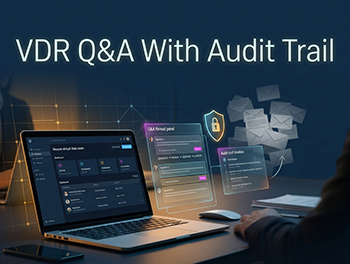
Checklist Item #9: Will the VDR Eliminate “Email Due Diligence” with Auditable Q&A and Collaboration?
Email-based Q&A is one of the most common IPO failure modes. Questions get lost, threads branch, and no one can produce a clean record of who asked what and when. The fix isn’t a better email thread. It’s moving all diligence communication inside the VDR.
Score collaboration features by traceability and speed, not how chat-like the UI looks.
What good looks like:
- A Q&A module where threads are linked to specific documents or folders, with assignment, ownership, and status tracking
- Annotations and commenting for counsel and auditors that stay attached to document versions
- All Q&A history exportable and attributable to named users with timestamps
- Automated notifications so no question goes unanswered past a deadline
DCirrus’s built-in Q&A forums, secure messaging, annotations, notifications, and version control keep all diligence communication inside the platform, which means it’s all auditable and out of personal inboxes.
Adoption tip: Establish a “one channel rule” at kickoff. All diligence questions go inside the VDR. No exceptions. This is a process rule, not a technology rule, but the VDR has to make it easy enough for 10+ external parties to actually follow it.
Checklist Item #10: Can You Justify ROI and Pricing Predictability To the Client (Before You Sign)?
A VDR decision at the mandate stage needs a cost-and-ROI story you can defend to your client, your team, and your own P&L.
ROI categories to quantify:
- Measurable: hours saved in document organization, retrieval, and redaction; reduced rework cycles
- Strategic: earlier DRHP readiness, fewer diligence gaps surfaced late, stronger mandate credibility
- Capability: a repeatable playbook you can use across multiple concurrent deals
Pricing evaluation checklist:
- Fixed vs. variable fees—know which you’re buying
- Per-user or per-page traps that inflate cost at scale
- Which AI features are included vs. priced as add-ons
- Overage scenarios for data volume and external user count
Require a written pricing schedule aligned to your expected number of external users and data volume before you sign. Surprises on the invoice after a deal closes are a relationship problem, not just a cost problem.
Summary and Next Steps: Run a 10-Day Pilot That “Earns the Purchase”
Stop evaluating VDRs in demos. Run a time-boxed pilot with pass/fail gates and a weighted score.
The stance: Gate on security and auditability first. Then score AI by IPO outcomes. Choose the vendor that clears both and provides predictable pricing.
10-day pilot outline:
- Day 1: Set up three roles, run permissions test, pull audit export
- Days 2–4: Upload 200–500 docs; measure indexing and categorization quality
- Days 5–7: Run 10 real diligence search queries; test clause recognition
- Days 8–9: Run redaction workflow on 20 docs; sample accuracy; confirm audit logging
- Day 10: Test Q&A traceability; export full collaboration log; complete weighted scorecard
Decision rule: The VDR that clears your gates, wins on weighted score, and gives you a written pricing commitment is the one you can defend to your client and to SEBI.
FAQ
What’s the difference between AI-powered search and clause recognition in a VDR? AI search finds documents based on keywords and metadata. Clause recognition goes a level deeper. It identifies specific contractual provisions (like change-of-control, lock-in, or related-party) within documents, even when the exact keyword isn’t present. For IPO diligence, clause recognition is higher value because material terms don’t always use standard language.
How do we validate AI outputs without slowing down the IPO timeline? Build validation into the workflow, not after it. Require that any AI-generated categorization, summary, or redaction suggestion goes through a named reviewer before it’s treated as final. This adds minimal time if the approval interface is fast, and it keeps your audit trail clean.
What audit trail details matter most for SEBI-grade defensibility? At minimum: user identity, action type, document name, timestamp, IP address, and device. For Q&A, you also need question text, respondent identity, and response timestamp. The trail needs to be exportable, not just viewable inside the platform.
Should we prioritize AI redaction or AI indexing first? Indexing first. You can’t redact what you haven’t organized. A well-indexed data room also makes redaction reviews faster because counsel can locate documents by category rather than hunting through unstructured folders.
How do we run a VDR pilot without exposing sensitive client data? Use anonymized or publicly available documents for the setup and indexing phases. For the redaction and access control tests, use internal test documents that mimic the format of real deal materials without containing live client information.
What’s a reasonable way to compare vendors when AI features are bundled differently? Map each vendor’s AI features to the four workflow stages: ingestion, retrieval, redaction, and collaboration. Score each stage 0–5 on your weighted rubric. Bundling differences become visible when you score by workflow impact rather than by feature name.
Do mobile access and dashboards matter during roadshows—and what should we control? Yes. During roadshows, bankers need to share documents without defaulting to email. Mobile access should be controlled via the same permission and DRM rules as the desktop, not as a separate, less-restricted channel. Dashboard visibility into investor engagement is useful, but don’t relax access controls to enable it.
What are the top 3 red flags that a vendor’s AI is mostly marketing? First, AI features that aren’t logged in the audit trail. Second, no human approval step in the redaction or categorization workflow. Third, the vendor can’t demonstrate the AI working on your document types in a real pilot, only in a pre-loaded demo environment.
Want to Evaluate an IPO-Ready VDR in a Real Pilot (Not a Demo)?
Book a free session focused on IPO workflows: permissioning and DRM, audit trails, AI-assisted document intelligence, redaction workflow, and centralized Q&A. We’ll walk you through a 10-day evaluation scorecard you can use to score any vendor, including us.
Latest Posts