Explain how AI in a VDR can improve investor engagement and communication during IPO preparation
Investor questions pile up faster than your team can answer them. Versions drift across email threads. Someone forwards the wrong file to the wrong person, and you can’t reconstruct who saw what or when. For SEBI-registered merchant bankers managing DRHP timelines, this isn’t an edge case. It’s the default state of IPO prep.
The fix isn’t a faster inbox. It’s an AI-enabled VDR. This is a system that handles secure disclosure, faster answers, and measurable engagement signals in one place.
This article is a practical playbook. We’ll cover how AI in a VDR improves investor engagement and communication for IPO prep, who owns what, where rollouts break down, and what you should implement first.
What changes when a VDR becomes “AI-enabled” during IPO preparation?
A standard VDR is secure storage. An AI-enabled VDR is more. It combines document understanding, workflow assistance, and engagement insight on the same platform.
This distinction matters because IPO prep is not a clean environment. You’re working with thousands of files, mixed formats (including scanned PDFs), and more than ten reviewers across legal, finance, and issuer teams, all on hard diligence deadlines.
AI earns its place when it improves the communication loop by helping you:
- Locate the right clause or figure, fast.
- Respond consistently across all investor touchpoints.
- Disclose securely with controlled, trackable access.
- Track engagement and drive timely follow-ups.
When AI in a VDR does all four, it stops being just a feature. It becomes your communication operating system for the deal.
How does AI document intelligence reduce investor back-and-forth and response time?
Response speed depends on finding the right information fast. Without AI, your team is stuck manually searching, cross-referencing folder structures, and hoping someone remembers where a specific disclosure lives.
Before AI: An investor asks about change-of-control terms. Your team spends hours searching a dozen agreements, pulls three different versions, and debates which is current. A response goes out the next morning.
With AI: Smart indexing surfaces the relevant clauses across your entire document set in seconds. The information is ready for human review and response within the hour.
DCirrus VDR supports this with AI-powered smart indexing, automated categorization, clause recognition, metadata search, and AI-assisted redaction. Teams can answer investor questions like these without the usual delay:
- “Where is the latest litigation disclosure language?”
- “Show all EBITDA references and liabilities schedule mentions across docs.”
- “Which agreement contains termination or change-of-control clauses?”
Important guardrail: AI accelerates retrieval and review. It does not replace legal or compliance sign-off. Every AI-assisted output (like summaries, redaction suggestions, and clause extracts) must go through human review before it reaches an investor.
What to standardize in your upload process so AI actually works
AI search is only as good as the documents you feed it. Before you enable indexing:
- Apply consistent naming conventions and a standard folder taxonomy across every upload.
- Convert scanned documents to readable PDFs where possible. Image-only files significantly reduce search quality.
- Enforce a single source of truth rule. No parallel versions should live in email threads or personal drives.
How can AI-enabled Q&A workflows improve investor communication quality, not just speed?
Email-based Q&A breaks under volume. It offers no routing, no shared history, and no record of who approved what answer. When two team members give an investor slightly different numbers, you have a defensibility problem.
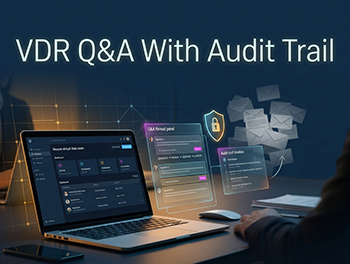
Centralized, structured Q&A fixes this. DCirrus VDR keeps all deal communication inside the platform with built-in Q&A forums, secure messaging, document commenting, automated notifications, and version control.
Good IPO Q&A in a VDR looks like this:
- One thread per question with context, attachments, and timestamps.
- Clear ownership, with questions assigned to issuer finance, legal counsel, or auditors.
- Standard response templates for recurring questions to reduce variance and speed up approvals.
The outcomes are direct:
- Shorter response cycles with less chasing and fewer repeat questions.
- Fewer contradictions because everyone is working from the same history.
- Better defensibility from a complete, timestamped record of every question and answer.
Version control adds another layer of security. Investors always reference the current disclosure pack, which eliminates the “you shared an older draft” escalation.
Position the VDR as your system of record for deal communications. It isn’t a replacement for every channel, but it is the authoritative source for everything that matters.
How does AI in a VDR improve investor engagement tracking and follow-up strategy?
During a tight roadshow window, merchant bankers can’t afford to guess which of their 20+ investors needs attention. Access logs alone don’t tell you much. What matters is what the data indicates and what action to take next.
DCirrus VDR tracks document access and user activity with comprehensive audit trails and exports engagement data in Excel format. This gives your team a weekly view of who is active, what they’re reading, and where their interest is concentrated.
Engagement signals that drive action:
- High activity on risk factors → Proactively share a clarified note or point them to updated disclosure.
- Repeated access to financials → Offer a focused call with the finance team.
- No logins after invite → Resend with a time-boxed next step and a direct support contact.
Dynamic watermarks serve a dual function. They deter unauthorized redistribution while embedding viewer identity, IP address, and timestamp into every document, keeping the audit trail complete.
A word of caution: engagement is a prioritization cue, not a commitment signal. High activity helps you allocate follow-up effort. It does not forecast deal outcomes.
How does an AI-enabled VDR reduce leak risk while keeping communication fast?
Faster communication increases exposure, unless access is controlled at the document level. During the roadshow and late-stage diligence, the pressure to share quickly is highest, and so is the risk.
The core of leak resistance isn’t AI. It’s DRM, granular permissions, watermarking, and auditable access patterns. DCirrus VDR delivers all four:
- Least-privilege permissions by investor group, counsel, or analyst role.
- Time-bound access scoped to specific diligence windows.
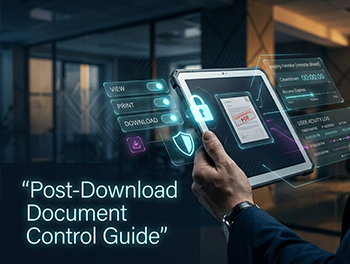
- DRM controls that restrict printing, copying, and sharing, with customizable expiry on downloaded files.
- Dynamic watermarks with viewer identity, IP address, and timestamp on every document.
- Device-level approval, IP restrictions, and 2FA to control who can authenticate from where.
- 256-bit encryption for data at rest and in transit, with data localization options.
This won’t stop someone from photographing a screen. But it does create deterrence through visibility, reduces uncontrolled redistribution, and gives you a complete reconstruction of “who accessed what, when” if SEBI questions arise.
For India-based IPOs, data residency matters. DCirrus supports data localization, allowing you to specify server locations to meet data protection obligations without turning it into a legal compliance exercise.
What does implementation look like for merchant bankers managing 10+ stakeholders?
Adoption fails when nobody owns the room. A lightweight responsibility structure prevents that:
- Merchant banker ops/admin: Manages folder structure, permissions, invites, and reporting.
- Issuer team: Owns source documents, disclosure updates, and approval workflows.
- Legal counsel: Handles clause workstreams, redaction review, and controlled Q&A.
- Auditors/finance: Manages financial schedules, KPI clarifications, and evidence packs.
An operating rhythm that keeps communication moving:
- Daily or biweekly Q&A triage: Assign, respond, and close open questions.
- Weekly engagement review: Identify active users, dormant users, and roadblocks.
- Defined version release protocol: Set a publish window and stakeholder notification plan.
During the roadshow, use platform-based sharing instead of forwarding files. Every forward outside the VDR is an audit gap.
What are the most common ways AI-VDR rollouts fail during IPO prep?
Most failures are process problems, not technology problems. Know them in advance:
- “Everyone gets access to everything” → Fix: Use role-based groups, least-privilege defaults, and device/IP constraints from day one.
- Multiple versions circulating via email or WhatsApp → Fix: Enforce a VDR-only sharing rule, maintain version control, and use automated update notifications.
- AI overtrust (teams accept outputs without review) → Fix: Implement human checkpoints for every AI-assisted output. Treat AI as a first draft, not a final answer.
- Unclear Q&A ownership → Fix: Assign subject matter experts to each question type, set response time SLAs, and maintain a visible triage queue.
- Messy uploads that break indexing → Fix: Enforce a naming taxonomy, use standardized folder templates, and ensure document hygiene before upload.
None of these are hard to fix, but all are easy to skip under deadline pressure. Don’t.
Summary and Next Steps: what to implement first to improve investor engagement in the next 30 days
An AI-enabled VDR improves investor engagement by shortening response loops and increasing controlled, auditable clarity, not just by storing documents securely.
30-day priority list:
- Set up folder structure, permissions, and watermarking defaults before inviting the first investor.
- Migrate Q&A into the VDR as your system of record. Stop using email for deal questions.
- Enable AI indexing and search. Standardize uploads with naming conventions and readable PDFs.
- Start weekly engagement reporting and define your follow-up rules based on activity.
Highest-priority action: Implement structured Q&A with version control first. It eliminates the chaos that slows responses, creates contradictions, and leaves you without a defensible record.
FAQ
1. What is an AI-enabled virtual data room (AI-VDR) in simple terms? It’s a secure document platform with added document intelligence, like smart search and automated categorization. It provides faster retrieval, structured Q&A, and engagement tracking in one auditable system.
2. How does an AI-VDR help during IPO roadshows when teams are traveling? Web and mobile access lets your team share documents and respond to investor questions securely without forwarding files. Engagement tracking continues in real time, so you know who’s active on the road.
3. Can AI in a VDR replace legal review or SEBI compliance judgment? No. AI accelerates document retrieval and helps surface relevant clauses, but every output requires human review. Legal and compliance sign-off remains with your team and counsel.
4. What investor engagement signals are most useful to a merchant banker? Document access frequency, which sections are revisited most, and which investors are dormant versus active. These signals help you prioritize outreach, not predict outcomes.
5. How do you prevent sensitive documents from being forwarded outside the deal team? DRM controls restrict printing and sharing. Dynamic watermarks embed viewer identity. Time-bound access limits exposure windows. Together, these features create deterrence and traceability.
6. How quickly can a VDR be set up for an IPO process? With pre-built templates, a configured room can be ready in under 10 minutes. The main time investment is organizing your documents and mapping permissions, which should happen before the first file is uploaded.
7. What should we standardize to make AI search effective? Consistent naming conventions, a clear folder taxonomy, readable (non-image) PDFs, and a strict single-version rule. AI performs best on clean, structured data.
8. What’s the simplest way to prove “who saw what” if questions come up later? Use a VDR with comprehensive audit trails that log user identity, document accessed, timestamp, and IP address. This data should be exportable for reporting and is the core of defensible disclosure.
Want an AI-enabled VDR that improves investor communication without increasing leak risk?
DCirrus VDR combines DRM and granular permissions for controlled disclosure, AI-powered indexing to accelerate investor responses, built-in Q&A forums to replace email sprawl, and comprehensive audit trails for full transparency. It is everything you need to run a tighter, faster, safer IPO process, all in one platform.
Want an AI-enabled VDR that improves investor communication without increasing leak risk?
Latest Posts