Why India Data Residency is Non-Negotiable for Your IPO VDR: A Guide to DPDP Act Compliance & SEBI Scrutiny
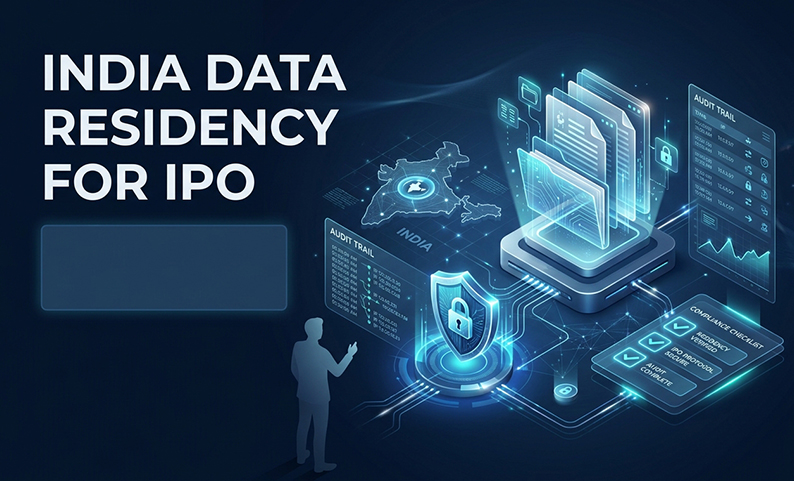
An IPO VDR isn’t just a place to store files. It’s part of your compliance story. It holds personal data, non-public information, and the full audit record of your diligence. Three pressures are making India data residency the only sensible choice: DPDP transfer uncertainty, SEBI‘s audit expectations, and geopolitical risk.
This guide provides a checklist of questions and controls to help you vet your VDR vendor this week.
Why does “India data residency” matter more for IPO VDRs than for normal file sharing?
An IPO data room isn’t a simple shared drive. It contains sensitive deal documents, personal data, auditor findings, and legal opinions for ten or more external parties at once.
This is different from routine file sharing for a few key reasons:
- SEBI scrutiny requires defensibility. You must be able to answer “Show me the trail” for who accessed what, when, and from where. If your logs are offshore and require vendor help to export, you have a problem on a tight timeline.
- Offshore hosting expands your data surface area. More jurisdictions and more sub-vendors mean more potential for unauthorized access.
- DRHP timelines leave no room for error. Gaps in your audit trail or confusing hosting arrangements create rework you can’t afford in the final weeks before filing.
Residency isn’t a bureaucratic checkbox. It’s a risk reducer when your exposure is highest.
What does DPDP Rule 15 actually mean for cross-border transfers during an IPO?
This is where merchant bankers often get it wrong. Many believe DPDP bans all cross-border data transfers.
The reality is that DPDP’s default position is permissive. Rule 15 does not impose a blanket ban. Instead, it gives the government power to restrict transfers to specific countries or for certain data at any time. Those restrictions can arrive mid-transaction.
That’s the real risk. It’s not a current ban, but a revocable privilege that can tighten with little warning. For a deal running 7 to 12 months, you cannot assume today’s rules will hold.
You are the data fiduciary and remain accountable for where that data lives, even if a vendor hosts it. “The vendor decided” is not a defensible position under DPDP.
What does SEBI scrutiny look like in practice, and where does VDR hosting show up?
SEBI doesn’t have a circular that says “host your VDR in India.” Instead, it asks questions that are hard to answer if your VDR isn’t easily auditable, accessible, and traceable.
SEBI actually cares about:
- Adequacy of due diligence. Can you prove the right documents were reviewed by the right parties?
- Documentation traceability. Can you show a reviewer exactly what was accessed, by whom, and when?
- Control over sensitive disclosures. Is there a credible answer to “Who else had access to this?”
Offshore hosting adds friction to every one of these points. Exporting logs might require vendor help, and access during geopolitical events isn’t guaranteed. Explaining a foreign-hosted data room to a regulator just adds an unnecessary conversation. The result is often avoidable rework and timeline slippage.
What’s the real downside of hosting IPO VDR data outside India?
The risks fall into three categories, and none of them help you get the IPO done faster.
1. Regulatory volatility. A sudden government order restricting data flows could force a platform migration mid-diligence. This isn’t a theoretical risk; it’s a predictable feature of today’s regulatory environment.
2. Operational continuity. If your VDR provider’s main operations are in another country, support escalations and data export requests depend on that country’s legal and operational stability.
3. Geopolitical risk. Foreign government access requests, sanctions, or service disruptions in a provider’s home country become your problem during diligence, when any interruption is maximally damaging.
The decision is simple: if two VDRs are comparable, choose the one with fewer external dependencies. Offshore hosting only adds risk.
What checklist should you use to vet an “India data residency” IPO VDR?
“India region available” is not the same as enforceable India data residency. Here’s what to verify.
1. Residency enforceability
- Ask: Can I contractually lock India as the exclusive hosting region? What prevents silent relocation?
- Good looks like: A clear region-selection tool (like AWS or Azure India) and a contract stating data won’t move without your written consent.
2. Transfer-change readiness
- Ask: If transfer rules tighten tomorrow, how quickly can you adjust our setup without disrupting India-based users?
- Good looks like: A documented process for rapid changes, not “we’ll figure it out then.”
3. Audit trail completeness
- Ask: Can I export a full audit log (user actions, IPs, timestamps) on demand, without your help?
- Good looks like: Self-serve, exportable logs in a readable format (Excel/CSV).
4. Leak deterrence controls
- Ask: What DRM and watermarking controls do you offer?
- Good looks like: Per-document restrictions (print/copy/download), file expiry, and dynamic watermarks that embed user ID, IP, and timestamp. For example, DCirrus VDR applies these watermarks to all viewed, downloaded, or printed documents.
5. Granular access model
- Ask: Can I set folder- and file-level permissions for each party and require device or IP restrictions per group?
- Good looks like: Role-based permissions, device approval, IP whitelisting, and enforced 2FA.
6. Collaboration traceability
- Ask: Do you have a built-in Q&A system with a preserved history?
- Good looks like: In-platform Q&A forums, so all diligence communication is on the record and not lost in email.
7. Operational reporting
- Ask: Can I generate an activity summary of who has reviewed what?
- Good looks like: Exportable usage reports with clickable file links.
8. Contractability
- Ask: Will you sign an MSA that legally commits to India data residency, sub-processor controls, and breach cooperation?
- Good looks like: A clear “yes,” with specific clauses in writing.
What security controls are “IPO-specific” and not negotiable once residency is in place?
Residency is step one. Step two is preventing leaks from the inside, which is the bigger day-to-day risk.
Controls that matter for IPO-grade leak prevention:
- DRM at the document level: Restrict printing, copying, and sharing. Set expiry dates on downloaded files so access ends when a party leaves the deal.
- Dynamic watermarking: Embed the viewer’s identity, IP address, and timestamp on every document. This makes leaks traceable, which deters the behavior in the first place.
- Least-privilege permissioning: Enforce access at the folder and file level so auditors and counsel only see what they need to.
- Comprehensive audit trails: Log every single action. This is your evidence if a SEBI query requires reconstructing who saw what.
- In-platform collaboration: Keep Q&A and discussions inside the VDR, not in insecure email threads.
DCirrus VDR supports these controls, from DRM to comprehensive audit trails. While no platform can stop a screen capture, these features materially reduce your exposure and provide defensible evidence if a leak occurs.
How do you operationalize this during a live IPO?
A checklist is useless without clear ownership.
| Role | Responsibility |
|---|---|
| Merchant banker | Access governance, reviewer list management, weekly audit log exports |
| Issuer | Document owner approvals, disclosure completeness sign-off |
| Counsel / auditors | Q&A discipline, no off-platform communication |
| VDR vendor | Uptime, log availability, India data residency commitment |
Key contract clauses:
- Explicit India data residency commitment
- Sub-processor list and advance notice of changes
- Written guarantees for audit log access and retention
- Breach cooperation and notification obligations
Weekly tasks:
- Remove stale users from the VDR.
- Export and archive a point-in-time audit log.
- Confirm all diligence Q&A is happening in-platform.
DCirrus VDR supports this rhythm with centralized Q&A, exportable reports, and complete audit trails. Remember, the platform supports your process, but your firm remains the data fiduciary.
Summary and Next Steps: What’s the single best move you can make this week?
The situation is straightforward. DPDP transfer rules can change without warning, SEBI demands auditable proof, and offshore hosting adds risk with no upside.
Your best move this week is to send the checklist questions to your vendor. Get written answers, not verbal reassurances. Verify their claims with a short pilot test before the deal starts, not during it.
Frequently Asked Questions
Is cross-border hosting always illegal under DPDP? No. The current framework is permissive. The risk is that the government can restrict transfers to specific countries by order, potentially mid-transaction. You should plan for this possibility.
If my issuer has foreign investors or advisors, can they still access an India-hosted VDR? Yes. India data residency refers to where data is stored, not where users access it from. Foreign parties can access the VDR from anywhere.
What’s the difference between data residency and data localization in practical terms? Data residency is choosing to store data in a specific country (e.g., an India AWS region). Data localization is a legal requirement to do so. By choosing India data residency now, you are better prepared if data localization rules strengthen.
What proof should I ask for to confirm “hosted in India”? Ask for the specific cloud region ID (e.g., AWS ap-south-1) and a contractual commitment in your MSA.
Do audit trails need to be exportable for SEBI readiness? Practically, yes. Logs that require vendor help are not useful during a fast-moving SEBI query. Demand self-serve export in a readable format (Excel/CSV).
What’s the fastest way to reduce leak risk without slowing diligence? Enable DRM controls on sensitive financials, use dynamic watermarking on all documents, and require all Q&A to happen inside the platform.
If we already use a global VDR, what’s a safe transitional approach? For your next deal, run a parallel India-hosted VDR. For an active deal, audit your current vendor’s residency controls and switch at the next natural break point, like after the DRHP filing.
Does on-premise matter vs. cloud for IPO VDRs? Cloud is the standard for IPO timelines. Where the cloud infrastructure sits is more important than the deployment model. On-premise setups often have delays that are incompatible with an IPO.
Need an India-residency IPO VDR you can defend under scrutiny?
DCirrus VDR provides contractually enforceable India data residency on AWS and Azure. It includes all the critical features from the checklist above, like DRM, dynamic watermarking, and comprehensive audit trails, in a platform built for high-stakes transactions.
Latest Posts