A VDR Evaluation Framework for Corporate Law Firms: 5 Critical Questions to Ask Before You Choose
When a deal is moving fast, the failure mode is usually not dramatic. It is administrative. Permissions are wrong, Q&A spills into email, documents get duplicated, and nobody can prove who saw what. In a cross-border matter, that is more than friction. It is risk.
That is why choosing VDR software should not start with a vendor demo and a feature parade. It should start with a framework that forces the hard questions: security, access control, secure collaboration, pricing, and support. This article gives you a practical, five-question checklist you can use to evaluate VDRs with confidence and justify the choice inside your firm.
Why a Framework Beats a Feature List
Most VDR reviews go wrong because they compare surface features instead of deal reality. A law firm does not need a tool that merely stores files. It needs a system that can survive privilege review, multi-party access, audit requests, and a messy closing.
A useful VDR evaluation criteria set should focus on what actually breaks a deal room:
- Can the vendor stand up to security and compliance scrutiny?
- Can it handle granular permissions without becoming a full-time admin job?
- Does the Q&A engine replace spreadsheets and inbox chaos?
- Is pricing predictable enough for management committee review?
- Will support hold up when the deal team is live?
That is the right lens for due diligence efficiency. Not “what looks modern,” but “what reduces risk and friction in the way corporate lawyers actually work.”
1. Can this vendor prove enterprise-grade security and compliance, and will it survive our audit?
If the security posture is weak, nothing else matters. For a corporate law firm, the real issue is not only keeping documents confidential. It is protecting privilege, proving control, and surviving an audit or dispute later.
What to evaluate:
- Encryption at rest and in transit
- Identity controls such as SSO, SCIM, MFA, and device approval
- Certifications and reports, including ISO 27001 and SOC 2 Type II
- Data residency commitments, not just region availability
- Dynamic watermarks, audit trails, and remote shred capability
- How AI features handle prompts, outputs, and permission scoping
What good looks like:
- The vendor can provide a current SOC 2 Type II report on request
- ISO 27001 scope and expiry are clear
- Data residency is contractually committed
- Remote shred works in practice, not just in a slide
- AI does not surface material outside a user’s permission set
What bad looks like:
- “SOC 2 compliant” with no report period or auditor
- “GDPR compliant” with no meaningful control detail
- Static watermarks that do not identify the user
- AI that is not permission-aware
How to test it in a demo:
- Ask for a live audit trail export from an active deal
- Trigger a remote shred and confirm the file is unreadable
- Ask how prompts and outputs are stored
- Request a sample SOC 2 report under NDA if needed
This is the first place to be strict. In VDR evaluation criteria, security is not a checkbox. It is the foundation of vendor risk management.
2. Does granular access control scale to a real deal without creating admin overload?
This is where many VDRs fail in practice. The platform may be secure on paper, but if your team spends hours assigning access across hundreds of folders, the tool is costing time every day.
What to evaluate:
- Role-based access at folder and file level
- Permission inheritance with override options
- View, download, print, edit, and share controls
- Multi-party segregation for bidders or workstreams
- Time-bound access and auto-expiry
- IP restrictions, SSO, and bulk user provisioning
- “View as user” preview for admins
What good looks like:
- New bidder groups can be created quickly from templates
- Permission changes take effect immediately and show in the audit trail
- Offboarding is fast because identity is tied to the firm’s IdP
- The admin can verify exactly what a user sees
What bad looks like:
- Permissions are managed one user at a time
- The workaround is to create a separate VDR for each party
- Watermarks are static
- IP controls are hard to find or absent
How to test it in a demo:
- Spin up two separate groups and confirm isolation
- Apply a sub-folder override and check the audit log
- Expire access and verify it shuts off automatically
- Review the template structure before a real matter begins
For a senior associate, this is a direct measure of secure collaboration. If access control is clumsy, the team will find workarounds. That is usually where risk enters.
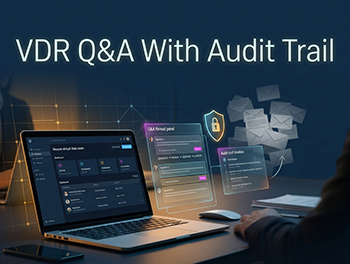
3. Does the Q&A engine replace email and spreadsheet sprawl?
The Q&A module is often the biggest operational lever in a deal. If it does not work well, people fall back to inboxes, shared docs, and side conversations. Then the room stops being a single source of truth.
What to evaluate:
- A structured Q&A flow from submission to publish
- Auto-routing to the right expert or workstream
- Duplicate-question detection
- Anonymity controls
- Document linking inside answers
- Side-by-side document and Q&A views
- Clean export of the full Q&A log at closing
- Browser-based mobile access
What good looks like:
- Every question has a unique ID and a clear owner
- The team can see response times by topic or bidder group
- Answers are tied to the relevant documents
- The log can be exported cleanly for closing or post-mortem review
What bad looks like:
- Q&A happens outside the platform
- Bidders can see each other’s questions
- The firm cannot produce a searchable log at the end
- AI drafts answers without respecting permissions
How to test it in a demo:
- Submit a bidder question and track it end to end
- Verify routing rules
- Run a duplicate check
- Export the full Q&A log
This is where due diligence efficiency becomes visible. The room either keeps the work inside the system or quietly leaks back into email. There is not much middle ground.
4. Is pricing transparent and aligned with how our deals actually run?
Pricing is where many firms get surprised. The quote may look reasonable at first, then SSO, audit export, watermarking, or overage charges appear later. That is how a modest matter becomes an expensive one.
What to evaluate:
- Pricing model: per-page, per-user, per-project, flat fee, or hybrid
- Overage policy
- Hidden fees for setup, training, admins, or add-on modules
- Contract terms for termination, export, auto-renewal, and price lock
- A written estimate based on a real deal scenario
What good looks like:
- One clear quote with every foreseeable fee
- Data export rights at termination
- A predictable overage policy
- A trial or pilot option before signing
What bad looks like:
- Pricing scattered across email, PDF, and verbal discussion
- SSO or audit export sold separately
- No defined exit path
- No written scenario estimate
How to test it in a demo:
- Ask for a quote based on a real matter size
- Ask what happens at 150% usage
- Ask what data you receive if the engagement ends
- Confirm the export format
For management committees, this is often the easiest part to explain. Good choosing VDR software decisions should reduce surprise, not create it.
5. What does onboarding, support, and the roadmap actually look like?
A VDR is not a passive tool during a live deal. It is operational infrastructure. If support is weak, the burden shifts back to your team at the worst possible time.
What to evaluate:
- Dedicated onboarding support for the first deal
- 24/7/365 support with named contacts
- Escalation paths for urgent issues
- Documentation for API, SSO, and SCIM
- A roadmap that shows real workflow development
- References from firms with similar deal profiles
What good looks like:
- A named deal lead is available
- Support is reachable by phone, chat, and email
- Documentation is clear enough for internal teams
- The vendor can explain how AI is used in deal workflows
What bad looks like:
- Email-only support
- No roadmap transparency
- No references
- Lock-in at the end of the term
How to test it in a demo:
- Call support before signing
- Ask for the export and transition terms in writing
- Request references for similar matters
- Ask the SE to walk through the AI workflow live
If the vendor cannot support the deal, the platform will not matter. This is the final filter in a serious framework for VDR evaluation criteria.
Implementation: who should own what?
The best evaluation process has clear roles. Otherwise the decision gets slowed down by internal ambiguity.
Use this simple division:
- Lead Partner: accountable for the final decision, risk posture, and commercial approval
- Associate: responsible for testing the workflow, permissions, Q&A, and export process
- VDR vendor PM: responsible for setup, onboarding, and support
- IT / Security: responsible for security review, identity, and compliance checks
- Conflicts team: responsible for privilege and segregation requirements
Practical ownership matters because VDRs touch multiple risk domains at once. A platform can look fine to the deal team and still fail security, or pass security and still be a poor fit for the matter workflow.
Common failures to catch early
A strong demo can hide a weak operating model. Look for these failure modes before signing:
- Messy folder hierarchy and inconsistent file naming
- Over-permissive default roles
- Static watermarks
- Audit trails nobody reviews
- No NDA gate before access
- Email-driven Q&A
- Hybrid pricing with hidden add-ons
- No portable export at termination
- Weak data residency commitments
Each of these creates friction, and friction becomes risk fast in a live transaction. That is especially true in cross-border matters, where regional compliance and access control are not optional.
Summary and Next Steps
The right way to evaluate a VDR is to test the system the way a deal will actually use it. Start with security, then access control, then Q&A, pricing, and support. If a vendor cannot perform on those five points, it is not ready for a corporate law firm.
If you need one high-priority action, make it this: run every shortlisted vendor through the same five-question framework and require live proof, not slide-deck promises. That is the cleanest way to justify your choice and protect the firm.
FAQ
How long does it usually take to set up a VDR for a mid-market deal?
It depends on the vendor and the complexity of the matter, but setup should be fast enough to support live deal timing. The real issue is not just launch speed. It is whether permissions, Q&A, and audit controls are usable from day one.
How does per-page pricing compare with flat-fee pricing?
Per-page pricing can fit large legacy workflows, but it is harder to predict. Flat-fee pricing is usually easier to forecast for firms that want budget clarity and unlimited users or documents.
What certifications should a VDR have for law-firm work?
At minimum, look for ISO 27001 and SOC 2 Type II. Depending on the matter, GDPR posture, data residency, and other regional compliance commitments may also matter.
Can bidders from multiple geographies collaborate securely in the same VDR?
Yes, if the platform supports strong access controls, region commitments, and document-level segregation. The key is not just hosting. It is whether the vendor can enforce the right permissions across parties and jurisdictions.
How should AI handle privileged or confidential content?
AI should be permission-scoped and assistive, not open-ended. It should not surface content a user could not otherwise access, and the vendor should be clear about how prompts, outputs, and training data are handled.
What happens to documents and audit trails after a deal closes?
That should be defined in the contract. You want a clear export path, a usable format, and retention or deletion terms that match the matter and the firm’s obligations.
Can a VDR integrate with our existing DMS, CLM, or e-signature tools?
It should at least support the identity and workflow pieces that let it fit into the firm’s stack. Public API docs and SSO or SCIM guidance are good signs that the system is meant to work inside a broader environment.
How do we evaluate customer support during a live deal?
Test it before signing. Call, ask specific workflow questions, and see whether the vendor gives you a named contact and a real escalation path.
Is encryption and key management actually verifiable?
It should be. Ask what encryption is used at rest and in transit, how keys are managed, and what the audit or certification evidence looks like.
Why does the Q&A log matter so much?
Because it is one of the clearest records of what happened in the deal room. It supports closing, internal review, and later dispute response, which makes Q&A traceability a core part of legal-grade secure collaboration.
Book a free demo
Need a VDR that supports compliance, control, and faster deal execution without adding admin burden?
See how DCirrus brings secure collaboration, granular permissions, audit trails, and AI-assisted document intelligence into one platform built for complex transactions.
Latest Posts