Legacy VDR vs. AI-Powered VDR: A Comparison Framework for Indian IPO Due Diligence
You’re three weeks from your SEBI filing. Forty external stakeholders are in your data room, and a question just landed about a clause buried in twelve different agreements. Your analyst is searching manually. Your inbox has seventeen Q&A threads. A critical file is sitting on a laptop you don’t control.
This is the moment when a “we’ll figure it out” approach to your VDR collapses.
The debate between legacy and AI-powered VDRs isn’t about marketing. It’s about whether your process can hold up under IPO pressure. The right decision comes from comparing how each platform handles governance, traceability, and exceptions, not from a generic feature checklist. The best VDR reduces human coordination risk as much as it reduces document security risk.
Why “Good Enough” VDRs Fail Under Indian IPO Pressure
Indian IPO diligence is different from a standard M&A deal. You’re managing lawyers, auditors, book-running lead managers (BRLMs), and compliance reviewers, all under tight timelines. This density of stakeholders exposes every weakness in your VDR.
What Breaks First: Permissions, Q&A, or Audit Trails?
In most deals, Q&A breaks first in a flood of emails with no single source of truth. Permissions break second as admin requests pile up. Audit trails break last, but matter most when compliance asks for a report your system can’t produce.
The Decision You’re Really Making: Tool Choice vs. Operating Model
Choosing a VDR is choosing your deal’s operating model. A platform without a structured Q&A module means your team will use email. The tool you choose defines the process and the risks you will face.
The Comparison Framework: 6 Dimensions That Matter for SEBI-Facing Diligence
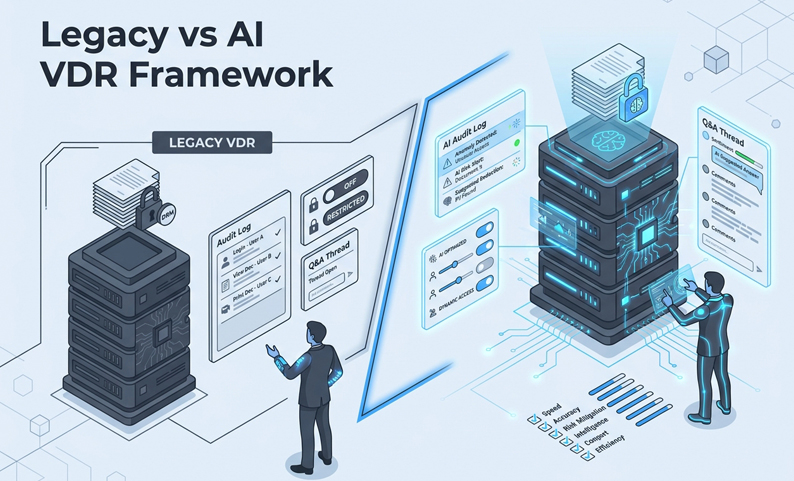
Evaluate any VDR against six key dimensions: post-download control, permission governance, audit defensibility, Q&A traceability, AI-assisted review, and pricing. Each one maps directly to a real IPO failure mode.
How to Use This Framework in a Shortlist/Pilot
During a 30-60 minute demo, score each vendor on a simple 1–3 scale for each dimension. You are not looking for perfection. You are looking for clarity on which platform best fits your risk profile.
1) Security That Holds Even After Download (DRM + Watermarking + Revocation)
Access control isn’t the same as post-download control. A legacy platform lets you set who can download, but your control ends once the file is on their device. You cannot revoke it, stop it from being forwarded, or set an expiry date. For pre-listing financials, that is an unacceptable gap.
Legacy VDR Reality Check: Where “Permissions” Stop Protecting You
Once a file is downloaded from a legacy VDR, your control ends. You can’t revoke it, stop it from being forwarded, or set an expiry. For an IPO involving sensitive pre-listing financials, that’s an unacceptable risk.
What to Test in a Demo: Print/Copy Restrictions, Expiry, Dynamic Watermark Fields
In your pilot, download a document. Can you print it, copy text, or share it without a visible watermark? Can an admin revoke the downloaded file remotely? A secure watermark should contain the user’s login, IP address, and a timestamp. DRM controls should block printing and copying, set expiry dates, and embed these dynamic watermarks as evidence.
2) Governance and User Management at Scale (Roles, Device Controls, Instant Revocation)
Managing 40+ users from five organizations is a governance problem, not just an IT task. Your VDR must enable a principled access model without making your analyst a full-time helpdesk. Look for robust data exports (like Excel) and single sign-on (SSO) to reduce friction.
A Practical IPO Access Model (Groups, Roles, and “Least Privilege”)
Start with role groups: Internal Team, Issuer, Legal, Auditors, and BRLMs. Give each group the minimum access required, then expand access as diligence progresses. Never start with open access and restrict it later. A VDR with a simple interface and automated notifications helps external teams get started quickly.
What to Demand: 2FA/MFA, Device Approval, IP Restrictions, Granular Folder/File Permissions
Your non-negotiable checklist should include role-based access at the folder and file level, two-factor authentication, device approval, IP address restrictions, and instant access revocation. Test each one during your demo.
Operational Tip: Designing for “Permission Emergencies”
Your platform must support urgent access changes. Can a non-technical admin make a permission change in under two minutes? Test this scenario.
3) Audit Defensibility and Reporting (What You Can Prove in 5 Minutes)
Being “audit-ready” means you can produce a clean, readable, and exportable record of who accessed what, within minutes, whenever a regulator asks.
Minimum Audit Outputs: Who Accessed What, When, from Where, and What Changed
Your audit trail must capture user identity, document accessed, action taken (view, download, print), timestamp, IP address, device, and any version changes.
Reference Testing: Exportability and Readability of Logs
During your demo, export the full audit log. Is it human-readable or just a raw data dump? Can you filter it by user or document? A log trapped in the UI is not audit-ready. Modern VDRs can export indexes to Excel, making it easy to review activity during a live compliance conversation.
4) Q&A Traceability: Replacing Email Chaos With an Accountable Workflow
Unstructured Q&A is where IPO diligence often breaks. In a SEBI-facing process, using email and WhatsApp for questions is a major disclosure risk.
Recommended Q&A Workflow (Intake → Routing → Draft → Approval → Publish)
- Intake: All questions submitted inside the VDR, linked to the relevant document.
- Routing: Admin assigns each question to the correct subject matter expert (SME).
- Draft: SME drafts the response inside the platform.
- Approval: Deal lead or counsel reviews before publishing.
- Publish: Response is visible and permanently logged.
Roles & Responsibility Mini-Matrix
| Role | Submits Questions | Drafts Answers | Approves Answers | Monitors SLAs |
|---|---|---|---|---|
| External Counsel/Auditor | ✓ | — | — | — |
| Subject Matter Expert | — | ✓ | — | — |
| Deal Lead / Director | — | — | ✓ | ✓ |
| VDR Admin | ✓ | ✓ | ✓ | ✓ |
What to Test: Linking Questions to Documents, Status Tracking, Notifications
Submit test questions linked to specific documents. Check if the platform tracks their status (open, pending, answered) and sends automated notifications. A good system keeps all communication and its audit trail inside the VDR.
5) AI-Powered Review Speed: Where AI Actually Helps (and Where It Doesn’t)
The 3 AI Capabilities That Matter Most in IPO Diligence
- Smart indexing and metadata search: Finding a specific clause across thousands of files in seconds.
- AI-assisted redaction: Flagging sensitive terms (names, personal data) for review.
- Automated categorization: Organizing documents into the correct folder structure.
Anti-Hype Guardrails: AI Won’t Fix Bad Structure or Unclear Ownership
AI doesn’t replace governance; it enhances it. If your data room has 400 files named “Draft_v3_FINAL.pdf,” AI will find them, but you still won’t know which one is current.
What to Test: Time-to-Find Clause, Categorization Accuracy, Redaction Workflow
Upload 50 real documents. Time how long it takes to find a specific clause. Test the redaction workflow to see if it can automatically flag personal data and how long manual review takes. This test gives you evidence, not a vendor’s demo story.
6) Pricing and Support: Avoiding Hidden Costs and “Deal-Night” Failures
Pricing Model Behavior Map (Per-Page vs Per-User vs Flat/Subscription)
| Model | Best For | Watch Out For |
|---|---|---|
| Per-page | Small, document-light deals | Costs spike with large data rooms; teams avoid uploading. |
| Per-user | Small, controlled stakeholder groups | Costs spike with more users; teams share logins (security risk). |
| Flat/Subscription | Mid-to-large IPOs with 30+ users | Requires clear scope upfront; most predictable. |
For a mid-size Indian IPO with 40-80 users, flat pricing is typically the most predictable and creates the best incentives.
Support That Matters in IPO Crunch Time
Ask vendors these questions:
- What is your guaranteed first-response time at 2am IST?
- Do we get a named support contact or a ticket queue?
- Can permissions be emergency-restored within 15 minutes?
- What is your escalation path if the platform is unavailable?
Vendor Pilot “Simulation Drill” (30–60 Minutes)
Run a drill covering these key tasks: setting permissions, submitting a Q&A question, exporting an audit log, and testing DRM on a downloaded file. Any step requiring vendor assistance is a red flag.
Reference Table: Legacy vs AI-Powered VDR for IPO Due Diligence
| Dimension | What “Good” Looks Like | Legacy VDR | AI-Powered VDR | How to Test It |
|---|---|---|---|---|
| Post-download control | DRM + expiry + revocation | Weak: stops at download | Strong: file-level DRM | Download a file; try to print/copy |
| Permission governance | Role groups, 2FA, device approval | Basic role tiers | Granular, device-level | Create 3 groups; time a user revoke |
| Audit defensibility | Exportable, human-readable logs | Exists but often UI-trapped | Exportable, filterable | Export 24hr log; check readability |
| Q&A traceability | Built-in workflow, zero email | Email-dependent | Fully logged in-platform | Submit 3 questions; check status |
| AI review speed | Clause-finding in seconds | Manual search only | Semantic search + redaction | Time a cross-document clause search |
| Pricing behavior | Predictable at scale | Often per-page/per-user | Flat/subscription common | Model total cost at 60 users |
| Support/SLA | Named contact, <15min response | Variable, ticket-based | Varies; ask explicitly | Run simulation drill at an odd hour |
How to Read the Table and Make a Shortlist Decision
Use the “How to Test It” column as your pilot script. Look for the platform that performs best under the conditions of your actual IPO, not the one with the most features.
Summary and Next Steps: pick the VDR that reduces coordination risk, not just document risk
A “good enough” VDR fails because diligence risk is about workflow integrity and human coordination, not just document security. The right platform holds your process together under pressure. Your next step is to choose two vendors, run the simulation drills, and see which one holds up.
FAQ
What’s the fastest way to tell if a VDR is truly “AI-powered” versus just having search? Ask for a semantic search demo, not just keyword search. Also test automated document categorization and AI-assisted redaction.
What should our IPO data room folder structure and permissions look like on day 1? Mirror SEBI’s DRHP categories. Set folder-level permissions by role group before inviting anyone.
How do we run Q&A so legal review doesn’t become the bottleneck? Assign question categories to SMEs who draft answers. Legal counsel should only review final drafts before publishing. Set and monitor a response SLA in the VDR.
Which pricing model is safest for a mid-size Indian IPO with many external users? For 30+ users, flat or subscription pricing is safest. Per-user models encourage login sharing, which is a security risk.
What audit trail exports should we require for compliance and post-deal defensibility? Require a full activity log (by user, date, and document) that is exportable to Excel or CSV. A log trapped in a UI is not useful.
What vendor support/SLA terms matter most during filing week and late-night diligence spikes? Get a guaranteed off-hours response time, a named escalation contact, and a documented process for handling permission emergencies.
Ready to run a tighter, faster IPO diligence process?
The best VDR reduces coordination risk. It prevents missed Q&A, uncontrolled downloads, and messy audit logs.
DCirrus VDR is built for high-stakes transactions like Indian IPOs, with DRM controls, AI intelligence, and a full audit trail. Book a demo to run the simulation drill with your own documents and see what holds up under real conditions.
Latest Posts