Replacing Risky Email Chains in IPOs: A Framework for Secure VDR Collaboration
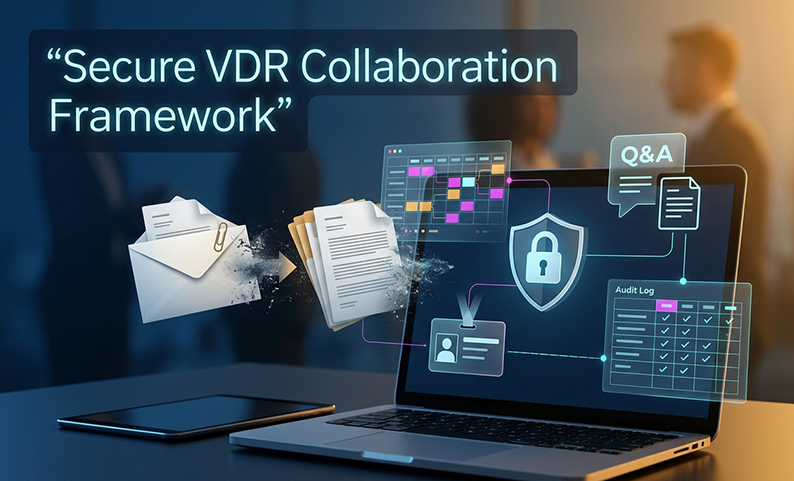
You’re three weeks from DRHP filing. Fourteen parties are active in the deal. Your legal counsel just sent “financials_final_v7_REVISED_USE THIS.xlsx” to a distribution list that includes two advisors who rotated off the deal last month. Someone’s already replied-all with tracked changes. Nobody knows if the registrar got the right version.
This is what email failure looks like in an IPO. It’s not a theoretical breach, but a slow-motion loss of control that creates version drift, confidentiality exposure, and audit gaps that SEBI can question later.
The fix isn’t a better folder structure on a shared drive. It’s replacing email as the operating system for diligence collaboration with a governed system built around controlled access, controlled documents, and controlled conversations.
This article delivers the Secure VDR Collaboration Framework, a 7-point checklist for merchant bankers running IPO and M&A processes. We’ll cover the checklist itself, role assignments, common failure modes, India-specific constraints, and the signals to track to know if it’s working.
Why Are Email Chains Uniquely Risky in IPO Due Diligence?
Email isn’t just slow for IPO work; it’s structurally incapable of meeting the necessary control requirements. Here’s where it breaks down:
- Over-sharing by design. One forward sends a confidential cap table to everyone on the thread, including people who shouldn’t have it.
- Version drift with no correction. Attachments diverge the moment they’re downloaded and edited. There’s no single source of truth, just whoever sent the most recent email.
- No chain of custody. You cannot reliably prove who accessed what, when, or from which device. If SEBI asks, you’re left guessing.
- Weak offboarding. When an advisor leaves the deal, their inbox still holds every attachment ever sent. You can’t revoke access to what’s already delivered.
- Invisible Q&A. Decisions buried in email threads can’t be surfaced as a coherent diligence story. When the same question gets asked in five different chains, the complete answer exists nowhere in a usable form.
For a SEBI-registered merchant banker, these are not just operational annoyances. They are compliance exposures. The risk of insider trading, incomplete audit trails, and missed DRHP deadlines all trace back to using communication tools that were never built for this kind of work.
What Does a VDR Collaboration Framework Need to Replace Email?
The most common mistake is treating a VDR like an upgraded file-sharing folder. Teams move documents in, but then all the real communication (the questions, clarifications, and approvals) happens back over email. Nothing really changes.
A VDR replaces email only when it operates as a governed collaboration system across four pillars:
- Identity & access: Who gets in, what they can see, and when access ends.
- Document protection: What users can do with files once they’re in (view, download, print, share).
- Structured Q&A: Where questions live, who owns them, and how they get resolved.
- Audit evidence: A complete, exportable record proving diligence happened the way you say it did.
A platform like DCirrus VDR combines Q&A forums, granular permissions, DRM controls, dynamic watermarking, and audit trails in one environment, keeping all collaboration securely inside the room. Simple “share link + chat” tools can’t do this. They lack fine-grained document control and create the same traceability gaps you get with email.
What Is the 7-Point Checklist for Secure VDR Collaboration in IPOs?
Use these 7 controls as your default operating system for IPO diligence collaboration.
1) How Do You Enforce Least-Privilege Access with Role-Based Permissions?
Every stakeholder group gets access scoped to exactly what their role requires. Nothing more. This applies to legal counsel, auditors, underwriters, registrars, and internal finance.
- Set folder- and file-level permissions by group, not by individual. This reduces admin errors.
- Default to “need-to-know.” Broad “all advisors” access is a sign that permissions haven’t been thought through.
- Build permission templates for standard IPO structures so you’re not configuring from scratch each deal.
- Review and tighten permissions at phase gates, like pre-DRHP filing, post-SEBI observation, and during the roadshow.
2) What Authentication and Access Guardrails Prevent Unauthorized Entry?
Strong authentication is the first line of defense before any document is touched.
- Use 2FA/MFA for every external user. No exceptions. DCirrus supports MFA via SMS, email, and Microsoft Authenticator.
- Implement device-level approval using unique device ID mapping for high-sensitivity users like senior advisors and auditors.
- Use IP address restrictions during critical phases when the deal team is operating from known locations.
- Control onboarding with approved credentials before granting access and ensure immediate offboarding when advisors rotate out.
3) What Document-Level Controls Stop Data from Escaping Once Viewed?
Attachment control is what makes a VDR structurally different from email. When someone downloads a file from your inbox, you’ve lost control of it permanently. Document-level DRM changes that.
- Disable printing and copy/paste on sensitive materials (financials, cap table, litigation, key contracts).
- Set download expiry windows so files become inaccessible after a defined period, even on a user’s local machine.
- Apply 256-bit encryption at rest and in transit. This is table-stakes.
- Prefer view-only access for parties who need to review but have no business owning a local copy.
The mindset shift is to separate viewing from possession. Most reviewers don’t need to download; they just need to read and respond.
4) How Do You Use Dynamic Watermarking to Deter Leaks and Support Forensics?
Watermarking doesn’t prevent leaks. No control does with certainty. What it does is raise the cost of leaking and preserve your ability to investigate if something does surface.
- Apply watermarks that embed user identity, IP address, and timestamp on every document that is viewed, downloaded, or printed.
- Prioritize sensitive materials: financials, cap table, customer contracts, litigation disclosures, and pre-IPO pricing data.
- Don’t rely on watermarking as your primary defense. It works best when layered with strict permissions and DRM. If someone has already been over-granted access, a watermark is your last deterrent, not your first.
5) How Do You Replace Email Threads with Document-Linked Q&A?
This is where most VDR implementations fail. Teams move documents into the VDR, then ask questions over WhatsApp or email “just this once.” That’s just email with extra steps.
Real replacement means every question is tied to a document or folder inside the room, and every answer lives there permanently.
- Questions route to a central Deal Collaboration Owner for triage, so no question sits unassigned.
- Use standard statuses: New → Assigned → Answered → Reopened → Closed.
- Set response-time expectations by workstream. Legal, finance, and tax have different realities.
- Allow no free-floating questions. If it’s not linked to a document, it doesn’t exist as a diligence record.
DCirrus VDR’s integrated Q&A forums and annotation tools keep this workflow inside the secure environment, with automated notifications to owners. The result is not just efficiency; it’s a coherent diligence narrative that can be reconstructed later.
6) What Audit Trail Standards Make the Process Defensible?
“Audit-ready” doesn’t mean you have a log file somewhere. It means you can produce a clean evidence pack (quickly, on demand) showing exactly who accessed what, when, from where, and what happened to every document and question in the room.
You must capture and timestamp:
- Document opens, views, downloads, and prints
- Permission changes and user additions or removals
- File uploads and version replacements
- All Q&A activity, including questions asked, answers given, and reopened threads
DCirrus VDR’s comprehensive audit trails and export functions make it practical to build that evidence pack without manual assembly. Schedule a weekly audit review checkpoint during critical deal windows. Don’t wait until SEBI asks.
7) How Do You Use AI Document Intelligence Without Creating New Risk?
The volume of files in IPO diligence is a real problem. AI-assisted tools can compress the time spent finding information, which reduces the impulse to “just email the relevant section” instead of finding it in the room.
High-impact use cases include:
- Smart search across metadata and document content to locate specific filings or clauses.
- Clause recognition for common diligence areas like indemnities and change-of-control.
- AI-assisted redaction to reduce manual errors on sensitive data before sharing.
DCirrus VDR includes AI-powered indexing, metadata search, clause recognition, and AI-assisted redaction. Before using any AI feature, ask the vendor directly: How does the AI model operate? Is our deal data used for model training? What admin controls do we have over AI access? These are non-negotiable governance questions for any IPO.
Who Owns What in This Workflow?
A framework with no owner devolves back into email within two weeks. Assign these roles before the VDR goes live:
- Deal Collaboration Owner (Merchant banker ops/deal manager): Manages permissions, onboarding/offboarding, Q&A triage, and the weekly audit review. This person is the operational backbone.
- Workstream Owners (Legal/Finance/Tax): Responsible for answer quality, document version integrity, and redaction sign-off in their area.
- Client Admin/Issuer SPOC: Handles document uploads, internal approvals, and readiness for diligence phases.
- External Advisors: Must explicitly commit to using the VDR’s Q&A and annotations for all deal questions, not email.
The operating cadence should include a daily Q&A sweep by the Deal Collaboration Owner, a weekly permission and audit review, and version control rules enforced at every upload.
What Are the Most Common Failure Modes When Moving Off Email?
Most failures are not tool failures. They are behavioral and configuration failures that a disciplined setup prevents.
- “We still send attachments for convenience.” → Set a hard rule: no diligence attachments in email. Link to the VDR item and route questions through the Q&A feature. No exceptions.
- Over-restrictive DRM causing reviewer pushback. → Apply graduated controls by sensitivity tier. Tier 1 (cap table, pricing) gets full DRM; Tier 3 (public filings) can be more permissive. Explain the reasoning to advisors upfront.
- Permission sprawl across deal phases. → Run scheduled access reviews at each phase gate. Stale users accumulate if nobody owns the offboarding step.
- Unstructured Q&A becoming noisy. → Enforce document-linking and status discipline from day one. A Q&A forum without structure just replicates email chaos.
- Multi-deal scaling errors. → Reuse permission templates and standardized naming conventions across deals. Consistency reduces errors when your team is managing three IPOs at once.
A bit of friction is the right trade-off. In IPO work, a slight inconvenience that prevents a confidentiality breach is always worth it.
How Do You Handle India-Specific and Cross-Border Constraints?
Data residency is a practical concern for SEBI-facing transactions. Where your documents are hosted affects your regulatory posture.
- India-only IPO: Choose a VDR that offers data localization. This is the ability to specify server locations so data stays within a preferred jurisdiction, which is increasingly relevant under India’s Digital Personal Data Protection Act 2023.
- Global counsel or overseas investors: Multi-region availability is essential for collaboration across time zones. Centralized Q&A with notifications is far better than asynchronous email for cross-border reviews.
- Geo/IP controls: For the most sensitive diligence phases, restrict access by geography or IP range to reduce the exposure surface.
DCirrus VDR runs on AWS and Azure infrastructure with multi-region availability and supports data localization. This lets clients choose server locations for compliance. When evaluating any vendor, ask: What hosting options do you offer? Can you restrict access by geography? Can you export audit logs in a format acceptable to regulators?
How Do You Measure Whether the Shift Away from Email Is Working?
If you can’t measure it, you can’t defend it. Track these signals across your active deals:
- Q&A turnaround time: Median time to first response and to closure.
- Percentage of questions tied to documents: Target near 100%. Unlinked questions signal process drift.
- Volume of out-of-room attachments: Target zero during active diligence.
- Access review cadence: Are weekly reviews happening or slipping?
- Repeat document requests: Fewer requests to “resend that file” mean better document discovery.
- Audit log exportability: Can you produce a clean index and usage report on demand? DCirrus VDR’s export functionality (like usage graphs and clickable indexes in Excel) makes this a practical checkpoint, not a fire drill.
These metrics connect directly to what merchant bankers care about: fewer delays, fewer compliance gaps, and a client experience that reinforces your credibility.
Summary and Next Steps: What to Do in the Next 7 Days
Email cannot enforce least privilege, document control, or end-to-end traceability in an IPO process. A VDR can, but only when it’s implemented as a governed collaboration system, not just a document folder.
The single highest-priority action is to stop sending diligence attachments by email, starting now. Every other item on this list supports that one shift.
Your 7-day checklist:
- Define stakeholder roles and permission groups
- Set up Q&A rules, statuses, and owner assignments
- Configure least-privilege permissions by workstream
- Enable watermarking with user/IP/timestamp identifiers
- Apply DRM tiers by document sensitivity
- Schedule weekly audit review checkpoints
- Communicate the “no attachments” rule to all parties in writing
Frequently Asked Questions
What’s the minimum VDR setup needed to stop using email attachments immediately? At minimum, you need role-based permissions, 2FA on all accounts, a structured Q&A section with document-linking, and basic audit logging. You don’t need every feature configured on day one, but you do need the “no attachments” rule enforced before bringing in external parties.
How do we convince senior stakeholders and external counsel to use VDR Q&A instead of email? Frame it as risk management for them, not just for you. A senior counsel whose email contains confidential deal materials is also exposed if there’s a leak. Brief them in the kickoff call, explain the Q&A workflow, and hold the line.
What should we look for in audit trails to feel comfortable under SEBI scrutiny? You need timestamped logs of every document view, download, print, permission change, and Q&A action tied to specific user identities. Exportability is also key: you should be able to produce a clean evidence pack quickly in a readable format.
Do DRM controls slow down diligence, and how do we apply them without derailing timelines? They can if applied bluntly. Use sensitivity tiers. Tier 1 (cap table, pricing, litigation) gets full DRM with print/copy disabled. Tier 2 (financials, contracts) might get view-only with download expiry. Tier 3 (public filings) can be more permissive. Resistance drops when reviewers understand why the controls exist.
How should we structure permission groups for 10+ parties in an IPO? Group by function, not by organization. Legal, auditors, underwriters, registrars, and internal finance should each get their own access scope. Use templates so you’re not rebuilding this for every deal. Keep the “all advisors” group for only non-sensitive materials.
How do we handle offboarding when advisors rotate mid-deal? The Deal Collaboration Owner should handle offboarding as a formal step. When someone rotates off, revoke their access immediately, confirm they’re removed from all groups, and note it in the audit log. Expiry settings on downloaded files provide a backstop, but revoking access is the primary control.
What AI features are actually useful in IPO diligence, and what AI governance questions should we ask? Smart indexing, metadata search, and clause recognition reduce the time spent locating documents. AI-assisted redaction reduces manual error risk. For governance, ask your vendor if deal data is used to train AI models, what data isolation exists between clients, and if AI access can be restricted. Get these answers in writing.
How does data residency affect VDR choice for India-based IPOs with global stakeholders? It’s a key selection criterion. For India-centric IPOs, choose a VDR that supports data localization. For deals with global counsel, confirm multi-region availability and check if the platform supports geo/IP access restrictions for sensitive phases.
Can a VDR help during roadshows and investor access without reintroducing email risk? Yes. Create a separate, tightly scoped room for roadshow materials with read-only access for investor contacts. Keep watermarking and audit logging active. Link to the VDR directly instead of emailing attachments so you retain visibility.
Ready to Replace IPO Email Chaos with Audit-Ready Collaboration?
Controlled document sharing, complete audit trails, structured Q&A, and data localization options are available now in a purpose-built VDR. If your process still relies on email attachments for diligence, the gap between where you are and where you need to be is a configuration decision, not a technology problem.
to see how DCirrus VDR can help your team run secure, traceable, deadline-ready IPO collaboration from day one.
Latest Posts
Buyer Engagement Analytics in a VDR: What Deal Teams Can Track
August 17, 2026
12 VDR Features Required for IPO Preparation in India
August 13, 2026
What Bankers and Auditors Need From an IPO VDR in India
August 12, 2026
How a VDR Supports the India IPO Journey Step by Step
August 10, 2026