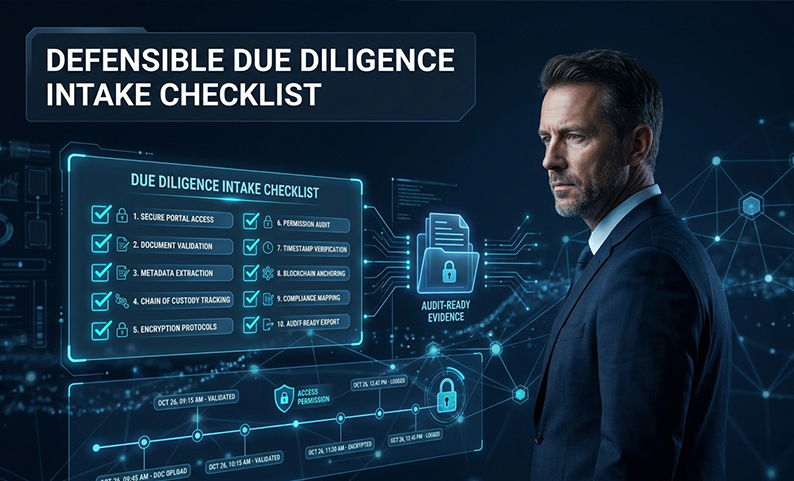
The Due Diligence Intake Checklist 10 Steps for a Defensible Document Collection Process
A key third party is weeks late with financials for your live IPO. Your inbox is chaos. You have no clear proof of what was requested. That isn’t just an intake problem. It’s a liability when SEBI asks for your documentation trail.
A defensible document collection process isn’t about a specific tool. It’s about an intake workflow that generates evidence: what was requested, who it was from, what you received, and what’s still missing. Teams that run intake as an auditable system, not an inbox, cut delays and walk into reviews with a complete evidence set instead of a scrambled paper trail.
Why “Defensible Intake” Fails in the Real World (and What We’re Fixing)
What “Defensible” Means in Plain English
Defensible means you can prove it. You can show a regulator, auditor, or opposing counsel the exact request log, submission timestamp, version received, and who accessed the file. If any of those artifacts are missing or stored in personal inboxes, your process isn’t defensible. It’s reconstructed after the fact, which is not the same.
The 3 Failure Modes This Checklist Prevents
Most intake breakdowns trace back to three patterns: missing docs (no one knows what’s outstanding), unclear ownership (a document was sent but no one confirmed receipt or assigned a reviewer), and no proof (because decisions and clarifications happened over email with no record). This checklist systematically addresses all three.
The Framework: A 10-Step Due Diligence Intake Checklist (Request → Proof → Close-Out)
This checklist runs from first request to final close-out. It’s designed for merchant bankers managing ten or more external parties across high-stakes transactions.
How to Use This Checklist on Your Next Deal
Run Steps 1–3 before any requests go out. Steps 4–8 happen during active collection. Steps 9–10 close the intake phase. Review the tracker at a fixed weekly cadence, not just when there’s a problem. A task is “done” only when every document has a received timestamp, a cleared status, a named reviewer, and an archived version. The entire record must be exportable.
Steps 1–3: Scope, Standardize, and Pre-Assign Accountability Before You Request Anything
Prevent rework by defining the document universe, acceptance criteria, and ownership upfront.
Step 1 — Define Scope and Defensibility Requirements Per Deal
Before sending a single request, document the minimum evidence set required for the transaction and its specific regulator. An IPO under SEBI has different requirements than a cross-border M&A with GDPR implications. Calibrate your intake checklist to the right standard from the start.
Step 2 — Build a Standardized Document Request List with Acceptance Criteria
Standardize every item on your request list. Define the exact document, time period, format, and sign-offs required. A request for “financial statements” invites ambiguity. A request for “audited P&L for FY2022-2024, signed by statutory auditor, in PDF format” ensures you get what you need and reduces resubmissions.
Step 3 — Assign Owners and SLAs Before Anything Moves
Every document line item needs one party responsible for providing it, one internal reviewer, one approver, and a submission deadline. Building this into the request list itself prevents the “everyone thought someone else had it” delays that plague deals.
Steps 4–6: Control Access, Collect Cleanly, and Track Third-Party Submissions Without Losing Version Lineage
Getting documents is half the job. Maintaining clean, provable records of what arrived, when, and in what state is what creates defensibility.
Step 4 — Set Up Secure Intake Lanes (Least Privilege + Separation by Party)
Before inviting any third party, configure access at the party level. Each external submitter should see only their own submission folder, not another party’s documents or internal review materials. If Party A can see Party B’s documents, your audit trail is compromised before a single file arrives.
Your platform’s controls are critical here. A VDR like DCirrus supports granular folder and file-level permissions, 2FA, IP address restrictions, and device-level approval. These features give you documented, enforceable controls over who accesses what.
Step 5 — Send Requests That Actually Get Responses
The most common cause of delays isn’t bad faith. It’s unclear instructions. Your request must specify what’s needed, the acceptance criteria, the deadline, the submission channel, and who to contact. Use a defined submission lane with confirmation receipts and follow up at fixed intervals (for example, Day 0 request, Day 3 reminder, Day 5 escalation).
Step 6 — Submission Tracking: What to Log for Every Document
For each document, maintain a tracking record with the requested date, requesting party, expected submitter, actual submission date, version number, file identifier, assigned reviewer, review status, exception notes, and final approval date. Without version lineage, you can’t prove which draft was approved. Without submission timestamps, you can’t demonstrate timely receipt.
DCirrus handles this layer through version control, audit trails, and dynamic watermarks that embed viewer identity, IP address, and a timestamp into documents. This makes version confusion nearly impossible.
Steps 7–8: Build Defensibility During Review — Audit Logs, Exceptions, and Q&A Traceability
Once review begins, many teams accidentally break their defensibility chain by taking clarifications offline or granting exceptions verbally.
Step 7 — Maintain Audit Logs and Evidence Artifacts Throughout the Cycle
Your audit log must capture more than just access. It should record key events like document uploads, user access (including device and IP), version changes, reviewer assignments, review decisions, and any noted exceptions. The log must be generated by the system, not kept by hand in a spreadsheet. A system-generated log is inherently more trustworthy and complete.
If you want a final gate before you submit to regulators, run a Pre-Submission Audit Readiness Review to validate access controls, log integrity, and evidence completeness.
Step 8 — Capture Clarifications Inside the Workflow (Link Q&A to Documents)
Every question and answer should be tied directly to the document it relates to, not lost in an email thread. Decisions made during intake, such as an exception or an approved resubmission, need to be traceable back to the specific file they affected.
DCirrus’s built-in Q&A forums, secure messaging, and document commenting tools keep these exchanges inside the platform. Automated notifications ensure the right people respond, and the full Q&A record becomes part of the final evidence set.
Steps 9–10: Escalate, Remediate, and Close Out the Intake with a Defensibility Proof Pack
Step 9 — Escalation Ladder When Submissions Stall or Fail Compliance Checks
Define your escalation triggers before the intake opens. A practical ladder looks like this:
Log every exception (like a format deviation, a delay, or a rejected document) with the trigger, who was notified, the decision made, and who approved it. Undocumented exceptions are vulnerabilities.
Step 10 — Close-Out: Final Completeness Check and Exportable Evidence Set
Before closing the intake phase, run a completeness check against your original request list. Every line item should show it was received, version confirmed, and approved. Anything still open needs a documented disposition, such as being waived or deferred. The output is your intake proof pack, a complete evidence set with the request log, submission tracker, version history, access log, Q&A record, and exception register.
Implementation Guide: Roles, Cadence, and a Simple Responsibility Matrix
Responsibility Matrix
| Activity | Merchant Banker | Client | Legal Counsel | Auditor | Third Party |
| Define scope & request list | Leads | Inputs | Reviews | Reviews | — |
| Submit documents | — | Owns | Owns | Owns | Owns |
| Configure access & permissions | Owns | — | — | — | — |
| Review & approve submissions | Leads | — | Owns (legal) | Owns (financial) | — |
| Manage Q&A/clarifications | Facilitates | Responds | Responds | Responds | Responds |
| Escalation decisions | Owns | Informed | Consulted | Consulted | — |
| Close-out & proof pack export | Owns | — | Reviews | Reviews | — |
Weekly Operating Rhythm
Hold a twice-weekly, 30-minute intake standup. Focus only on what’s outstanding, what’s cleared, and any exceptions. Assign clear action items with names and dates to prevent stalls and last-minute crises.
Tooling and ROI: What to Use for Defensible Third-Party Collection
Comparison Table: Email vs. Cloud Storage vs. Forms/Doc Collection Tools vs. VDR
| Criteria | Cloud Storage | Forms / Doc Collection Tools | VDR (like DCirrus) | |
| Audit trail (who, what, when) | None | Basic access logs | Submission logs only | Full lifecycle audit trail |
| Version control | Manual | Folder-level | Limited | Document-level with lineage |
| Granular permissions | No | Folder-level only | No | File/folder/user/device level |
| DRM | No | No | No | Yes, with expiry |
| Watermarking | No | No | No | Dynamic (ID + IP + timestamp) |
| Q&A traceability | No | No | Comment threads only | Linked to specific documents |
| AI Document Intelligence | No | No | No | Yes (e.g., smart indexing, redaction) |
| Data localization | No | Limited | No | Yes (India data centers + DPDPA) |
| Defensibility for SEBI review | Not viable | Not viable | Partial | Purpose-built |
What to Measure to Prove the Process Is Working
Measure four key metrics to prove your process is working: intake cycle time, resubmission rate, missing-doc rate, and escalation frequency. Improving these numbers shows a maturing intake workflow and provides concrete data for internal or client reporting.
If you’re evaluating automation, AI Document Intelligence can reduce cycle time by improving indexing, search, and review accuracy inside the data room.
Summary and Next Steps
A defensible document intake process is an evidence-generating system. These 10 steps, from scoping requests through access control and close-out, are what convert a chaotic collection process into one you can stand behind in a regulatory review.
Your immediate next action is to run Steps 1–3 on your next live intake before any requests go out. Lock the request list, define the acceptance criteria, and assign owners. That step alone will significantly reduce your resubmission rate and delays.
Ready to run a defensible due diligence intake process on your next deal?
See how DCirrus VDR supports every step in this checklist, from granular access controls and dynamic watermarking to built-in Q&A traceability and exportable audit trails. Book a free demo to walk through a live intake workflow built for SEBI-registered merchant bankers managing high-stakes transactions.
Latest Posts

Buyer Engagement Analytics in a VDR: What Deal Teams Can Track
August 17, 2026

12 VDR Features Required for IPO Preparation in India
August 13, 2026

What Bankers and Auditors Need From an IPO VDR in India
August 12, 2026