The Hidden Liability in Your Inbox_ Why Using Email for M&A Document Collection Creates Unacceptable Risk
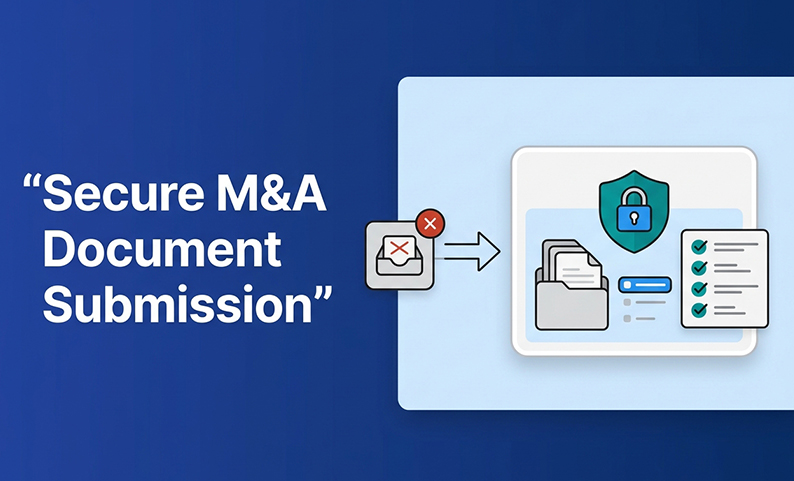
You send a document request to 11 external parties: counsel, auditors, bidders, and client teams. Within 48 hours, sensitive files land in six different inboxes and are forwarded to three unauthorized people. There’s no record of who opened what. Now, imagine that deal attracts SEBI scrutiny.
Using email for M&A document collection isn’t just “less secure.” It’s a governance failure. The legal and compliance risk becomes indefensible the moment an investigation begins, leaving your firm exposed on every deal you run.
Email isn’t just inconvenient. It’s an M&A liability.
In M&A, a misrouted email is a potential information breach with an undocumented chain of custody. A regulator can pull that apart easily. These aren’t isolated security risks. They are interconnected failures in compliance (broken chain of custody), operations (workflow chaos), and governance (indefensible audit trails).
What makes M&A different from normal document exchange?
Three factors make email uniquely dangerous here: the number of external parties (often 10+), the sensitivity of unpublished price-sensitive information (UPSI), and the legal requirement to prove access was controlled. Email has no enforced identity verification, no forwarding controls, and no permanent audit trail. Every email thread is a potential evidence gap.
The 7-point Minimum Secure Submission Standard for M&A (use this as your policy)
This is the floor, not the ideal. If your current process doesn’t meet every item, you have an open liability. Meeting this standard requires a purpose-built Virtual Data Room (VDR) to move critical workflows out of insecure inboxes.
1) Control the entry point (one sanctioned upload path per deal)
Every external party should submit documents through one single, governed channel, not to individual team inboxes. Scattered inboxes create scattered accountability. A single upload path means one record, one log, and one place to shut things down if something goes wrong.
2) Verify identity (don’t accept “typed names” as proof)
An email address gives you zero proof that the sender is who they claim to be. Real identity confidence requires layered verification like multi-factor authentication and device-level approval. A typed name isn’t proof. DCirrus VDR uses MFA (via SMS, email, or an authenticator app) and unique device ID mapping to reduce this “unknown uploader” risk.
3) Enforce least-privilege access (internal and external)
Bidder A should never see documents from Bidder B. Counsel for one party shouldn’t access another’s folder. The standard is granular, role-based permissions for specific folders and files, not a single “here’s the link” for everyone. This applies internally, too. Not every member of your deal team needs access to every single document.
4) Make every action traceable (audit trails + user-attributed viewing)
Defensible logs mean timestamped, user-attributed records of every view, download, or sharing attempt for each document. And those logs must be immutable. If a regulator asks who accessed a specific file, you need a precise answer, not an approximation. DCirrus VDR provides these audit trails and pairs them with dynamic watermarking (displaying user login, IP, and timestamp) on all documents.
5) Protect documents even after access (DRM + watermarking)
Downloading a file shouldn’t mean you lose control. Digital Rights Management (DRM) restrictions like “no printing” or “no copying” ensure files remain governed after leaving the platform. Dynamic watermarks deter unauthorized sharing and create a traceable chain if a document surfaces where it shouldn’t.
6) Build in lifecycle governance (retention windows, revocation, secure deletion)
Document collection doesn’t end at submission. You must define how long documents are retained, when access is revoked post-deal, and how secure deletion is documented. Indefinite retention is indefinite exposure. Most email-based workflows fail here completely. There is no lifecycle, just accumulation.
7) Make the workflow practical (notifications, status tracking, version control)
Security and speed can coexist. Automated notifications, status dashboards, and version control eliminate the endless email chases that slow down deals. You know your process is working when the platform’s audit log becomes the single source of truth for submissions, not your team’s inboxes. DCirrus VDR’s AI tools (like smart indexing and AI-assisted redaction) help accelerate review after documents are securely collected, compressing diligence timelines without cutting corners on controls.
File request links vs. a VDR: the trade-offs that matter in real deals
When a secure file request link is good enough
For low-stakes, single-party submissions without UPSI, a secure file request link might work (for example, collecting a vendor’s NDA). The link must be access-controlled, logged, and temporary.
When you need a VDR-level control plane
Any transaction with UPSI, multiple external parties, or regulatory obligations needs VDR-level controls. These include granular permissions, DRM, dynamic watermarking, and immutable audit trails, which lightweight file request tools lack. A purpose-built VDR like DCirrus centralizes these controls in a single governed environment.
Implementation: who owns what (deal team, IT, legal, compliance)
A simple RACI-style split (approve, administer, use, audit)
Compliance and legal approve the policy. The IT team administers the VDR setup. The deal team uses the platform to manage the deal. Compliance audits the trail after the deal closes. Without a clear split of duties, someone will always default to “just email it.”
If something goes wrong: incident response for inbound document leaks
Contain: shut down links/access and preserve evidence
If you suspect a leak, revoke access to the submission path immediately. Do not delete anything. Preserve all logs and audit records, as these are your evidence. Revocation and preservation are separate actions.
Investigate: audit review, scope, and stakeholder notification readiness
Pull the audit trail for the affected documents to identify every access event. Determine the full scope before communicating externally because a premature or inaccurate disclosure only compounds the problem. Involve legal and compliance from the first minute.
Summary and Next Steps: ban inbox collection, adopt a governed submission standard
Email-based M&A document collection is a governance gap that creates real exposure. It leads to audit trail failures, unverifiable identities, uncontrolled forwarding, and indefinite retention of sensitive files. Apply the 7-point standard to your next deal.
If you want to see how DCirrus VDR centralizes secure document submission and control in a single platform, book a free demo. We’ll walk you through it with your own deal workflow in mind.
FAQ
Why is email uniquely risky for M&A document collection compared to other business sharing? M&A involves unpublished price-sensitive information shared across 10+ parties. This combination creates insider-trading exposure and multi-party chain-of-custody obligations. Email lacks enforced identity verification, forwarding controls, and an immutable audit trail, making it structurally unfit for these requirements.
What’s the best way to validate the identity of external document submitters? Use layered verification: MFA (via SMS, email, or an authenticator app) combined with device-level approval. A typed name and email address are not proof of identity; they are unverifiable claims.
What are the key security trade-offs between OneDrive-style file requests and a full VDR? Lightweight file request tools lack DRM, granular permission management, dynamic watermarking, and immutable audit trails. They may be acceptable for low-risk, single-party collections but cannot meet the governance needs of a regulated M&A transaction.
What retention and secure deletion rules should apply to collected diligence documents? Define retention windows before collection begins, typically aligned to the deal close plus a regulatory hold period. Revoke access at deal close, and ensure secure deletion is documented. Indefinite retention without a policy is indefinite exposure.
What should our incident response look like if we suspect a leak during document submission? Immediately revoke access to the affected path, preserve all audit logs, and determine the scope from the audit trail before communicating. Engage legal and compliance before making any notifications. Containment and evidence preservation must happen at the same time.
How can AI help during due diligence without compromising security? After secure collection is complete, AI can accelerate the review process. Tools like smart indexing, metadata search, and AI-assisted redaction reduce manual effort and error. The key is to ensure these tools operate within the same governed VDR environment.
Latest Posts
Buyer Engagement Analytics in a VDR: What Deal Teams Can Track
August 17, 2026
12 VDR Features Required for IPO Preparation in India
August 13, 2026
What Bankers and Auditors Need From an IPO VDR in India
August 12, 2026