Stop Chasing Attachments: A Better Way to Request Documents From Vendors and Counsel
You sent a document request two weeks ago. You followed up three times. The vendor just emailed back with the wrong version. The email thread is now 47 messages deep.
Email-based document collection fails. This is not because people are slow. It fails because email was never built to be a control environment. In M&A and due diligence, you need confidentiality, completeness, and auditability. That distinction matters. This article explains a modern document request workflow. It shows you how to stop chasing documents.
What’s the real problem with “just email the documents”?
Email moves files. It does not manage them. This gap becomes a serious problem when you coordinate document collection with vendors, opposing counsel, and internal reviewers.
The three failure modes: control, completeness, and context
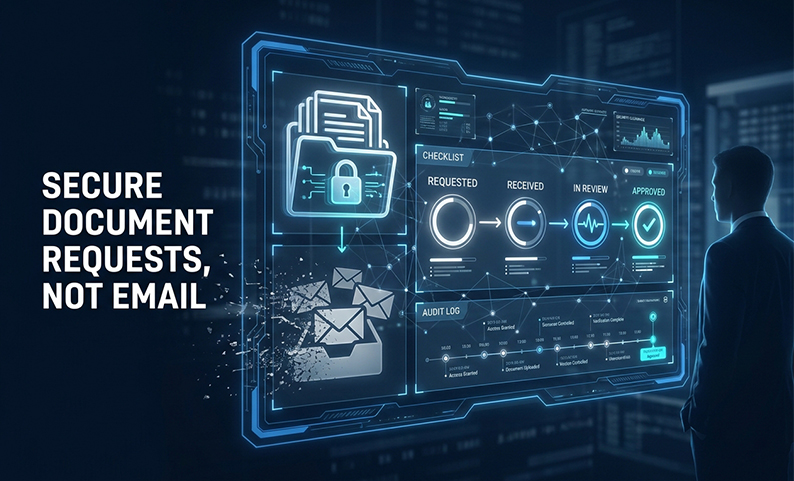
Email creates three specific failures. Control: You cannot revoke a file from an inbox. You cannot prove who accessed it. Completeness: Tracking documents is a manual process that leads to errors. Context: Questions and updates get lost in different email threads. This makes it impossible to create a clean audit record.
Why this becomes a deal risk (not an admin annoyance)
Missed documents cause delays. Uncontrolled file sharing creates confidentiality risks. Your company must be able to prove who accessed what and when. This is critical if a deal becomes contentious after it closes.
Where leaks and mistakes actually happen
Most leaks come from internal mistakes, not external threats. A folder is shared too broadly. A file is sent to the wrong bidder. A document is released before an NDA is signed. These are not malicious acts. They are process failures caused by using informal systems like email.
Cross-border pressure: data residency and access logging expectations
Global deals add another layer of complexity. GDPR and other regional laws dictate where data is stored and who can access it. You cannot tell a regulator your diligence documents were managed by email on U.S. servers. Regulators now expect you to prove access through detailed logs.
VDRs like DCirrus are built for this challenge. They provide granular permissions, 2FA, IP restrictions, and complete audit trails. This makes access provable, not just assumed.
How a modern document request workflow works
The core idea is to treat document collection as a pipeline, not a conversation.
Standardize the request: checklist + owner + deadline + required format
Standardize every request. Use a checklist that specifies the exact document, owner, deadline, and required format. Clarity at the start prevents rework and email clutter.
Track status like a pipeline (Requested / Received / In review / Needs remediation / Approved)
Every document should have a clear status. Anyone on the deal team can see what is outstanding and what is in review. This replaces constant status update emails with a single source of truth.
Build in remediation for partial/late submissions (and preserve the evidence trail)
Do not start a new email chain for an incomplete submission. Flag the item as “Needs remediation” in the system. Assign it to an owner and log the action. Keep all communication auditable. Use integrated Q&A and commenting features to keep questions attached to the document request itself.
Picking the right approach: folder link, form, portal, or VDR
Choosing the right tool depends on your deal’s complexity and risk profile.
When cloud file requests are “good enough”—and where they fail
Google Drive and Dropbox file requests can work for low-stakes internal collection. They fail for sensitive diligence materials. They have no usage restrictions, no meaningful audit trail, and no data residency controls. “Encrypted in transit” is not a control environment.
When a VDR becomes the safer default for high-stakes diligence
A Virtual Data Room (VDR) is not just storage. It is a permission and accountability layer. DCirrus DRM capabilities let you disable printing, copying, and sharing for each document. You can set expiry dates and apply dynamic watermarks. You retain a level of control even after a file is downloaded.
UX factors that drive completion (mobile, accessibility, no-account friction)
Completion rates depend on ease of use. External parties should not need to create an account or use a difficult interface. A simple, mobile-friendly submission process means fewer delays.
How to prove ROI and efficiency (so you can justify change)
Metrics to track: cycle time, follow-up touches, completion rate, version rework
To measure if a new process is working, track key metrics.
These numbers show if your new approach is more efficient.
Comparing approaches by risk, effort, and governance
| Approach | Security Controls | Audit Trail | External UX Friction | Scalability | Best For |
| None | None | Low | Poor | Nothing sensitive | |
| Cloud file request (Drive/Dropbox) | Minimal | Minimal | Low | Limited | Low-risk internal use |
| Form + upload tool | Moderate | Partial | Low–Medium | Moderate | Structured intake, lower stakes |
| VDR | Enterprise-grade | Comprehensive | Low–Medium | High | M&A, diligence, cross-border |
Deal hygiene: retention, deletion, and closeout
You need a clear policy for documents after a deal closes or fails.
A practical retention/deletion policy template
Your policy framework should include:
DCirrus supports data localization, with certified data centers and SOC reports for audit readiness.
What to ask when evaluating a secure document collection platform
Security & governance questions
Do not stop at “is it encrypted?” Ask vendors specific questions:
The answers show if you are buying a file-sharing tool or a true control environment.
FAQ
Why should I stop using email to request diligence documents? Email has no enforceable controls. You cannot restrict file usage. You cannot track access. You cannot prove a chain of custody. These gaps create unacceptable liability in due diligence.
What’s the most secure way to request documents from vendors and opposing counsel? A purpose-built VDR is the most secure method. It provides role-based permissions, DRM controls, and a full audit trail. This controls document access and usage, not just transmission.
How do I handle partial or late document submissions without losing track? Use a system that assigns a status to each document request. Log every update with a timestamp. This creates an objective record for resolving any disputes.
How can I automate reminders and follow-ups without creating more inbox noise? Use platform-level notifications tied to status or deadlines. This keeps follow-up systematic and out of email threads. A system like DCirrus handles this within the deal environment.
What security controls matter beyond encryption when documents are highly sensitive? You need to disable print, copy, and sharing at the document level. Apply dynamic watermarks with user identity and a timestamp. Set expiry dates on downloads. These controls reduce risk even after a file has left the browser.
What should our retention and secure deletion process be after the deal? Define retention periods by jurisdiction. Assign an owner. Use a platform that can confirm and log the secure deletion of data.
Ready to stop chasing attachments on your next deal?
A VDR like DCirrus gives your team a control environment. It provides features that email cannot. These include granular permissions, DRM, dynamic watermarking, and integrated Q&A. You get full audit trails in one secure platform.
Latest Posts
Buyer Engagement Analytics in a VDR: What Deal Teams Can Track
August 17, 2026

12 VDR Features Required for IPO Preparation in India
August 13, 2026

What Bankers and Auditors Need From an IPO VDR in India
August 12, 2026