
How Virtual Data Rooms Revolutionized International Marine Trade
Client Background
Industry: International Marine Trade & Shipping
The global shipping industry is the quiet force that keeps the world moving. More than 80% of the products we rely on—coffee, clothing, electronics, fuel—cross oceans before reaching us. Behind this massive operation is a complex network of ship owners, port authorities, insurers, financiers, and buyers spread across multiple continents. Each has their own set of rules, responsibilities, and risks.
But with this scale comes equally massive challenges. The sector was under increasing pressure to modernize while safeguarding sensitive information and staying compliant with ever-changing global regulations.
The Challenge We Set Out to Solve
Our clients in the marine trade sector needed a way to cut through the chaos of outdated processes. They were struggling with:
• Document overload: Every shipment generated 500–700 critical documents, from bills of lading to customs clearance forms. Missing even one signature could stall an entire operation.
• Time zone delays: When one side of the world was working, the other was asleep—costly port fees piled up while documents sat waiting for approvals.
• Compliance headaches: International maritime law and customs requirements shifted constantly, making it hard to stay up to date.
• Security concerns: Sensitive contracts and pricing strategies couldn’t afford to be leaked. Yet, traditional methods like email left them vulnerable.
• Inefficient collaboration: Endless email threads, paper couriers, and version conflicts slowed everything down.
The industry needed a modern, reliable way to exchange information without sacrificing trust, compliance, or speed.
Challenges
1. High-Stakes Confidentiality: Leak of R&D data or regulatory correspondence could risk drug approvals and market trust.
2. Complex Regulatory Landscape: Different jurisdictions (USFDA, MHRA, CDSCO) demanded tailored documentation, audit trails, and real-time access control.
3. Fragmented Communication: Global teams, law firms, auditors, and government agencies struggled with email chains and offline document sharing.
4. Version Chaos: Ongoing changes in licensing terms, clinical trial results, and IP disclosures often created versioning confusion.
Our Solution: Implementing Virtual Data Rooms (VDRs)
We introduced Virtual Data Rooms as a secure, collaborative hub tailored for marine trade operations. The implementation included:
• Secure Document Exchange: Encrypted “digital vaults” for storing and sharing contracts, insurance policies, customs records, and compliance documents.
• 24/7 Global Collaboration: Time zones stopped being a bottleneck. Stakeholders accessed, reviewed, and approved documents anytime, anywhere.
• AI-Powered Document Intelligence: Automatic checks flagged missing documents, outdated certificates, or compliance issues before they became problems.
• Granular Access Control: Each stakeholder saw only what they needed—no more, no less.
• Comprehensive Audit Trails: Every action was tracked, creating transparent records that satisfied even the strictest regulators.
• Faster Deal Execution: Automated workflows and e-signatures replaced slow, manual approvals, turning weeks into days.
The Results Spoke for Themselves
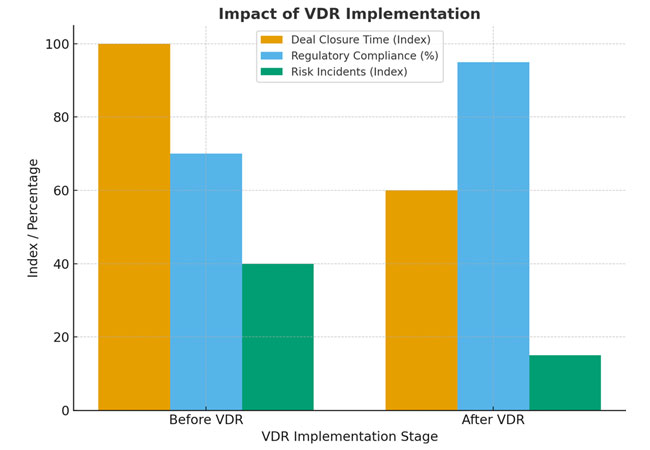
The impact was immediate and measurable:
• 40% Faster Deal Closure: Multi-week agreements were finalized in just days. Ships spent less idle time in port, cutting costs and improving client satisfaction.
• Stronger Compliance: Automated checks and built-in audit trails virtually eliminated regulatory errors.
• Enhanced Security: Not a single data breach or unauthorized access was reported after implementation.
• Boosted Confidence: Insurers offered better rates, banks expedited funding, and buyers increased orders—because the system inspired trust.
• Global Scalability: Clients expanded into new regions with confidence, knowing their documentation processes could handle the complexity.
Looking Back: What We Accomplished
This wasn’t just about rolling out a new tool. It was about giving one of the world’s most critical industries the ability to operate with greater confidence, speed, and resilience.
Virtual Data Rooms went from being a secure storage solution to becoming the strategic backbone of global trade. They helped ensure that the world’s supply chains remained fast, reliable, and secureso that goods continue to move across oceans without disruption.