Due Diligence Timeline for Acquisitions: A Deal-Ready Plan to Keep Stakeholders Moving
Diligence stalls not because a deal is complicated, but because teams fail to agree on owners, milestones, and data management before the process begins. This article outlines a system for treating diligence as a governed project, preventing the delays that erode negotiating leverage and lead to post-close surprises.
What problem are you solving with a due diligence timeline?
The common failure mode: document chaos + unclear ownership
Without a clear plan, diligence devolves into document chaos. Unprioritized request lists are sent, responses create version control issues, and critical tasks are dropped as team members assume someone else is responsible.
The “deal fatigue” effect on stakeholders
These process failures cause “deal fatigue.” The accumulating friction erodes morale and trust, making the final negotiation unnecessarily contentious.
Why acquisition diligence timelines slip: the 5 bottlenecks to design around
Timelines slip for predictable reasons. A robust diligence process must be designed to preempt these five bottlenecks:
How to build a deal-ready diligence workflow (milestones, owners, exit criteria)
The minimum viable diligence RACI
Assign a single, accountable owner for each primary workstream: finance, legal, operations, and IT/cybersecurity. The deal lead retains ownership of timeline governance and escalations.
Milestone design: define “done” before work starts
Define clear exit criteria for each milestone to prevent ambiguity. For example, “Financial pack validated” means the quality of earnings review is complete and the working capital peg is agreed upon. “Contract exceptions logged” means all material agreements are reviewed and impacts are assessed.
The diligence dashboard: what to track weekly
A central dashboard should track documents reviewed, open queries, and milestone status. A purpose-built virtual data room like DCirrus VDR automates this, replacing manual status checks with an objective audit trail.
A practical due diligence timeline for acquisitions (example plan)
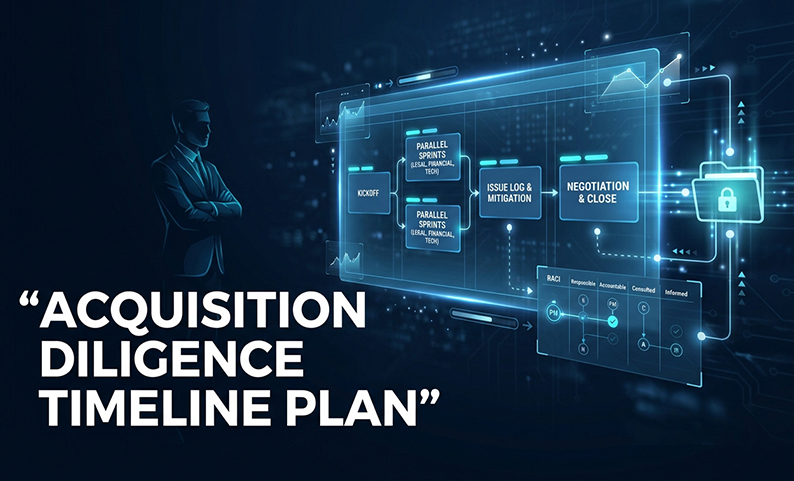
A typical timeline moves from setup to parallel sprints, then to issue consolidation and negotiation.
Week 0–1: Kickoff + scope + data room readiness
The deal lead establishes scope and the RACI. A VDR with pre-set permissions and folder structures is brought online before the clock starts.
Week 1–3: Core review sprints in parallel
Financial, legal, operational, and tech workstreams run simultaneously, with daily updates to manage cross-dependencies.
Week 3–5: Issue log, follow-ups, confirmatory diligence
Workstream leads consolidate exceptions into a master issue log, while re-requests and confirmatory diligence run in parallel.
Final stretch: negotiation inputs + close readiness
The deal lead translates the final diligence report into valuation adjustments, representation and warranty positions, and other deal terms.
Communication and Outside Counsel Coordination
Cadence: daily async + twice-weekly checkpoint
Use daily asynchronous updates and twice-weekly checkpoint calls for workstream leads to maintain accountability without excessive meetings.
Counsel coordination tactics: batching, standardizing, and escalation
Batch queries to outside counsel every 48 hours. Standardize the request format and build a turnaround SLA into the engagement letter.
Q&A rules: one channel, tagged owners, time-boxed responses
All buyer queries must be routed through a single, trackable channel, such as a VDR’s Q&A module. Assign each query an owner and a response deadline.
Decision Support: Timelines and Tooling
Accelerated/auction diligence: what to tighten vs. what not to cut
In competitive processes, compress timelines using tools like the AI-powered document search in DCirrus VDR to accelerate contract review. Never compress the core risk analysis for quality of earnings, litigation, or cybersecurity.
Extension triggers and how to document them
Justify any schedule extension in writing, citing a specific trigger and providing a revised milestone schedule to maintain clarity on closing obligations.
Tooling evaluation questions (VDR/workflow)
Evaluate VDRs on their ability to support granular permissions, generate complete audit trails, and manage Q&A. Consider whether a platform supports data localization requirements for compliance with regulations like SEBI.
Bottom Line: Governance and a Single Source of Truth
The system for preventing diligence delays combines four elements: a milestone-based RACI, defined exit criteria, a strict communication cadence, and a secure VDR where all documents, Q&A, and audit trails are centralized. The most common delay drivers are late documents and slow turnaround from outside counsel, both of which are process failures, not deal complexities.
Build a diligence-ready workspace before the clock starts
The first request list often goes out before teams agree on data room protocols, a gap that costs weeks. DCirrus VDR provides deal teams a purpose-built workspace with granular access controls, integrated Q&A, and complete audit trails for SEBI-regulated environments. Establish this workspace before the LOI is signed to run diligence on your timeline, not one dictated by document chaos.
Latest Posts

Buyer Engagement Analytics in a VDR: What Deal Teams Can Track
August 17, 2026

12 VDR Features Required for IPO Preparation in India
August 13, 2026
What Bankers and Auditors Need From an IPO VDR in India
August 12, 2026