AI-Powered Due Diligence for Merchant Bankers: A Definitional Guide to Features, Benefits, and Risk Reduction
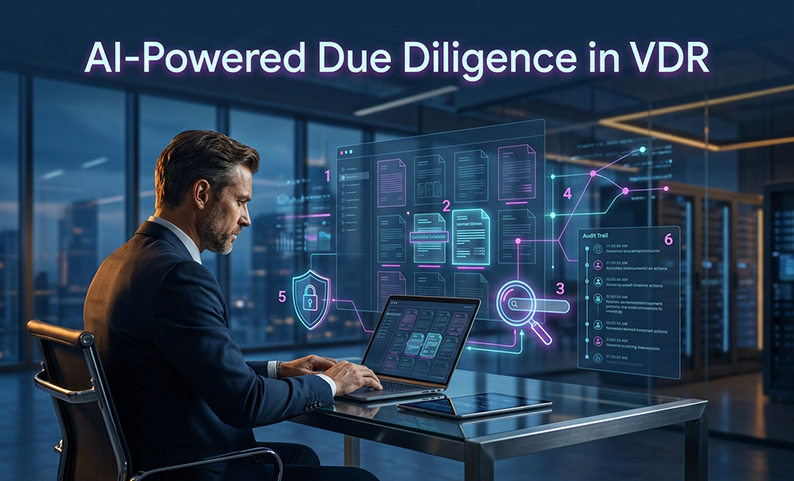
You’re managing 2,000 documents, 150 users across four organizations, and a buy-side legal team that just asked for proof of who viewed what. Your analysts are buried in email Q&A, and somewhere in that document set is a change-of-control clause that could kill the deal if you miss it.
AI-powered due diligence in a VDR promises a solution. But the term “AI-powered” can mean anything from genuinely useful clause recognition to a glorified keyword search with a marketing rebrand. The difference matters, especially when running a SEBI-regulated process where auditability and confidentiality aren’t optional.
This guide gives you a plain-language definition of what AI-powered due diligence is, a 7-point checklist for what works, and practical advice on implementation, governance, and the failure modes you need to avoid.
What Is AI-Powered Due Diligence in a VDR?
AI-powered due diligence isn’t just a search bar with a smarter algorithm. It’s the ability to ingest an entire diligence corpus, extract meaning from it, and surface synthesized, traceable insights inside a controlled workflow.
The shift is from asking “where is the document?” to “what do these documents collectively mean, and where are the risks?”
Standard document search finds files. AI-powered due diligence reads them. It recognizes clause types, identifies patterns across contracts, and flags contradictions you’d never catch by manually sampling.
For merchant bankers, one constraint is non-negotiable: every AI output must be traceable to its exact source location and auditable. If an AI flag can’t show you the specific paragraph it came from, it isn’t useful. It’s just noise you have to verify manually anyway.
What Does “Good” AI-Powered Due Diligence Look Like as a Workflow?
A good AI-powered workflow is a four-stage process that separates what the AI does from what your team must own.
Stage 1 — Automated Intake + Classification
- Documents are ingested, categorized, and indexed automatically.
- Your analysts don’t spend three days building a folder structure from scratch.
Stage 2 — Extraction + Semantic Understanding
- AI reads document content (not just filenames or metadata) to extract key terms, clause types, and data points.
- Semantic search finds relevant content even when the exact wording varies.
Stage 3 — Cross-Document Risk Synthesis
- AI surfaces patterns, contradictions, and cumulative exposure across the entire set of documents.
- A change-of-control clause buried in contract #847 gets flagged alongside the 23 others like it.
Stage 4 — Human Validation + Decisioning
- Your legal and finance team reviews flagged items, interprets materiality, and frames the negotiation strategy.
- This stage is irreplaceable. AI augments expert judgment; it doesn’t substitute for it.
Which 7 Capabilities Actually Define AI-Powered Due Diligence for Merchant Bankers?
Treat this as your evaluation checklist. A platform that can’t demonstrate most of these with proof, not just a polished demo, doesn’t qualify as AI-powered due diligence for high-stakes banking.
1. Smart Indexing + Automated Categorization
- Automatically organizes uploaded documents by type, topic, and relevance. This reduces the manual sorting that consumes analyst time at deal launch.
- Ask: How does the system handle mixed file types (PDFs, scanned docs, spreadsheets)?
2. Semantic Search
- Finds documents based on meaning, not only exact keyword matches. This reduces the risk of missing a critical item because a clause used non-standard language.
- Ask: Can it find “termination for convenience” and “right to exit” as related concepts?
3. Clause Recognition for High-Impact Terms
- Identifies and flags specific clause types like change of control, indemnities, and liability caps across every document. It eliminates the sampling problem by giving you coverage across 100% of contracts.
- Ask: Which clause types does it recognize out of the box, and can it be trained on custom ones?
4. Cross-Document Pattern Detection
- Surfaces contradictions (like conflicting governing law clauses) and cumulative risk. This is where AI earns its place. It catches what no analyst team could find consistently at scale.
- Ask: Can it compare clause language across 500 contracts and flag the outliers?
5. AI-Assisted Redaction
- Identifies and redacts sensitive data (like personal information) before sharing documents with certain user groups. This reduces leak exposure without manual page-by-page review.
- Ask: Is redaction applied permanently to the shared version, or is it a display layer only?
6. Q&A Traceability Inside the VDR
- Questions and answers are linked directly to specific documents. This creates a single, auditable record and eliminates the risk of critical answers living only in someone’s inbox.
- Ask: Can you export the full Q&A log with document references for post-deal reporting?
7. Explainability + Auditability
- Every AI flag, extraction, or summary must link back to the exact document and page that generated it. This supports compliance, internal escalation, and defensibility in disputes.
- Ask: If a flagged clause is challenged, can you produce the source location?
What Should You Ask a Vendor to Prove These Capabilities?
Demos show best-case scenarios. You need to push harder.
- Ask for a live test on a sample from your own document set, not their curated examples.
- Confirm 100% document coverage. Does the AI analyze the full corpus, or does it sample? Sampling defeats the purpose.
- Ask how AI results interact with permissions. A junior analyst should never see clause extractions from documents they can’t view. The AI must respect your access controls.
How Do AI Features Reduce Risk—Not Just Effort?
Faster review is valuable, but the real benefit is coverage and consistency. That’s where AI addresses genuine diligence risk.
Consider the “needle in a haystack” problem. A single change-of-control clause in a customer contract can trigger termination at closing. If your team only reviews a sample of contracts, that clause can go undetected. Clause recognition, applied across the full document set, closes that gap.
The same logic applies to cross-document inconsistency. A team might read every contract individually but miss that three of them have contradictory governing law provisions. Pattern detection flags it instantly.
Surfaced risks don’t just prevent surprises. They change your negotiating position. Identified indemnity exposure can be repriced. Problematic renewal terms can become closing conditions. The intelligence you gain from AI-assisted review translates directly into better transaction terms.
What Security and Compliance Controls Must Sit Next to AI in a VDR?
An AI tool that surfaces clause risks on a platform with weak permissions or no DRM doesn’t reduce your exposure. It expands it.
For merchant bankers, these controls are non-negotiable:
- Granular permissions: Folder- and file-level access with instant revocation.
- DRM controls: Block printing, copying, and screen capture. Set expiry dates on downloaded files.
- Dynamic watermarking: Embed user login, IP address, and timestamp in every document.
- Comprehensive audit trails: Log every view, download, and print.
- Data localization + certifications: For India-based transactions, confirm the platform supports data residency and holds certifications like ISO 27001 and SOC 2.
A platform like DCirrus VDR, for example, combines AI document intelligence (smart indexing, clause recognition, AI-assisted redaction) with these essential security controls in a single environment. The security and intelligence layers must operate together when speed and confidentiality are on the line.
How Do You Implement AI-Powered Diligence Without Losing Control?
Clear role ownership is what keeps AI acceleration from becoming AI confusion.
- Deal lead (AVP/Director): Defines risk themes and sets review priorities.
- Analysts: Run searches and compile issue lists, linking every finding to its source.
- Legal counsel: Validates clause interpretation and assesses materiality.
- Compliance/IT: Manages permissions, runs access reviews, and handles audit logs.
Operating rhythm also matters. A daily Q&A triage and a weekly audit review keep AI output actionable, not overwhelming.
What Are the Most Common Failure Modes?
Most AI diligence failures aren’t about the technology. They’re about governance.
- Over-reliance on AI summaries: AI surfaces findings; humans must validate them. Always require legal or finance review for any material finding.
- Poor explainability: If your platform can’t show the source paragraph behind a flag, your issues register is built on unverifiable output.
- Vendor and model risk: Request SOC reports. Get contractual clarity on how your data is handled and where it’s processed.
- Permission drift: Mistakes happen with large user bases. Use role templates and run periodic access reviews.
- Q&A falling back to email: One person using email can unravel your traceability. Mandate VDR-only Q&A from day one, with no exceptions.
Summary and Next Steps: How to Shortlist an AI-Powered VDR Confidently
The definition of AI-powered due diligence that holds up under scrutiny requires three things:
- A 4-stage workflow with clear ownership.
- 7 provable capabilities, including smart indexing and clause recognition.
- Ironclad governance controls like DRM, granular permissions, and full audit trails.
DCirrus VDR aligns to this checklist, providing AI document intelligence (smart indexing, clause recognition, and AI-assisted redaction) alongside the integrated security and audit infrastructure that regulated VDRs require.
Your next step: Request a demo using a sample from your own document set. Test the full chain: find a clause, trace it to the source, and verify permission-limited visibility. If a platform passes that sequence, it belongs on your shortlist.
FAQ
Is AI-powered due diligence acceptable for regulated financial transactions? Yes, it’s acceptable and increasingly expected, provided you have the right controls. The risk isn’t the AI, but using it without full auditability. If every AI output is source-linked and your audit trails are complete, the process is stronger.
What’s the difference between keyword search and semantic search? Keyword search finds exact matches. Semantic search understands meaning, so a search for “termination rights” also finds phrases like “right to exit.” This directly affects what you catch and what you miss.
How do I verify AI clause recognition is accurate? Test it on documents you know well before going live. Use AI output as a first pass, not a final answer. Human validation remains essential for material issues.
Can AI-assisted redaction replace manual redaction? It accelerates the process and improves coverage, but it shouldn’t fully replace human review for high-stakes materials. Treat it as a first pass that significantly reduces the manual workload.
How do we keep Q&A auditable and out of email? Use a VDR with a built-in Q&A module that links questions to specific documents. Establish a firm rule from kick-off: all diligence questions go through the VDR, with no exceptions.
What audit logs should I be able to export? At a minimum, every view, download, and print event, with user, timestamp, and IP address. You should also be able to export full Q&A logs and permission change records.
Does AI reduce headcount on diligence teams? No. It reduces time spent on mechanical tasks, freeing analysts for higher-value work like analysis and negotiation support. AI doesn’t reduce headcount; it changes what your team’s hours go toward.
What should be included in vendor risk checks for an AI-enabled VDR? Request current SOC 2 and SOC 3 reports. Get explicit contractual language confirming your documents aren’t used for model training. Verify where data is stored and that it meets your firm’s requirements.
Want to See AI-Powered Due Diligence Without Compromising Confidentiality?
Book a demo built around your actual diligence workflow. See AI-powered due diligence tools like smart indexing, clause recognition, and AI-assisted redaction working alongside DRM, granular permissions, and exportable audit trails. Move faster on your next deal without creating new governance exposure.
Latest Posts
Buyer Engagement Analytics in a VDR: What Deal Teams Can Track
August 17, 2026
12 VDR Features Required for IPO Preparation in India
August 13, 2026
What Bankers and Auditors Need From an IPO VDR in India
August 12, 2026