What Bankers and Auditors Need From an IPO VDR in India
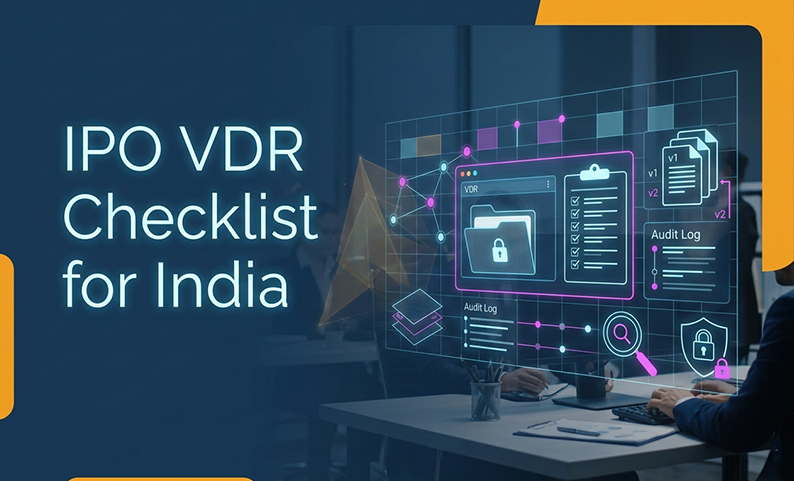
When an IPO room starts to sprawl, the real problem is not file volume. It is when a missing source document, an obsolete version, or an answer buried in email forces bankers and auditors to second-guess the evidence behind the offer document. That is how diligence slows, disclosure questions multiply, and the process becomes hard to defend later.
The right way to judge an IPO VDR is as an evidence-control and collaboration system, not a secure folder. It should help each reviewer find the right document quickly, know which version is authoritative, ask and answer questions against that version, see only what their role permits, and export a clean record for compliance and inspection.
This guide gives you a practical 10-point checklist, a simple responsibility matrix, common failure signals, and an FAQ so you can test whether a room is actually workable for an Indian IPO.
Why an IPO VDR has to do more than store files
A workable IPO VDR is different from generic cloud storage because it has to support the merchant banker’s evidence trail from first upload through repository export and retention. The key question is not “can it hold documents?” It is “can it prove what was reviewed, by whom, in what version, and with what result?”
That matters in India because the merchant banker remains responsible for due diligence, while SEBI’s framework expects records, logs, and document control that can stand up to inspection. The room must also be ready for the separate exchange repository process, which means the working environment should produce a clean, repository-ready evidence set.
For bankers, that means speed without losing control. For auditors, that means traceability without broad access to unrelated material. For counsel, it means privilege and version discipline. For issuers and other reviewers, it means a room that is easy to use without becoming loose on permissions.
The 10-point IPO VDR workability checklist
1. Can the room act as the single source of truth?
Start with the evidence map, not the upload pile. If the room does not tell you which file is current, who owns it, and how it connects to a disclosure point, it is already failing.
Look for:
- a stable document ID for every file;
- metadata for owner, category, period, entity, status, and confidentiality;
- clear states such as working, approved for disclosure, superseded, redacted, privileged, and repository-ready;
- exportable index and clickable links between the index and the current file;
- a structure that lets the team move from a disclosure question to the supporting record without leaving the room.
What good looks like is simple: a banker can trace a disclosure back to the supporting document, current version, reviewer, and final answer. What bad looks like is a folder called “final” that contains duplicates with no explanation.
2. Can it ingest and classify documents without manual cleanup?
Indexing is the first real productivity test. If the room needs constant renaming and hand-tagging just to become usable, the workflow will bog down once the deal gets busy.
Test whether it can handle:
- bulk upload;
- OCR for scanned records;
- automated numbering and categorization;
- duplicate detection or at least duplicate review;
- an error queue for failed or partial uploads;
- mixed file types such as PDFs, scans, spreadsheets, presentations, images, and password-protected files.
You should also verify that the original file stays intact and that searchable text is added without overwriting the source. For an IPO process, that distinction matters. A searchable copy is useful, but it should never replace the underlying evidence.
3. Can auditors and bankers search by meaning, not just filename?
Filename search is not enough in diligence.
A room can look tidy and still hide the clause you need in an attachment, a scan, or an older version.
The search test should include:
- full-text and OCR search;
- metadata filters;
- clause-level or semantic retrieval where available;
- queries on change-of-control rights, related-party transactions, debt covenants, contingencies, litigation, licences, and inconsistent financial fields;
- misspellings, synonyms, scanned pages, tables, and Indian names.
If the platform offers AI or semantic help, treat it as review assistance only. The reviewer still has to open the source passage, confirm the current version, and record the decision. That is especially important for auditors, who need repeatable evidence, not a black box answer.
4. Does version control prevent obsolete disclosure from surviving?
Version control has to be a control feature, not a cosmetic file history panel. If a later upload silently hides the earlier one, the room can create a false sense of completeness.
Check for:
- version numbers, upload timestamps, and change reasons;
- visible superseded status rather than silent overwrite;
- side-by-side or redline comparison where practical;
- linked Q&A and comments tied to the exact version;
- a disclosure freeze for milestone cuts.
This is one of the most important features for bankers and counsel because it prevents an outdated answer from following the deal into the draft prospectus or letter of offer. At close, the room should export both the approved version map and the superseded history.
5. Can access be narrowed by role, folder, and file?
A workable room is built around least privilege. If every external party gets broad access just because the platform cannot narrow roles, that is a design failure.
Test for:
- folder- and file-level permissions;
- separate rights for view, download, print, copy, and share;
- MFA and device approval;
- time-limited access;
- immediate revocation;
- restricted privileged and personal-data folders.
You should also verify offboarding. Access after a team change or issue milestone should be reviewed, not assumed. And remember the practical limit: “view-only” does not automatically stop screenshots or photos. The provider should show what the control actually does and where the residual risk remains.
6. Do DRM, watermarking, and redaction hold up under pressure?
Security features are only useful if they still work when the room gets busy. This is where many platforms look good in a demo and weaker in real use.
Test whether the room can:
- block printing, copying, and sharing where required;
- apply dynamic watermarks with user identity, email or login, IP address, and timestamp;
- restrict downloaded files with expiry;
- support redaction with human review and approval;
- keep unredacted and redacted versions separate.
For auditors and counsel, this matters because sensitive schedules, legal material, and personal data often need different handling. A redaction tool that hides text on screen but leaves hidden text, metadata, or attachments exposed is not good enough.
7. Does Q&A replace email chaos with traceable diligence?
Q&A is where many IPO rooms either become truly workable or slide back into inbox sprawl. If every question lives in email, the answer trail becomes hard to audit and easy to lose.
A usable Q&A module should capture:
- question ID, asker, date, and linked document or folder;
- version, category, priority, owner, and due date;
- response, responder, and timestamp;
- follow-up, acceptance, escalation, and closure;
- exportable thread history.
A question should be attached to the exact source version it came from. That gives bankers and auditors a defensible record of who asked what, who answered, and what changed afterward. It also makes it easier to reopen an issue if a later version changes the underlying answer.
8. Can the audit trail stand on its own?
A strong audit log is not a nice-to-have. It is part of the evidence set. If the room cannot export a defensible activity record, it is weak at the exact point where diligence becomes sensitive.
At minimum, the log should show:
- user;
- action;
- document;
- version;
- timestamp;
- IP address;
- device where available.
It should cover logins, uploads, views, downloads, print or copy attempts, Q&A, permission changes, invitations, expiry, deletion, and admin actions. Just as important, the report should be exportable outside the vendor UI in a format the team can review and retain.
For an Indian IPO, this supports the merchant banker’s inspection readiness and helps avoid the problem of evidence trapped in personal inboxes or inaccessible system logs.
9. Can reviewers work quickly without losing control?
Speed matters, but not at the cost of visibility. The room should let reviewers work inside their permissions instead of forcing them to download everything first.
Look for:
- browser-based preview;
- readable OCR text;
- spreadsheet-friendly navigation;
- stable performance on large files;
- dashboards that show only the reviewer’s scope;
- progress views for missing items, stale versions, open questions, redaction queues, and repository readiness.
A mobile app can be useful for authorized internal reviewers, but it should stay an internal convenience. This is not about investor communications. It is about making it easier for controlled parties to review material without creating a new access problem.
10. Has the vendor passed security, resilience, compliance, and exit tests?
The last test is the one too many teams skip. A polished product does not matter if the contract, architecture, or exit path is weak.
Verify:
- hosting architecture and region options;
- encryption, authentication, device controls, and network protections;
- current certification scope and audit reports;
- subprocessors and incident-notice terms;
- business continuity, backup, and disaster recovery;
- data processing, deletion, return, audit rights, and legal hold terms;
- export of index, documents, version map, Q&A, permissions, logs, and usage reports.
You should also ask for a written answer on India data residency and any cross-border transfer options. Do not assume that “India compliance” automatically means India-only hosting.
A simple implementation and responsibility matrix
The best room design still needs clear ownership. Without that, the platform becomes another place where people wait for someone else to act.
| Activity | Lead merchant banker | Issuer/finance | Auditor | Legal counsel | VDR administrator/vendor |
|---|---|---|---|---|---|
| Define diligence taxonomy | A/R | C | C | C | C |
| Supply source documents | A | R | C | C | I |
| Verify financial evidence | A | C | R | I | I |
| Verify legal and regulatory evidence | A | C | I | R | I |
| Approve disclosure version | R/A | R | C | R | I |
| Configure permissions | A | C | C | C | R |
| Own and close Q&A | A | R | R for audit questions | R for legal questions | I |
| Monitor audit and security logs | R/A | I | C | C | R for platform evidence |
| Repository export and filing handoff | R/A | C | C | C | R for export support |
| Retention and room closure | R/A | C | C | C | R for technical deletion/export |
The exact split should follow the mandate letter and internal controls, but the principle is fixed: the merchant banker remains accountable for the room’s evidence quality, even if the vendor runs the platform.
Common failures to catch early
These are the failures that usually show up after the room is already in use:
- Email becomes the shadow data room. Move questions, answers, and approvals into linked Q&A.
- “Final” has no meaning. Use version numbers and milestone freezes.
- One external role sees too much. Test least privilege with restricted accounts.
- Search finds filenames but not evidence. Test OCR, tables, attachments, and clause retrieval.
- Redaction is only visual. Check hidden text, metadata, and attachments.
- The audit log cannot be exported. Run a scripted event test and export the result.
- The VDR and repository are conflated. Keep a separate export and completion checklist.
- Retention stops at close. Preserve the evidence set for at least the required minimum period.
If a room fails on permissions, audit export, redaction integrity, or access revocation, it should not be rescued by a fast search demo.
How this fits into a broader IPO control strategy
A good IPO VDR does not replace diligence discipline. It makes discipline easier to execute and easier to prove later. That is the real value for bankers and auditors: less friction, fewer lost answers, and a cleaner record when someone asks how a disclosure was built.
It also matters because the room is part of a larger control stack. SEBI records expectations, repository handling, cyber controls, contract terms, and retention rules all sit around it. The VDR should be designed to support that system, not pretend to replace it.
In practice, that means measuring the room on things you can verify:
- index completeness;
- retrieval time;
- search quality;
- version integrity;
- Q&A discipline;
- audit completeness;
- permission integrity;
- repository readiness.
Those are better tests than vague claims about being “AI-powered” or “military-grade.”
Summary and Next Steps
The main point is straightforward: before external reviewers start working, test the room as an evidence-control system. If your IPO VDR cannot keep the source of truth clear, restrict access properly, preserve version history, trace Q&A, export audit logs, and produce a repository-ready evidence set, it is not ready for an Indian IPO.
The highest-priority next step is to run a pass/fail workability test on the actual room your team plans to use. Do that before the first large external invite, not after the first disclosure question.
FAQ
Is an IPO VDR just a secure cloud folder?
No. A workable room combines controlled storage with indexing, search, version control, permissions, Q&A, audit trails, reporting, and usable exports.
Does SEBI require a specific VDR?
No specific product requirement was established in the sources reviewed. The merchant banker still has to perform and evidence due diligence properly.
Does the VDR replace the SEBI document repository?
No. The repository is a separate process. The VDR should produce a clean, repository-ready evidence set for it.
How long should diligence records be kept?
At least five years for the relevant records and documents, subject to longer firm policy, legal hold, tax, litigation, or other requirements.
What should an auditor be able to do in the room?
Search, inspect current files and supporting schedules, compare versions, ask linked questions, receive controlled answers, and export the relevant history without broad access to unrelated material.
What should bankers verify in the audit trail?
User, action, document, version, timestamp, IP address, device where available, and all major events such as uploads, views, downloads, permission changes, Q&A, and admin actions.
Is AI review enough for disclosure diligence?
No. AI can help with indexing, retrieval, and redaction, but a human reviewer still has to confirm the source, version, and decision.
Does India require every IPO VDR to be hosted in India?
The research did not establish a universal rule that way. Confirm current regulatory, contractual, and client requirements before choosing hosting.
What should be tested before selecting DCirrus?
Run a pilot that tests roles, permissions, OCR, search, versioning, redaction, Q&A, audit export, access revocation, and a representative quote for the full scope.
What does DCirrus charge?
The public homepage consulted describes pricing based on actual data volume, charged per GB, but no numeric public price was found.
Book a free demo
Want to see whether your IPO room is actually workable for bankers and auditors?
Book a free demo and run the checklist against a representative IPO VDR. Use the session to test permissions, search, Q&A, redaction, audit export, and repository readiness on the kind of deal evidence your team handles every day.
Latest Posts
Buyer Engagement Analytics in a VDR: What Deal Teams Can Track
August 17, 2026
12 VDR Features Required for IPO Preparation in India
August 13, 2026
What Bankers and Auditors Need From an IPO VDR in India
August 12, 2026
How a VDR Supports the India IPO Journey Step by Step
August 10, 2026