Post-Deal Compliance: A Checklist for Archiving VDR Data Under SEBI & DPDP Act Regulations
The deal closes and the team celebrates, but the virtual data room stays live. Permissions are unchanged, and no one is in charge of closing it down. Months later, a regulator requests information, and you have no clean proof of who had access after the deal.
This is a common post-deal compliance gap.
Proper post-deal archiving isn’t just an admin task. It’s a governed process to freeze data, capture audit context, restrict access, and align data retention with SEBI and DPDP Act requirements.
This article is your 7-day checklist. Follow it, and you’ll build a defensible, audit-ready record, not just a folder of files nobody can navigate.
Why Is “Post-Deal Archiving” a Compliance Task—Not an Admin Task?
Calling post-deal archiving “housekeeping” is a mistake that creates real risk. If access lingers, anyone still in the room can view or download sensitive documents. Once a file is downloaded, you lose the chain of custody.
A missing audit trail means you can’t answer the three questions a regulator or counterparty will ask:
- What was shared? (document set, versions, deletions)
- Who accessed it? (user, timestamp, action)
- What changed? (uploads, removals, Q&A, permissions)
If your VDR record can’t answer these, you don’t have a compliance archive. You just have files with evidentiary gaps.
A quick note: this checklist is a practical guide to support your internal process. Always confirm retention periods and legal interpretations with your own counsel and compliance team, as this is not legal advice.
What Does “SEBI + DPDP Compliant Retention” Mean When the Rules Overlap?
The DPDP Act requires erasing personal data when its purpose ends, while SEBI regulations often mandate keeping records for set periods. The rules can be reconciled with a documented decision for each data category, not a blanket “keep everything” policy.
The practical approach:
- Default to erasure for personal data (HR files, KYC, payroll) once the deal purpose ends, unless a specific legal basis requires retention.
- Retain when required by law, such as for SEBI obligations or a litigation hold, and document the specific legal basis.
- Retain logs and metadata even when documents are erased. The DPDP Act expects certain processing records to be kept after the original purpose is complete.
Deal data is rarely clean. It mixes corporate documents with personal data from financials, HR schedules, and KYC packs. This mix means data retention decisions require data classification. Work with counsel to define this before you archive.
What Must Be Included in a VDR “Compliance Archive” to Be Audit-Usable?
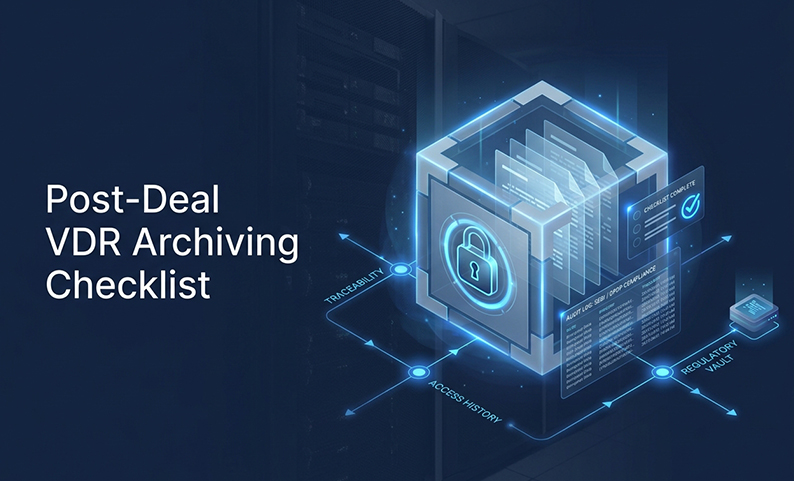
A compliance archive isn’t just a folder of PDFs. It’s the documents plus the context that makes them verifiable. Your archive must be able to answer “who saw what, and when?” without anyone digging through old emails.
While the VDR platform is your tool, your firm’s governance and internal approvals are what make the archive defensible.
Must include:
- Final document set (including all executed versions)
- Full audit trail (views, downloads, prints, with timestamps and user info)
- User list and permission history
- Q&A log and all attachments
- Record of any deleted or removed items
- An index or report that makes the archive searchable
Nice to include:
- Version history for high-risk documents
- Deal timeline notes (key dates, permission changes)
One operational note: these archives are often large. Plan for storage and transfer before you start the export.
What Is the Step-by-Step Post-Deal Archiving Checklist (Day 0 to Day 7)?
Follow this timed sequence. Each step has a clear owner to prevent it from getting lost in a group to-do list.
1. Declare “deal close” and freeze changes. Set a cutoff timestamp. Halt all uploads unless a deal lead gives specific approval.
2. Reconfirm data ownership. Clarify in writing who owns the system and who is the custodian of record post-close: the bank, the client, or counsel. This cannot be ambiguous.
3. Lock down access immediately. This is the highest-risk window. Remove all external parties not required post-close, convert remaining users to view-only, disable new invites, and enforce MFA/2FA. Document the access change with the date, time, and approver’s name.
4. Minimize the archive footprint. Before exporting, reduce unnecessary personal data. Identify folders with personal data, remove duplicates and non-required drafts per your policy, and redact where needed (with documented review sign-off).
5. Generate the compliance archive package. Using admin-level privileges, export all documents, logs, Q&A records, indexes, and reports. This ensures nothing is omitted.
6. Verify completeness and integrity. Do not skip this step. Compare file counts to your index, spot-check high-risk folders, and confirm the audit trail covers the entire deal period.
7. Store securely with retrieval controls. Restrict archive access to a small, defined group. Retrieval should require approval from a compliance officer or function head.
8. Create the archiving record. This is the memo that makes your archive defensible. Include the purpose end date, legal basis for retention, retention period, destruction trigger, and approver names.
9. Set the destruction workflow. Calendar a review date and enter the destruction trigger in your register. Require documented approval before any destruction happens.
Who Should Own What: A Simple Responsibility Matrix
| Task | Deal Lead / AVP | Analyst / Deal Ops | Compliance / Risk | Legal Counsel |
|---|---|---|---|---|
| Access lockdown (Day 0–1) | Accountable | Executes | Notified | Consulted |
| Archive export | Accountable | Executes | Notified | — |
| Completeness verification | Approves | Executes | Reviews | — |
| Retention decision & documentation | Consulted | — | Accountable | Accountable |
| Secure storage setup | Approves | Executes | Notified | — |
| Retrieval approvals (post-close) | — | — | Accountable | Consulted |
| Destruction approvals | Consulted | — | Accountable | Consulted |
The principle is simple: one person is accountable for the archive, and one is accountable for responding to regulators. If it’s unclear who responds when SEBI asks for the deal file, the matrix isn’t done.
What Are the Most Common Post-Deal Archiving Failures?
Leaving the VDR open “just in case.” → This creates ongoing leak risk and zero audit clarity on post-close access. → Fix: Set a hard close date and maintain a documented exception list for any continued access.
Archiving only documents, not Q&A and logs. → This leaves you with no defensible trail of the communications that shaped the deal. → Fix: Require a full compliance archive contents list before sign-off.
No proof of who approved retention decisions. → This creates DPDP Act exposure if personal data is kept without a documented legal basis. → Fix: The archiving record must include approver names for every retained data category.
Archive that can’t be searched quickly. → This leads to missed deadlines on regulatory requests. → Fix: Maintain an indexed export and define a retrieval SLA.
Destruction never happens. → Data hoarding increases risk over time, especially for old personal data without a legal basis for retention. → Fix: Schedule periodic reviews and use a destruction register with documented approvals.
How Do You Make This Repeatable Across Deals?
A one-off checklist isn’t enough. You need a standard process that every deal follows.
- Create reusable templates for your archiving record, access exception list, and verification checklist.
- Define “close readiness” as a deal deliverable. Post-deal archiving belongs in the deal plan, not as an afterthought.
- Use VDR-native controls to reduce manual work. Centralized Q&A, permissioning, and audit exports mean less reconstruction work when you close down.
The goal is a simple SOP that a new analyst can follow without constant supervision.
Summary and Next Steps: What to Do on Your Next Deal Close
Within seven days of close, produce a compliance archive and archiving record and lock down access. This lets you prove you’re compliant, not just hope you are.
- Day 0–1: Declare close, freeze changes, and revoke external access.
- Day 2–3: Minimize the data footprint and export all documents, logs, and Q&A.
- Day 4–5: Verify completeness and move the archive to secure storage.
- Day 5–7: Complete the archiving record with retention decisions and approvers.
- Ongoing: Schedule and document destruction reviews.
Your immediate next step: assign a named owner for the archive and set the deadline in the deal calendar.
FAQ
What’s the difference between a “data archive” and a “compliance archive”? A data archive is just storage. A compliance archive is storage plus evidence: audit trails, user logs, Q&A, and permission history. The difference is crucial when a regulator asks for proof, not just files.
Do we need to archive Q&A threads and comments? Yes. Q&A threads contain clarifications and representations that shaped the deal. Archiving documents without them leaves critical gaps in the evidence record.
How long should we retain VDR data for SEBI-related transactions? Retention periods depend on the transaction type and specific SEBI regulations. Confirm these periods with your compliance team and legal counsel.
Under the DPDP Act, can we retain personal data after a deal closes? Only when there’s a documented legal basis, such as a statutory obligation or regulatory requirement. Without a clear legal basis, you create exposure.
Who should have access to the compliance archive? A small, defined group, typically a deal lead, compliance officer, and legal counsel. Broad access defeats the purpose of locking down the VDR.
Should we delete or redact personal data before archiving? Where personal data is not required for the retention purpose, you should minimize it before archiving. Use redaction tools but ensure all decisions are reviewed and signed off by counsel.
Need an Audit-Ready VDR Archive Without the Analyst Scramble?
DCirrus VDR is built for exactly this moment. It offers rapid post-deal lockdown with granular permission controls, exportable audit trails for regulatory response, and centralized Q&A that keeps deal communications inside the room. Our platform helps deal teams close with a defensible, audit-ready archive, without burning analyst hours rebuilding the trail after the fact.
Book a free demo and see how DCirrus VDR can help you close your next deal with confidence.
Latest Posts


Buyer Engagement Analytics in a VDR: What Deal Teams Can Track
August 17, 2026

12 VDR Features Required for IPO Preparation in India
August 13, 2026

What Bankers and Auditors Need From an IPO VDR in India
August 12, 2026