How a VDR Supports the India IPO Journey Step by Step
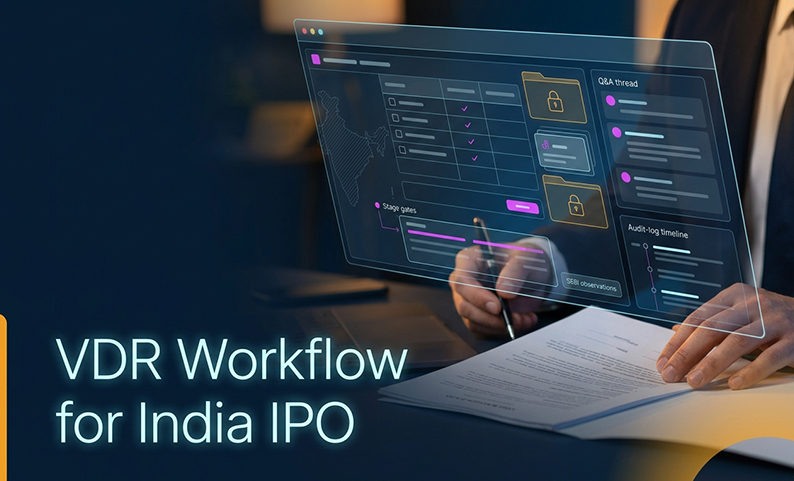
A merchant banker can have every document somewhere and still not have a defensible process. That is the real problem in an India IPO journey: email threads sprawl, permissions get too broad, versions multiply, and a missing approval or litigation update shows up only when the draft prospectus is already under pressure.
That is where a VDR for IPO helps. Not as a file dump, but as a controlled transaction workspace with evidence trail, version discipline, and stage-by-stage access control. Used well, it gives the team one place to collect source material, run diligence, manage disclosures, control investor access, and rehearse the close-to-listing handoff.
This article gives you an eight-step framework for using a VDR to support the India IPO journey, plus the controls, roles, failure points, and checklist you need to keep the deal moving.
Why a VDR for IPO works better than a shared folder
A VDR is useful because an IPO is not a static storage problem. It is a sequence of regulated handoffs where each stage needs the same four answers:
- Who can see this?
- Which version is authoritative?
- What remains unresolved?
- What evidence proves the step was completed?
That is why a VDR for IPO should be designed around control layers, not just folders.
- Information control: permissions, MFA, device and IP restrictions, download and print controls, expiry and revocation.
- Process control: requests, ownership, deadlines, Q&A, approvals, notifications, and stage gates.
- Evidence control: access history, Q&A history, superseded versions, decision records, and issue-resolution evidence.
- Disclosure control: a traceable link between the draft prospectus statement and the supporting source.
This matters because the VDR does not replace the issuer, merchant banker, counsel, auditors, registrar, or regulators. It supports them. The process still has to stand up on its own.
The eight-step VDR framework for the India IPO journey
1. How should the team set up the room at mandate award?
The room should exist before the document rush, not after the first draft is already circulating. At mandate award, the lead merchant banker should translate the timetable into a controlled workspace.
What to do
- Build a master timetable covering mandate, diligence launch, management interviews, audit deliverables, draft offer-document preparation, public comments, SEBI observations, RHP filing, issue opening and closing, allotment, demat credit, refunds or unblocking, and listing.
- Name the room owner, at least two administrators, and the escalation contact for security incidents.
- Define naming conventions, document numbering, date format, status values, and version rules before uploads begin.
- Create access groups for the issuer core team, merchant banker, legal counsel, auditors, registrar, underwriters, exchange and regulatory response team, approved investor groups, and a tightly limited executive group.
- Set the incident-response rule in advance: who can suspend a user, revoke a session, preserve logs, notify counsel, and decide whether a document must be reissued.
What matters in the VDR
- Multiple administrators
- Role-based permissions
- MFA
- Device approval
- IP restrictions
- Audit logs
- Retention and export controls
- Notifications
- Setup dashboard for incomplete tasks
What good looks like
The first external invite goes out only after the index, permissions, watermark, MFA, and escalation path have been tested.
What bad looks like
A shared admin account, broad access for everyone, and a room that keeps changing shape every week.
2. How should the team collect and structure source documents?
The best VDRs do not mirror the issuer’s local drive. They mirror the disclosure and diligence workstreams.
Recommended index
- Administration, timetable, contacts, and room rules
- Constitutional, incorporation, corporate authority, and statutory registers
- Promoters, directors, key management, group companies, and subsidiaries
- Historical financial statements, restatements, audit reports, accounting policies, and management analysis
- Tax, statutory dues, assessments, and notices
- Business, industry, products, plants, locations, customers, suppliers, seasonality, and competition
- Intellectual property, technology, property, insurance, and operational approvals
- Material contracts, related-party transactions, leases, and change-of-control provisions
- Debt, security, guarantees, borrowings, defaults, and financing arrangements
- Litigation, regulatory proceedings, investigations, penalties, and claims
- Human resources and other non-financial disclosures
- Licences, consents, sector approvals, and compliance records
- Capital structure, valuation support, use of proceeds, and issue expenses
- Diligence requests, Q&A, and evidence links
- Draft offer document, DRHP working versions, regulator comments, response matrix, RHP, and prospectus
- Registrar, exchange, allotment, listing, and close-out deliverables
What to do
- Start with a request list mapped to offer-document sections and the issuer’s sector and structure.
- Require metadata for each file: category, entity, period, owner, confidentiality, status, source, version, review date, and linked request or disclosure.
- Use statuses such as requested, uploaded, under review, query raised, response received, accepted, superseded, and not applicable.
- Keep original source files separate from redlines or scans.
- Use OCR only after checking the extracted text is accurate enough for review.
- Preserve the final file name used in the disclosure matrix.
What matters in the VDR
- Bulk upload
- Smart indexing
- Metadata search
- Version control
- Folder and file permissions
- Document preview
- Duplicate detection where available
- Exportable index
What good looks like
A reviewer can find the latest audited financial file, see its predecessor, and identify the open request without leaving the room.
3. How should the room run diligence and Q&A?
This is where a VDR for IPO earns its keep. The real benefit is not faster downloading. It is Q&A traceability.
What to do
- Assign each request a unique ID, category, owner, priority, due date, and status.
- Use separate Q&A queues for legal, financial, tax, business, regulatory, and registrar matters.
- Require answers to cite or attach the supporting document.
- Flag whether the response changes disclosure, a risk factor, a financial figure, or the timetable.
- Escalate unresolved high-risk items such as litigation, related-party matters, defaults, statutory dues, accounting changes, licences, customer concentration, contingent liabilities, and use-of-proceeds questions.
- Record why a query was closed, not just that it was closed.
- Keep an evidence-to-disclosure matrix with section, proposed wording, source file, reviewer, open issue, response, and approval status.
- Export Q&A and access records at major stage gates.
What matters in the VDR
- Centralized Q&A
- Threaded comments
- Assignments
- Notifications
- Search
- Clause recognition
- Redaction support
- Audit trails
- Document linking
- Workstream-isolated permissions
What good looks like
A high-risk issue is visible, assigned, and linked to evidence. The final disclosure can be traced back to the decision trail.
What bad looks like
An answer arrives by email, but nobody can prove which source version was reviewed.
4. How should the VDR support draft prospectus preparation?
The draft prospectus should be built from verified diligence, not from disconnected notes. The VDR should act as the evidence layer beneath the document.
What to do
- Create a disclosure matrix with section, proposed statement, materiality rationale, supporting evidence, reviewer, and approval status.
- Keep an approved evidence collection separate from the active drafting room.
- Give drafting counsel edit access to working drafts, while the broader adviser group gets read-only or comment access as appropriate.
- Use redline and comparison tools to track changes between versions.
- Preserve approved versions at each internal gate.
- Record the source and date of every financial, operating, and shareholding figure.
- Apply controlled redaction to personal data, bank details, commercially sensitive information, or privileged material.
- Run a completeness review against the offer-document categories.
What matters in the VDR
- Version comparison
- Document-level permissions
- Redaction
- Audit trail
- Search
- Annotations
- Approval workflow
- Watermarking
- Finalization or freeze function
The platform does not decide materiality, certify the prospectus, or file it. It supports the people who do that work.
5. How should the team handle public comments, SEBI observations, and revisions?
Once the draft is filed and made available through the required channels, the room needs a separate response workflow. Otherwise, regulator comments get buried in normal diligence traffic.
What to do
- Preserve the exact filed draft as read-only.
- Create a comment and observation register with source, date received, section, issue, owner, proposed response, supporting evidence, status, and approval.
- Store regulator correspondence and response drafts in restricted folders.
- Record the observation date and calculate the current validity window, with legal confirmation.
- Use a change-impact checklist so one response triggers review of related sections, risk factors, financial tables, capital structure, and issue terms.
- Mark every superseded draft as no longer current and remove it from external views without destroying the audit history.
- Before each freeze, verify the version is the same one reviewed by the responsible advisers.
What matters in the VDR
- Restricted groups
- Preserved baseline versions
- Response tracker
- Redline comparison
- Workflow approvals
- Time-stamped activity records
- Controlled external sharing
The older 21-day public-comment language is useful context, but the current issue-specific rule should always be checked before publication.
6. How should the room lock the RHP, price-band, and issue-opening materials?
This is the switch from broad diligence to tightly controlled issue readiness. For a book-built issue, the RHP is filed before the issue opens and excludes the final price and final number of securities.
What to do
- Freeze the RHP and record filing date, version, approvers, and distribution list.
- Keep price-band approval, issue schedule, issue terms, risk-factor confirmation, and final financial data in a restricted readiness folder.
- Confirm the price band disclosure timing with the current issue-specific requirement and exchange timetable.
- Prepare the final disclosure checklist covering offer documents, abridged materials, advertisements, issue forms or links, contact details, grievance process, registrar details, and exchange submissions.
- Give registrar and exchange users only the folders they need.
- Lock or archive every prior draft.
- Run a “known unknowns” meeting for pending certificates, litigation updates, financial confirmations, approvals, and issue-system dependencies.
What matters in the VDR
- Read-only publication folders
- Approval gates
- Watermarking
- Download restrictions
- Access expiry
- Controlled distribution lists
- Final-version locking
- Audit export
What good looks like
No external user sees an obsolete share count, price, or disclosure version.
7. How should the team manage investor access and roadshow collaboration?
Investor access should be separate from the full diligence room. That distinction matters more than most teams admit.
What to do
- Verify the identity, institution, role, jurisdiction, and approval status of every external user.
- Separate anchor or institutional diligence, underwriters, research analysts, legal advisers, auditors, and internal management.
- Default to read-only access and enable download only when needed.
- Use watermarking with user identity, organization, and timestamp.
- Restrict access by folder and file, not just by room.
- Remove access when the mandate or workstream ends.
- Keep Q&A in the room, not in email chains.
- Treat engagement as an operational signal, not a promise of demand.
- Explain clearly that bidding, ASBA, UPI, allotment, refunds, and demat credit happen in prescribed issue systems, not in the VDR.
What matters in the VDR
- Granular permission groups
- MFA
- Device approval
- IP restrictions
- Dynamic watermarking
- DRM
- Download, print, and copy restrictions
- Expiry and revocation
- Mobile and web access
- Q&A and activity analytics
A VDR can support approved information sharing. It does not process bids or move money.
8. How should the team prepare for allotment, close-out, and T+3 listing readiness?
The last stage is compressed, and the deadline is unforgiving. The public-issue listing timetable is T+3, with T as the issue closing date.
What to do
- Build a close-to-listing checklist with one owner and deadline for each registrar, exchange, issuer, merchant banker, depository, bank, and underwriting deliverable.
- Preserve the final filed offer documents and approved announcements in read-only form.
- Confirm basis-of-allotment, demat credit, refund or unblocking, and listing-application dependencies.
- Reconcile the final approved share count, issue price, allotment data, and public disclosures.
- Rehearse the actual registrar and exchange timetable.
- Retain audit records, Q&A, approvals, superseded versions, access lists, and incident records.
- Close external access in waves and preserve a final access report.
- Produce a lessons-learned report covering missing requests, late approvals, access exceptions, response times, security events, user feedback, and cost.
What matters in the VDR
- Workflow checklists
- Deadline notifications
- Role-based close-out access
- Final archive
- Exportable indexes and logs
- Revocation
- Retention controls
The VDR supports listing readiness. It does not execute allotment, refund, or listing actions.
How should you configure roles and responsibilities?
A VDR only works when ownership is explicit. The practical rule is simple: the issuer owns the content, the merchant banker owns the process, counsel owns legal review, auditors own financial evidence, the registrar owns issue deliverables, and the VDR admin owns the platform controls.
Responsibility matrix
| Work product/control | Issuer/CFO/CS | Lead merchant banker | Legal counsel | Auditors | Registrar | VDR admin/IT |
|---|---|---|---|---|---|---|
| Source-document production | A/R | C | C | C | C | I |
| Room architecture and access model | C | A/R | C | C | C | R |
| Financial evidence and restated information | A/R | C | I/C | A/R | I | I |
| Legal, litigation, and contract diligence | C | A | A/R | I | I | I |
| Diligence requests and Q&A | R | A/R | R | R | R | I |
| Disclosure adequacy and diligence judgment | C | A/R | R | R for financial matters | I | I |
| Draft prospectus version authority | A/R with advisers | A/R for transaction process | R | C | I | I |
| Regulator comments and observations | R | A/R | R | C | I | I |
| User approval, MFA, and revocation | C | A | C | C | C | A/R for configuration |
| UPSI structured-database mapping | A through compliance function | A/R for intermediary records as applicable | C | I | I | R for supporting logs |
| Allotment, refund, and listing data | C | A/R for coordination | I | I | A/R | I |
| Archive, retention, and incident evidence | A | A/R | C | C | C | R |
A means accountable, R responsible, C consulted, and I informed. This matrix is an operating model, not a replacement for the engagement letter or current law.
What failure modes should you watch for?
The most common mistakes are predictable. The good news is they are easy to detect early if you know where to look.
- The room opens too late
Trigger: the first draft is already moving by email.
Fix: create the room at mandate award and upload a controlled first batch before diligence starts. - Everyone sees everything
Trigger: access is flat across all folders.
Fix: map access by role, workstream, and purpose. - Email becomes the real Q&A system
Trigger: answers cannot be linked to requests or evidence.
Fix: keep every material answer and follow-up in the room. - “Final” has no meaning
Trigger: multiple files share the same label.
Fix: use version authority, status metadata, freezes, and superseded labels. - AI output is treated as a conclusion
Trigger: a clause or redaction is accepted without human review.
Fix: use AI for discovery and triage, then require named professional validation. - Investor access is too broad
Trigger: the investor room inherits the full diligence room.
Fix: create a separate approved-material room with need-to-know permissions. - The access log is mistaken for the UPSI database
Trigger: the team cannot identify what was shared and with whom.
Fix: map vendor fields to the intermediary’s structured digital database and get compliance sign-off. - Controls are assumed, not tested
Trigger: no revocation or external-user test exists.
Fix: run browser, mobile, download, watermark, and expiry tests before go-live. - The T+3 window is not rehearsed
Trigger: the close-to-listing checklist starts after issue closure.
Fix: rehearse the registrar and exchange handoffs in advance. - The room closes without evidence
Trigger: users are removed but exports are missing.
Fix: preserve access, Q&A, and final-version records under retention and legal hold rules.
How do you measure whether the room is actually helping?
Do not measure success by claiming the VDR “worked.” Measure it by whether the transaction became easier to control.
Useful internal metrics include:
- time from mandate to room launch
- percentage of requested documents received by due date
- median age of open high-priority Q&A
- percentage of Q&A answers with linked evidence
- number of duplicate, superseded, or misclassified files
- time to approve, change, or revoke external access
- number of access exceptions and failed control tests
- time to produce an audit or Q&A export
- percentage of disclosure-matrix rows with an approved source
- number and age of unresolved regulator observations
- time from issue close to each listing-readiness handoff
- security incidents, near misses, and unapproved downloads
- reviewer search time for a known document or clause
- cost per deal, per GB, and per active external user
- user adoption, response latency, and adviser satisfaction
Baseline the numbers on comparable deals and treat any percentage improvement as an internal result, not a guaranteed platform outcome.
Summary and next steps
The main point is simple: open the VDR before the document rush, design it around the disclosure and diligence workflow, and make every stage gate prove who saw what, which version was approved, and what remains unresolved.
That is what makes a VDR for IPO useful across the full India IPO journey. It helps the team collect and classify source documents, run traceable diligence, support the draft prospectus, control regulator responses, separate investor access, and rehearse T+3 close-out without pretending the software replaces legal judgment or regulatory responsibility.
The best next step is a pre-mandate acceptance test. Load a representative index, create the role groups, test MFA and revocation, run sample Q&A, link one disclosure to evidence, export the audit record, and rehearse the close-to-listing checklist. Baseline the time, cost, and control gaps before you claim improvement.
FAQ
When should a merchant banker open a VDR for an IPO?
Open it at mandate award or before the main diligence launch. Waiting until the draft prospectus is nearly complete sacrifices the version history and evidence trail.
Does a VDR replace the DRHP, RHP, or prospectus filing?
No. It stores and controls working material and approved copies. Filing and public dissemination still happen through the prescribed regulatory and issue process.
What is the difference between a DRHP and an RHP?
The draft offer document is prepared for regulatory review and public comments before the issue-stage document. An RHP for a book-built issue contains the relevant issue information but excludes the final price and final number of securities.
Can a VDR make an IPO SEBI-compliant?
No. It can support least privilege, evidence preservation, Q&A traceability, version control, and auditability. Compliance responsibility remains with the issuer, merchant banker, and other responsible parties.
Can investors access the VDR?
Approved investors or analysts can receive purpose-limited access to a separate investor room. That room should not expose internal drafts, privileged advice, raw UPSI, or unrelated diligence.
What security controls matter most in a VDR for IPO?
Start with MFA, individual accounts, least-privilege folder permissions, read-only defaults, device and IP controls where appropriate, watermarking, download and print restrictions, expiry and revocation, Q&A containment, version control, and exportable activity records.
What does T+3 mean for the IPO team?
T+3 means the public-issue listing timetable is three working days from issue close, with T as the closing date. The team still needs the actual registrar and exchange handoff schedule.
Does the VDR replace ASBA, UPI, or the registrar?
No. The VDR supports approved information sharing and coordination. ASBA, UPI, allotment, refunds or unblocking, demat credit, and listing happen in the prescribed issue systems.
Can AI write or approve the draft prospectus?
No. AI can help locate clauses, classify files, identify inconsistencies, and assist with redaction, but qualified reviewers must validate the material conclusions.
How should a team measure VDR ROI?
Track room-launch time, document completeness, Q&A age, search time, access administration effort, audit-export time, security exceptions, adviser satisfaction, and close-to-listing readiness. Compare comparable deals and treat the results as internal outcomes, not guaranteed vendor promises.
Need an IPO data room you can configure, test, and audit before the DRHP clock starts?
Book a free DCirrus demo to review role-based access, document controls, Q&A traceability, version management, and audit-ready workflows for a high-stakes transaction.
Latest Posts
Buyer Engagement Analytics in a VDR: What Deal Teams Can Track
August 17, 2026
12 VDR Features Required for IPO Preparation in India
August 13, 2026
What Bankers and Auditors Need From an IPO VDR in India
August 12, 2026

How a VDR Supports the India IPO Journey Step by Step
August 10, 2026