How to Use VDR Audit Trails to Defend Due Diligence in SEBI Regulatory Inquiries
You completed the diligence. The documents are in the VDR. The work was done. Then SEBI raises an observation: adequacy of diligence, version disputes, a suspected leak. Suddenly, the question isn’t “did you do it?” It’s “can you prove it, quickly and cleanly, for every party who touched the deal?”
This is where most merchant bankers get caught. Not because the work wasn’t done, but because the audit trail wasn’t built to be evidence.
This article gives you a SEBI inquiry-defense framework. It’s a 7-point workflow for VDR configuration, proactive reviews, and a pre-built inquiry bundle. The goal is to help you respond to SEBI questions in hours, not days, without derailing your deal.
What Should a VDR Audit Trail Prove in a SEBI Due Diligence Inquiry?
SEBI isn’t asking for a raw IT log. It’s asking for operational discipline: proof that you controlled access, that documents were reviewed by the right parties, that versions are traceable, and that nothing material changed without a record.
In a typical IPO or M&A process, you have more than ten external parties, from legal counsel to statutory auditors. Each group needs access to different materials. Your audit trail must show that segregation was enforced, not just assumed.
The inquiry scenarios that demand this proof most often are:
- Adequacy of diligence: Were critical documents actually reviewed by the right teams, or just uploaded and ignored?
- Document completeness: Can you show when key disclosures were uploaded and who saw them?
- Suspected leak: Can you trace exactly who accessed price-sensitive material and when?
- Version disputes: Which version of a financial schedule was current on a specific date, and who relied on it?
If your audit trail can’t reconstruct that story clearly, it doesn’t matter how thorough your work was.
What Makes an Audit Trail “Defensible” (and What Fields Must Be Captured)?
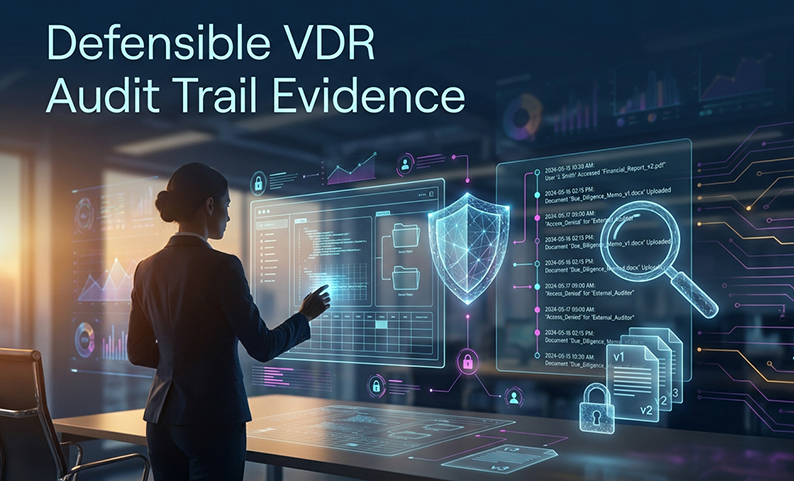
A defensible record comes from three things: granularity (the right fields), integrity (consistent, tamper-evident logging), and retrievability (fast filtering and export). If you can’t extract and explain it under pressure, it won’t protect you.
Minimum log fields to insist on:
- User identity: A named individual with their role and party affiliation (not a shared login).
- Timestamp: UTC or IST, with the time zone noted explicitly.
- Action type: View, download, upload, edit, comment, Q&A post, or permission change.
- Document identifier + version: File name, unique ID, and version number at the time of access.
- Session context: IP address and device ID where relevant.
Integrity expectations:
- Logs should be chronological and consistent, with no gaps or edits to the log itself.
- Access to the
audit trailshould be restricted. Not every user should be able to view or export it.
Retrievability:
- You must be able to filter by user, document, date range, action type, and party group.
- The export should be in a format that counsel and regulators can read, typically Excel with clear column headers.
Platforms like DCirrus VDR put this into practice. They give you granular role-based permissions, 2FA and device-level approval, IP address restrictions, and dynamic watermarking. This watermarking embeds user identity and a timestamp on every document. Paired with a comprehensive audit trail, these controls make each log entry attributable and hard to dispute.
What Is the 7-Point Audit-Trail Framework to Defend SEBI Diligence?
Think of this as your operating system. Run through it at setup and reinforce it at each diligence milestone. You’ll have defensible evidence ready at every stage.
1. Lock roles and least-privilege access Segregate parties by folder and file. Legal gets legal files. Auditors get financial workstreams. No one gets “everything” by default.
- Map party groups to folder permissions before inviting anyone.
- Review permissions at each stage gate (like pre-DRHP or post-DRHP).
- Document the permission structure itself, as it’s part of your governance record.
2. Enforce strong authentication and access conditions Reduce plausible deniability. If someone claims, “I didn’t review that document,” your log needs to be airtight.
- Require 2FA for all external parties.
- Apply device-level approval and IP restrictions for sensitive workstreams.
- Log every login attempt, both successful and failed.
3. Harden document-level controls Leakage is harder to trace when documents have no identity. Fix that before it becomes a problem.
- Apply dynamic watermarking with the user’s login, IP address, and timestamp.
- Restrict download and print rights on materials adjacent to unpublished price-sensitive information (UPSI).
- Use DRM controls to limit what people can do with files after access.
4. Make collaboration traceable Email decisions leave no trace in the VDR. If a clarification happens over email, it doesn’t exist in your audit trail.
- Keep all material Q&A inside the VDR’s built-in discussion forums.
- Use document commenting and annotation for review notes.
- If a decision must happen over email, follow it up with a VDR note documenting the outcome.
5. Standardize structure and naming Audit logs tell a coherent story only if the underlying structure is clean. A file named “Final_v7_FINAL2” in a folder called “Misc” is not a defensible document.
- Agree on a folder taxonomy before setup: financial, legal, operational, regulatory.
- Enforce consistent file naming with version numbers.
- Map workstreams to the folder structure so logs trace back to the diligence scope.
6. Review audit trails on a cadence An audit trail you only review when SEBI asks is a liability waiting to be discovered.
- Do weekly spot-checks during peak diligence and fortnightly checks during early stages.
- Before a DRHP, do a “hardening” review to confirm all critical docs have been accessed by the right parties.
- Flag anomalies immediately. Don’t let them accumulate.
7. Pre-build an inquiry-ready evidence bundle Don’t wait for an inquiry to figure out what you need to produce. Build the template now.
- Maintain a standing export format that you’ve agreed on with counsel.
- Pre-define what goes in the bundle, who assembles it, and how fast it needs to be ready.
- Treat this as a standard deliverable, not an emergency response.
How Do You Use Audit Trails to Spot Diligence Gaps Before SEBI Does?
The audit trail isn’t just a retrospective record. Used proactively, it’s an early-warning system for the exact gaps that generate SEBI observations.
Signals to look for during your weekly review:
- Key documents with zero views from the right reviewer group. For instance, legal uploaded a disclosure schedule, but no auditor has opened it.
- Late-stage bulk downloads by unexpected roles, like a party that shouldn’t be pulling large volumes at that stage.
- Critical documents with multiple versions and no traceable rationale. Revisions happened, but there’s no Q&A thread explaining why.
- Approvals that happened over email, which means the VDR shows no corresponding review activity for a material decision.
Fix actions when you find a gap:
- Assign a named owner to chase the missing review and confirm its completion.
- Move any open clarifications into the VDR’s Q&A to create a traceable record.
- Tighten permissions on any sensitive folder that had unexpected access.
DCirrus VDR supports this proactive review with built-in Q&A forums, version control, and audit trail exports to Excel (including usage graphs). This makes it faster to spot patterns without manually scanning logs line by line.
What Implementation Workflow Keeps You “Inquiry-Ready” Without Slowing the Deal?
A consistent operating rhythm prevents the last-minute scramble. Keep it simple: three roles, a clear cadence, and defined outputs.
Roles:
- VDR admin / compliance lead: Owns permissions, runs log exports, flags anomalies, and maintains the evidence bundle.
- Workstream owners (legal, finance, business): Confirm their section’s completeness, close open Q&A threads, and flag version changes.
- Partner or senior reviewer: Does a weekly exception review of only the flagged items, not every log line.
Cadence:
- Weekly during peak diligence:
audit trailspot-check and exception list review. - Pre-DRHP hardening: A full permissions audit, confirming all critical docs have been accessed.
- Post-DRHP: Monitor for unusual access patterns and tighten controls on UPSI-adjacent folders.
Standard outputs:
- An exception list (missing reviews, unaccessed documents, open Q&A).
- A version-change summary for key financial and disclosure documents.
- An access summary for sensitive folders showing who accessed what and when.
What Should Your “SEBI Inquiry Bundle” Include (and How Do You Export It Fast)?
When SEBI asks, you need to respond in hours. Pre-assembling a standardized export pack is the only way to do that.
Bundle components:
- Master index: A full folder and file map with document IDs and version numbers.
audit trailextract: Filtered by the relevant date range, workstream, and user groups, not the entire raw log.- Key document timeline: A summary of uploads, revisions, and access milestones for the 20-30 documents most likely to be scrutinized.
- Q&A log export: A summary of material clarifications, especially for contentious disclosures.
- “How to interpret these logs” note: A one-page guide to action types, field labels, and user groups (written for counsel or a regulator who didn’t set up the VDR).
DCirrus VDR supports fast assembly through its export functionality. It creates indexes with clickable file links and usage graphs directly in Excel. This gives you a structured, navigable pack, not a raw data dump that needs hours of reformatting.
Practical tip: Agree on the export format with counsel before the first inquiry. Consistency from deal to deal means a faster response and no improvising under pressure.
What Are the Most Common Audit-Trail Mistakes That Trigger SEBI Pain?
Most failures aren’t software problems. They’re operational.
The mistakes:
- Over-broad permissions: When everyone can download everything, the log proves nothing about controlled access.
- Diligence happening over email or WhatsApp: These material decisions leave no trace in the VDR.
- No version discipline: Using file names like “Final_v3_REVISED_NEW” with no formal versioning in the system.
- Logs exist but aren’t reviewed: The evidence of a gap was there, but no one looked at it until SEBI asked.
- Unclear retention: Logs are stored somewhere, but finding and exporting them quickly isn’t straightforward.
Prevent them with a pre-flight check:
- Review and tighten permissions before any external party is invited.
- Mandate VDR Q&A for all material document queries, with no exceptions.
- Start your weekly exception review from day one.
- Define your retention and archiving approach before the deal closes.
Summary and Next Steps: How Do You Operationalize Audit Trails as a Defensible Diligence Asset?
An audit trail that can’t be quickly extracted, explained, and tied to your diligence process isn’t a compliance asset. It’s a liability waiting to be exposed. The 7-point framework treats your audit trail as what it actually is: defense-grade evidence that reconstructs who saw what, when, what changed, and what controls were in place.
Your single next step: Run a permissions and logging pre-flight on your current VDR setup. Schedule your first weekly audit trail review. And build the inquiry bundle template before you need it. Do those three things now, and you’ll be inquiry-ready by default, not by emergency.
Frequently Asked Questions
What’s the difference between a basic activity log and a defensible audit trail? A basic log just records that something happened. A defensible audit trail proves who (named user, role), what (document ID, version), when (timestamp), and how (action type, IP address). This information must be in a format that you can filter, export, and explain under pressure.
How often should we review audit trails during an IPO diligence cycle? Weekly during peak diligence and fortnightly during early-stage document collection. You should also add a full review at the pre-DRHP “hardening” point to confirm all critical documents have been seen by the right parties.
Which users and actions should we treat as “high sensitivity” for review? Any access to UPSI-adjacent materials like price-sensitive financials or valuation workings. Also, flag bulk downloads, late-stage access by unexpected roles, and any action taken just before a regulatory milestone.
How do audit trails help if there’s a suspected information leak? They let you reconstruct exactly who accessed which document and when, from which IP address and device. You can track activity before and after the suspected leak. This helps you either identify the source or prove your controls were solid enough to rule out the VDR as the point of failure.
Can we rely on email for Q&A and still defend diligence? No. Email decisions create a separate record that isn’t tied to the VDR log. If a material decision happens over email, the audit trail shows no review activity, creating the kind of gap that attracts SEBI observations.
What export formats make regulatory response faster? Excel exports with named columns, clickable file links, and a usage graph give counsel a navigable file, not a raw data dump. Pair it with a one-page field-definition note and a filtered extract by workstream.
How should we handle retention and archival of audit logs? Define your retention period before the deal closes, typically aligned with SEBI’s requirements. Ensure logs are archived in a retrievable format (not just stored) and that the person responsible for retrieval is named and has tested the process.
What should we ask a VDR vendor about data localization and encryption controls? Ask where data is physically hosted and if India-based data centers are an option. Ask what encryption standard is used at rest and in transit, and whether you can point data to your own cloud account. Finally, confirm the audit trail itself is protected from tampering.
Can Your Current VDR Produce Inquiry-Ready Audit Evidence, Fast?
When SEBI raises a question about your diligence, the strength of your response depends on what your VDR can produce and how quickly. DCirrus VDR provides granular access controls, dynamic watermarking, DRM, integrated Q&A, and exportable indexes with usage graphs. This is the infrastructure you need to build a defensible audit trail and package it fast, without disrupting your deal.
Book a free demo and see how DCirrus supports inquiry-ready diligence from day one.
Latest Posts
Buyer Engagement Analytics in a VDR: What Deal Teams Can Track
August 17, 2026
12 VDR Features Required for IPO Preparation in India
August 13, 2026
What Bankers and Auditors Need From an IPO VDR in India
August 12, 2026