A Merchant Banker’s Guide to VDR Pricing: Comparing Per-User, Per-GB, and Flat-Fee Models for IPO & M&A Deals
The VDR quote looked clean in week one. By week three, you had 45 users, two buyer consortiums, and a regulatory hold that pushed the timeline six weeks. This is the standard IPO and M&A story. User count grows. Data volume expands. Timelines slip. When any of those variables moves (and in live deals, all three usually do), a pricing model that looks cheap at kickoff becomes the most expensive option at close.
This is the standard IPO and M&A story. User count grows. Data volume expands. Timelines slip. When any of those variables moves (and in live deals, all three usually do), a pricing model that looks cheap at kickoff becomes the most expensive option at close.
The right VDR pricing decision comes down to two things: how volatile your deal is across users, data, and time, and how much operational friction you can tolerate.
This guide provides a 7-point Deal Volatility Checklist to match the right model to your deal, plus a negotiation checklist to lock in a fully-loaded quote before you sign.
What Makes VDR Pricing “Unpredictable” in IPO & M&A Deals?
Costs spike because deals are volatile. Most vendors have structured their pricing to capture that volatility as revenue.
- User volatility: A deal starting with 10 internal users can easily expand to 40-60 seats as counsel, auditors, and multiple buyer teams join.
- Data volatility: Initial upload estimates are almost always conservative. Updated financials and late-stage requests can push storage 3–5x beyond the original plan.
- Timeline volatility: Regulatory reviews and negotiation delays extend timelines. Many contracts respond with full-period re-billing or steep extension surcharges.
Choose your pricing model based on which of these variables is most unpredictable in your deal. The model that absorbs that volatility cheaply is the one you want.
What Are the Three Common VDR Pricing Models (and What Do They Really Meter)?
Each model shifts risk. The question is who absorbs it: you or the vendor.
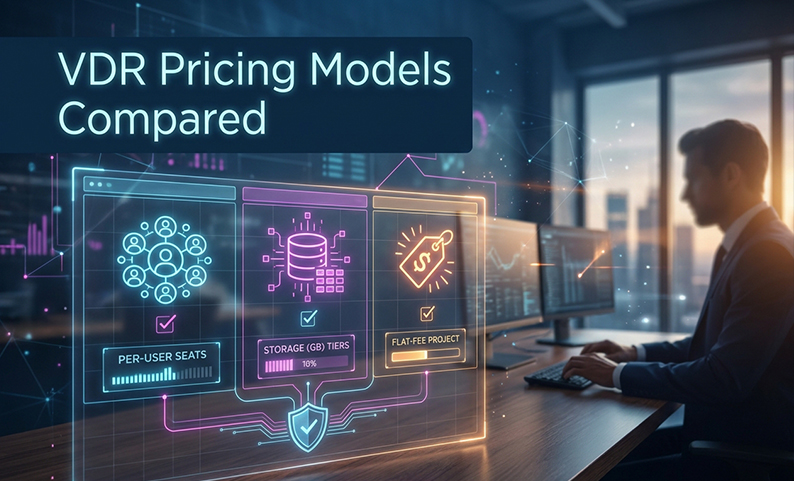
- Per-user: Monthly seat-based pricing. It’s predictable when your user count is stable but punishing when it’s not.
- Best for: Small, controlled deals with a locked stakeholder list.
- Risky when: External participants multiply mid-deal.
- Per-GB (storage-based): A monthly storage allocation with overage charges. This feels manageable early on but becomes painful when a diligence expansion doubles your document set.
- Best for: Deals with light data and no late-stage supplemental uploads.
- Risky when: Data grows on a timeline you don’t control.
- Flat-fee (room-based): A fixed fee per data room, regardless of users or storage within defined limits. Predictability is the main advantage.
- Best for: Most live IPO and M&A deals where volatility is a concern.
- Risky when: “Flat” is marketing language that still gates exports, security features, or support. Always read the contract.
How Do You Choose the Right Model? Use This 7-Point “Deal Volatility” Checklist
The right pricing model matches your volatility profile and includes required controls without overages.
- Will external users exceed 15–20? If yes, per-user becomes high-risk. Lean toward a flat-fee model.
- Will you add or remove users weekly? If yes, avoid per-seat models that require a change-order process. Predictable room pricing removes this friction.
- Is data likely to grow 3–5x from the initial estimate? If yes, per-GB is a liability. Prefer a flat-fee or a capped storage tier with a clear overage rate defined in the contract.
- Is the timeline uncertain? If yes, avoid contracts with punitive extension clauses. Insist on flat-fee with clear monthly renewal terms or a prorated extension option in writing.
- Do you need audit-grade reporting on views, downloads, and prints? If yes, confirm it’s in the base plan, not a premium add-on. This is non-negotiable for many regulated processes.
- Is Q&A volume high and multi-threaded? If yes, integrated in-room Q&A is a cost reduction tool. It cuts email sprawl and keeps an auditable record.
- Do you run more than two deals per year? If yes, an annual flat-fee or subscription plan usually reduces the cost-per-deal and administrative overhead.
What This Checklist Deliberately Ignores
- Ignore the headline monthly price until you know what’s gated behind higher tiers.
- Ignore “unlimited” claims unless the contract explicitly defines what it covers (users, storage, exports, etc.).
- Don’t treat a low price as a proxy for compliance. Security and audit features are often the first to be paywalled.
What Do Real Costs Look Like? Compare 3 Realistic Deal Scenarios
Scenario math makes pricing risk concrete.
| Scenario | Users | Data | Timeline | Best-Fit Model | Risk |
|---|---|---|---|---|---|
| A – Small, controlled | ~10 users | ~50GB | 6–8 weeks | Per-user or per-GB acceptable | Low if fees are clean |
| B – Typical mid-market | 15 internal → 40–60 total | Grows materially | ~3 months | Per-user/per-GB becomes risky | High—user growth drives overruns |
| C – IPO-style diligence | Multiple stakeholder groups | Large, frequent updates | 3–6 months | Flat-fee | Predictable; extensions manageable |
The table makes a few things clear. User count drives cost more aggressively than storage in per-user models. And Scenario B is where most bankers get burned; a deal starts small but expands, while the pricing stays painfully variable. Many advisors report significant savings on M&A projects after switching from per-user to flat-rate plans.
The table makes a few things clear. User count drives cost more aggressively than storage in per-user models. And Scenario B is where most bankers get burned; a deal starts small but expands, while the pricing stays painfully variable. Many advisors report significant savings on M&A projects after switching from per-user to flat-rate plans.
What Hidden Fees Should You Force Into the Quote Before You Sign?
Prevent budget surprises by converting vague “maybe fees” into explicit line items. Send this checklist to every vendor.
- Close-out costs: What does it cost to archive and export? Is there a fee per gigabyte exported?
- Overage triggers: Define the exact threshold and rate for extra users, GB, or rooms.
- Timeline extensions: Is an extension prorated, billed as a full new period, or a flat monthly add-on?
- Security feature gates: Are watermarking, DRM, and audit log exports in the base plan? Get a written yes or no for each.
- Support scope: Is support 24/7 or business hours? Is onboarding included?
- Storage definitions: What counts as “GB used”-active files only, or also deleted files and version history?
No vendor should hesitate to answer these questions in writing. If they do, that’s your answer.
How Do You Negotiate VDR Pricing Without Weakening Security or Process?
Negotiate for predictability, not by stripping away controls you’ll need later.
- If deal flow is steady, push for annual volume or multi-room discounts of 15–25%.
- Insist on converting variable fees into fixed structures, like user bundles or storage bands with pre-agreed overage rates.
- Ask for a predefined extension price, such as a flat monthly add-on, not a full-period reset.
- Request waivers on administrative fees for onboarding, branding, or close-out. These are commonly negotiable.
- Do not trade away security features like watermarking, DRM, or audit exports to save a small monthly amount. It’s a false economy.
How Do You Reduce Total Cost of Ownership (TCO) After You Choose a Model?
The biggest cost reduction savings come from reducing administrative drag.
Operationally, do this:
- Set role templates before you go live. Define permission sets for buyers, auditors, and internal teams to avoid dozens of individual permission tickets later.
- Centralize all Q&A inside the room. Keeping diligence Q&A in-room prevents missed commitments and creates a traceable, auditable record.
- Plan your export and audit reporting needs upfront. Decide who needs which report and when. Figuring this out under pressure at closing adds cost and delay.
Where a platform helps: DCirrus VDR is built to reduce this kind of friction. Granular permissions and audit trails cut down on management overhead. Built-in Q&A and secure messaging keep communication centralized and defensible.
For document-heavy diligence, DCirrus’s AI-powered document intelligence helps teams move through large document sets faster with features like smart indexing and AI-assisted redaction. When data volume grows mid-deal, finding the right content quickly is often more urgent than the storage cost itself. (Note: AI-assisted tools accelerate review; they don’t replace legal judgment.)
Efficient operations reduce timeline extensions, the biggest cost multiplier of all. Every week shaved off diligence is a week you’re not paying for the room.
Summary and Next Steps: What Model Should You Pick for Your Next Deal?
Volatility in IPO and M&A deals is normal. The right VDR pricing decision absorbs that volatility without creating cost overruns or operational drag.
Default to the model that buys you predictability, which is usually a flat-fee for any deal with uncertain variables. Use the 7-point Deal Volatility Checklist to validate that choice.
Then, before you sign, send the hidden-fee checklist to every vendor and require a fully-loaded quote. The vendor that answers clearly is the one that won’t surprise you.
FAQ
Is per-user pricing ever a good fit for an M&A data room? Yes, but only if the stakeholder list is small and fixed. Insist on a defined cap for external users and clear pricing tiers in the contract.
Is per-GB pricing the same as per-page pricing? Different meter, same risk. Both models penalize you for late-stage diligence expansion when data volumes grow unexpectedly.
What should be included in a “flat-fee” VDR contract? At minimum, it should define user and storage limits, Q&A functions, security features like watermarking, support hours, and terms for extension and close-out.
What’s the single biggest cause of VDR cost overruns? Unplanned user growth combined with timeline extensions. The solution is a contract that doesn’t penalize you when these normal deal events occur.
How do I estimate users for an IPO diligence process? Count every stakeholder group (internal, legal, auditors, regulators) and add a buffer. Then negotiate for a flat or bundled user plan based on that higher number.
What audit reports do merchant bankers typically need from a VDR? You need logs of views, downloads, and prints by user and document, plus user access history. Ensure these reports are included and exportable without extra fees.
Can a VDR reduce diligence timelines without sacrificing control? Yes, if it centralizes Q&A and enables fast search. A well-configured platform can compress review cycles, but it still requires a disciplined process.
Want a VDR Pricing Plan That Won’t Spike Mid-Deal?
Book a free demo of DCirrus VDR to see how granular permissions, DRM, dynamic watermarking, audit-grade reporting, and integrated Q&A can help you run a tighter IPO/M&A diligence process with predictable cost.
Latest Posts
Buyer Engagement Analytics in a VDR: What Deal Teams Can Track
August 17, 2026

12 VDR Features Required for IPO Preparation in India
August 13, 2026

What Bankers and Auditors Need From an IPO VDR in India
August 12, 2026