How to Test a VDR’s Audit Trail Integrity: 5 Stress Tests for Your Pilot Program
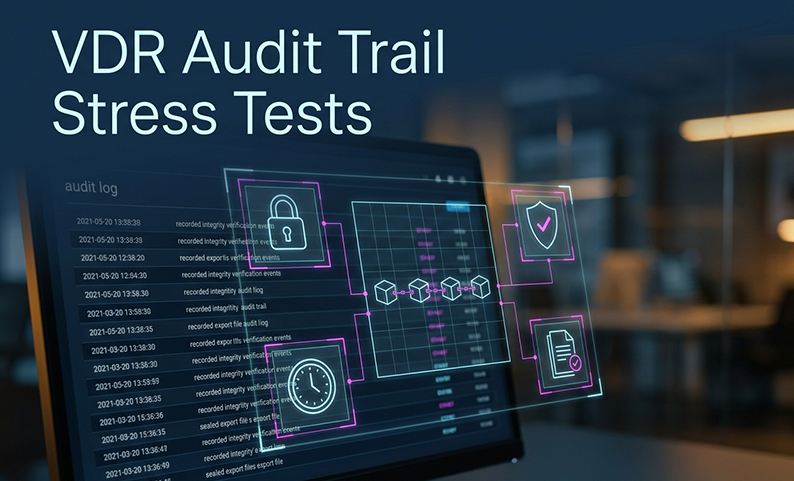
If you are running a live deal, the audit trail is not a nice-to-have report. It is the record you will need if a buyer, counsel, or compliance asks who saw what, when, and under what access rule. And if that trail is thin, editable, or impossible to export cleanly, you do not have control. You have risk.
That is why the right way to evaluate a VDR is not to read the brochure. It is to run a forensic audit pilot that pressure-tests the immutable audit trail, the user activity log, and the export path before the room ever goes live. Below is a five-step playbook you can use in a pilot to judge whether the platform will hold up for compliance reporting and real-world dispute handling.
Why audit trail testing is different from checking a feature box
A lot of vendors can say they “track activity.” That is not the same thing as proving the trail is complete, time-synced, and defensible after the fact. In a transaction, the difference matters.
A useful framework focuses on five things: immutability, completeness, accuracy, exportability, and monitoring. If a VDR fails any one of them, the log may still look polished, but it will not give you much protection when the questions get serious.
What you want in a pilot is not a demo of dashboards. You want evidence that the platform can preserve, reconstruct, and export the full history of deal activity without gaps or hand-waving.
1. Stress test immutability and tamper-evidence
A real immutable audit trail should behave like a record, not a spreadsheet. If the vendor can rewrite entries, collapse them into a mutable admin view, or keep logs too close to the document store, you do not have a trail you can trust.
Start by asking where the user activity log lives, who can write to it, and whether the vendor can prove that entries are append-only. Then ask for a verification method, not a promise.
- Confirm the audit log is stored separately from the document store.
- Ask whether the log is append-only and protected by an immutability lock or equivalent retention control.
- Request a hash-chaining or signed-manifest example that proves later edits would be detectable.
- Verify that the vendor can produce a tamper-evident export on demand.
- Check whether the vendor’s own ops team can alter historical entries after the fact.
What pass looks like
A pass means the log is separate, append-only, and protected from alteration. You should also be able to verify the integrity of the exported trail with a signed manifest or equivalent proof.
What fails looks like
A fail is a mutable log, a shared admin path with the document store, or an export that looks fine but cannot prove it has not been altered. If the vendor cannot explain how the trail resists tampering, move on.
2. Stress test completeness and granularity
A good compliance reporting story means little if the log only captures logins and document opens. You need to know whether the platform records the actual activity pattern that matters in a deal.
In the pilot, run a controlled set of actions in a test room. Then export the audit data through every available path and compare the results.
- Test login, failed login, MFA challenge, view, scroll, print, full download, page download, watermark render, upload, replace, version increment, delete, soft-delete restore, permission grant, permission revoke, group change, Q&A post, Q&A answer, audit report export, and timezone change.
- Use bulk actions, such as a large drag-and-drop upload or a bulk download, to see whether events are collapsed.
- Check concurrent sessions and VPN or IP changes.
- Export via UI, CSV, PDF, and API if the platform offers them.
- Confirm every event has the right metadata fields, including user ID, full name, email, role or group, document ID, action type, timestamp with timezone, IP address, device fingerprint, session ID, client, outcome, and denial reason where relevant.
What pass looks like
A pass means every action appears, with enough metadata to reconstruct the sequence later. The trail should be searchable and filterable by user, document, action, and time.
What fails looks like
A fail is missing page-level events, missing permission changes, or bulk activity collapsed into one line item. If the trail cannot show who did what at that level, it will not support a serious forensic audit.
3. Stress test accuracy, time sync, and identity binding
A log is only useful if you can trust the timestamps and the person attached to them. Local-time-only records, clock drift, or weak identity binding will create confusion fast, especially across multiple firms and time zones.
Ask the vendor how the platform synchronizes time and whether it uses UTC with a trusted NTP source. Then verify identity binding through SSO and a real control event.
- Confirm the server time is synchronized to UTC through NTP.
- Check for sub-second drift or a documented tolerance that is tight enough for deal work.
- Set a controlled access denial at a specific UTC time and compare the recorded timestamp.
- Confirm each event ties to a specific human user, not just a service account.
- Verify email, role, and group fields stay consistent across events.
- Check whether originating IP and device details are logged, especially when users switch networks or use VPNs.
What pass looks like
A pass means the timestamps reconcile cleanly, the identity is stable across the session, and the log shows the originating context clearly. That is what makes the trail credible in a dispute.
What fails looks like
A fail is drift, inconsistent identity fields, or IP data that disappears behind a shared egress address without explanation. Once you see that, assume reconstruction will be messy later.
4. Stress test forensic exportability and chain of custody
This is where a lot of platforms look fine until you actually need the evidence. A PDF screenshot of activity is not enough. You want exports that can stand on their own and be verified later.
In the pilot, export the trail in every format the platform supports. Then open those files in a clean environment and see whether they preserve the details you need for review and production.
- Export CSV, PDF, JSON, or XLSX if available.
- Confirm each export includes original timestamps with timezone, full event metadata, and a hash or signature mechanism.
- Check for a unique export ID, export timestamp, and the identity of the user who exported it.
- Look for a signed manifest or authenticated bundle that can be verified independently.
- Test whether tampering breaks the signature or manifest.
- If re-import is supported, verify that the export can be brought back into the platform for legal-hold review.
What pass looks like
A pass means you can verify the export outside the platform and trace it back to a specific export action. That is the difference between a convenience report and usable evidence.
What fails looks like
A fail is PDF-only output with no structured data, no signature, and no chain-of-custody detail. That is not enough for serious compliance reporting or downstream review.
5. Stress test continuous monitoring, alerts, and retention
An immutable audit trail is only part of the picture. You also need the platform to flag unusual behavior, retain records for the right period, and make review practical at deal scale.
Set alert rules in the pilot and test them with live events. Then check whether the system actually surfaces the behavior you care about.
- Create alerts for repeated failed logins, bulk download activity, bulk permission changes, audit log exports, new IP or device use, geolocation anomalies, and permission changes outside business hours.
- Test how fast alerts arrive and through which channel.
- Verify whether alerts deduplicate properly or spam the team.
- Confirm retention settings, project-level extension options, and any immutable storage tier with retention lock.
- Test SIEM export if your team uses one.
- Run a search on a large event set and check how quickly the platform can return a specific user, document, action, or time range.
What pass looks like
A pass means alerts fire reliably, retention is configurable for the deal, and search remains usable even as event volume grows. That is what keeps the log operational, not just compliant.
What fails looks like
A fail is fixed retention, no SIEM integration, missed alerts, or search that takes forever once the room gets busy. At that point, the trail may exist, but it will not be practical.
Implementation roles and responsibilities
You do not need a huge team to run this pilot well, but you do need clear ownership. The worst version of a VDR pilot is when everyone assumes someone else checked the logs.
| Activity | Deal team | Compliance / InfoSec | Vendor success | External counsel |
|---|---|---|---|---|
| Define audit-trail requirements | R | A | C | C |
| Configure alerts and retention | C | R | A | — |
| Run stress tests | R | A | C | C |
| Validate export formats | R | R | A | C |
| Sign off on tamper evidence | — | R | A | C |
| Train the team on log interpretation | A | C | R | — |
R = Responsible, A = Accountable, C = Consulted.
Common failures to watch for
Most bad audit trails fail in predictable ways. If you know the traps, you can catch them during the pilot instead of after a problem surfaces.
- Login-only logs that miss page-level or document-level actions.
- Timezone drift or logs written in local time without a clear offset.
- Permission changes that do not generate a visible event.
- Watermarks that exist on the file but are not tied back to the actual download event.
- Soft-delete or restore actions that are not captured cleanly.
- Bulk activity collapsed into one summary event.
- No audit-of-the-audit, meaning you cannot see who accessed or exported the log itself.
- Retention that ends when the deal ends, which is not enough for many regulated use cases.
If you see more than one of these, you should treat it as a real warning sign, not a minor configuration issue.
Summary and next steps
If you want a VDR to support a serious transaction, do not ask whether it has audit logs. Ask whether those logs are complete, time-synced, exportable, and hard to alter. That is the standard that matters in a contested deal.
The simplest next step is to run these five stress tests in your pilot before you commit the platform to live work. If the vendor can pass them, you have something you can trust for forensic audit readiness and compliance reporting. If not, keep looking.
FAQ
What is an audit trail in a VDR?
It is a chronological, tamper-resistant record of user and system actions inside the data room, such as logins, document views, downloads, permission changes, and exports.
How do you test a VDR’s audit trail integrity?
Run controlled user actions in a pilot, then check whether the audit data is complete, time-synced, exportable, and protected against alteration.
What should a VDR audit trail capture?
At minimum, it should capture who acted, what they did, when they did it, where they did it from, and what object or document was affected.
What is the difference between an audit trail and an activity report?
An activity report is usually a presentation layer. An audit trail is the underlying record that can be used for reconstruction, compliance, and evidence handling.
How long should a VDR audit trail be retained?
That depends on the deal and regulatory context. Some regulated environments require multi-year retention, so the platform should let you configure retention accordingly.
What is hash-chaining for audit logs?
It is a method that links each log entry to the previous one with a cryptographic hash, so later edits become detectable.
Can a VDR vendor alter its own audit logs?
A defensible platform should not let vendor ops alter history after the fact. If they can, the trail is much weaker.
Do all VDRs support SIEM streaming?
No. You should verify whether the platform can export or stream logs to your SIEM if that matters to your monitoring process.
How do you prove a VDR audit log has not been altered?
Look for a signed manifest, hash chain, or equivalent verification method, then test whether tampering breaks the proof.
What is the safest way to use the audit trail in a pilot?
Test it as evidence, not as a dashboard. If it can survive controlled stress, exports, and review, it is much more likely to hold up later.
Book a free demo
Want a VDR that gives your team stronger security, cleaner auditability, and less manual cleanup in the middle of a deal?
Book a free demo to see how DCirrus helps teams manage confidential transactions with granular access control, dynamic watermarks, and comprehensive audit trails.
Latest Posts

Buyer Engagement Analytics in a VDR: What Deal Teams Can Track
August 17, 2026

12 VDR Features Required for IPO Preparation in India
August 13, 2026

What Bankers and Auditors Need From an IPO VDR in India
August 12, 2026

How a VDR Supports the India IPO Journey Step by Step
August 10, 2026