VDR Features Merchant Bankers Need for IPO and M&A Execution
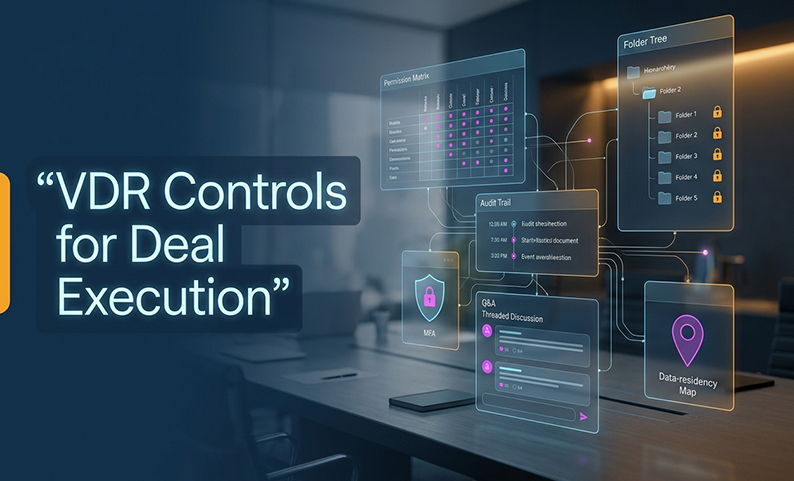
A live IPO or M&A process rarely breaks because there are “too many files.” It breaks because the wrong person sees the wrong folder, a download escapes control, a question gets lost in email, or nobody can prove who accessed what when the audit comes. For a SEBI-registered merchant banker, that is not just messy. It slows the deal, weakens confidence, and leaves the team scrambling under deadline pressure.
That is why a virtual data room for IPO and M&A should be treated as a transaction-control system, not a storage box. The right test is whether it supports controlled stakeholder access, defensible evidence, structured Q&A, data-location governance, and rapid coordination across live workstreams. This article gives you a practical framework to evaluate VDRs the way a deal team actually uses them.
What makes this framework different?
Most VDR comparisons start with features. That misses the real failure points.
A merchant banker needs a room that holds up across concurrent mandates, bidder groups, advisers, and regulatory handoffs. So the evaluation has to follow the order a deal can fail: isolate rooms, lock down identity, control documents after viewing, capture evidence, route questions cleanly, verify data handling, and test recovery and exit. Storage alone does not solve any of that.
1. Can the VDR isolate each live mandate and stakeholder group?
The first question is simple: can one deal stay completely separate from another?
For a team running several rooms at once, controlled stakeholder access starts with room separation. If a platform makes inherited permissions easy, it also makes accidental exposure easy.
Test for:
- Separate workspaces for each mandate
- No default cross-room visibility
- Separate bidder or investor groups
- Per-room administrators
- Permission templates that do not carry users forward by accident
- A room dashboard that shows unusual access, bulk downloads, and unanswered questions
What failure looks like:
- The vendor says permissions are configurable, but cannot prove room isolation
- A user invited to the wrong group can still discover a restricted file through search or notifications
2. Does identity control really enforce least privilege?
A strong login is not enough if authorization is too broad. The platform has to deliver controlled stakeholder access at the folder, file, and action level.
That means the right person gets the right view for the right time window. Nothing more.
Test for:
- Role-based groups for bankers, issuers, lawyers, auditors, bidders, and observers
- File and folder controls for view, download, print, copy, upload, share, and admin
- Clear deny behavior when parent and child permissions conflict
- Expiry dates on invitations
- Immediate revocation for individuals, groups, devices, and domains
- Permission-change history
- Preview of effective access before sending an invite
- No shared credentials
What failure looks like:
- “Read-only” exists, but descendant folders are still exposed
- Access can be removed only manually, with no proof trail
3. Are external-user authentication and device controls strong enough?
Diligence users come from different firms, devices, and networks. If access is too weak, you create leakage risk. If it is too rigid, the team moves back to email.
The goal is a workable control layer that does not stall the deal.
Test for:
- MFA for every external user
- Device approval or device binding
- IP or network restrictions where practical
- Session timeout and forced logout
- Reauthentication for downloads or other high-risk actions
- Login alerts and failed-login monitoring
- A clean emergency path to disable a user or revoke a device
What failure looks like:
- A blocked login cannot be explained
- A legitimate user needs helpdesk intervention for basic access
- Passwords or credentials are sent by email
4. Can the platform control documents after they are viewed or downloaded?
This is where many rooms overpromise. Digital Rights Management reduces leakage risk, but it does not make leakage impossible. It should be treated as risk reduction and evidence, not as magic.
For a virtual data room for IPO and M&A, the important question is whether the platform still controls use after the document leaves the browser.
Test for:
- Printing, copying, sharing, and download restrictions
- Expiry dates on downloaded files
- Remote revocation behavior, including offline behavior
- Dynamic watermarks with user identity, timestamp, and IP where appropriate
- Watermarks visible on view, download, and print output
- A clear distinction between browser controls and screenshot or camera risk
What failure looks like:
- A file can be downloaded with no expiry or traceability
- The platform advertises control, but cannot demonstrate what happens after revocation
5. Does the audit trail prove actions, not just traffic?
A dashboard that counts views is not the same as an audit trail. A proper record should show who did what, to which document, when, and from where.
That matters because a merchant banker may need to reconstruct access for a client, lawyer, auditor, regulator, or counterparty.
Test for:
- Login, MFA, invite, revoke, and session events
- Upload, view, download, print, copy, move, delete, replace, and version changes
- Permission changes and admin actions
- Search events where recorded
- Q&A activity
- Export into a durable format
- Time-zone explicit timestamps and tamper-evident records
What failure looks like:
- The vendor shows a colorful activity screen but cannot export raw events
- You cannot tell a preview from a download or prove who changed access
6. Is Q&A truly controlled, or just email in disguise?
This is one of the biggest operational differences between a serious platform and a shared drive. The room should keep questions, approvals, and answers inside one record.
For a deal team, structured Q&A is not a convenience. It is a control layer.
Test for:
- Category-based routing
- Unique question IDs
- Ownership, due dates, and status tracking
- Approval before release for legal or sensitive answers
- Bidder-specific visibility where required
- Links between answer, source document, and version
- Exportable Q&A history at close
What failure looks like:
- The team still runs the process in email chains
- Multiple answers exist with no clear release history
- A revised document changes the answer, but the question is never reopened
7. Can the room support review, search, and intelligence without losing version control?
Search should help the team find what matters faster. It should not create false confidence around duplicated, unreadable, or superseded files.
The practical test is whether the platform can organize content cleanly enough for human judgment to work.
Test for:
- Stable indexing with document title, section, entity, date, version, and status
- OCR for scanned PDFs
- Full-text search across documents and spreadsheets
- Clause recognition
- Duplicate detection and version visibility
- Search results that respect permissions
- Human review controls and source references
What failure looks like:
- Search finds the wrong clause because the OCR failed
- Restricted documents leak through title or snippet
- Superseded versions appear as if they were current
8. Can the provider prove data residency and cloud boundaries?
“Hosted in India” is not the whole answer. A SEBI-linked transaction platform has to raise harder questions about primary content, replicas, backups, logs, keys, support, and subprocessors.
That is especially important when you are evaluating a virtual data room for IPO and M&A under real deadline pressure.
Test for:
- Exact region choices for content, replicas, backups, and logs
- Key-management design and where keys are handled
- Subprocessor and support-access disclosure
- Incident cooperation and forensic access
- Data-return and exit procedures
- A contract that matches the architecture
What failure looks like:
- The homepage says “data localization,” but the support model is unclear
- The vendor cannot show where logs or recovery copies live
9. Can the room support the issuer, lawyers, auditors, and bidders without confusion?
A good deal room makes accountability visible. A bad one creates hidden channels and side conversations.
The best platforms let the merchant banker orchestrate the process while each stakeholder owns its own content and approvals.
Test for:
- Controlled issuer upload and approval lanes
- Legal access limited to legal documents and legal Q&A
- Financial and tax access scoped to their workstreams
- A formal exception log
- Clear rules for when answers need issuer or legal approval
- Bidder instructions that keep questions inside the room
What failure looks like:
- Everyone has broad access because it is easier
- Urgent issues move outside the room and never come back with a clean record
10. Does the platform automate the right work?
Automation should remove repetitive admin, not replace judgment.
The useful kind includes invitations, expiry, reminders, routing, version alerts, and report exports. The risky kind auto-releases answers or grants access too broadly.
Test for:
- Invitation and expiry workflows
- Bulk changes with preview and approval
- Q&A routing and overdue reminders
- New-version alerts
- Standard reports for access, activity, and readiness
- A close-out workflow that freezes content and exports evidence
What failure looks like:
- One click makes too many changes
- Nobody can explain what an automated action changed
Implementation sequence for a live mandate
If you want this to work in practice, follow a simple sequence.
- Define the control objective
- Name the deal, stage, jurisdictions, and user groups
- Separate working material, issuer-approved disclosure, bidder-specific content, and archive
- Design the index and roles
- Build the index from the workstreams
- Assign owners and backups
- Set permissions, watermark rules, and approval gates
- Load and check content
- Scan for duplicates, corrupt files, wrong versions, and missing pages
- Run OCR validation
- Mark restricted or confidential material clearly
- Test access
- Check MFA, device approval, expiry, and revocation
- Run a wrong-group test and a restricted search test
- Run Q&A
- Route by category
- Require approval where needed
- Reconcile answers against new uploads
- Freeze and hand off
- Export permissions, activity, Q&A, and content
- Revoke access
- Reconcile the room with recordkeeping and repository handoff
Who owns what?
| Activity | Merchant banker | Room team | Issuer | Lawyers | Auditors/advisers | VDR provider |
|---|---|---|---|---|---|---|
| Room separation | A | R | C | C | C | C |
| Permissions matrix | A | R | C | C | C | C |
| Content approval | A | R | R/C | C | C | I |
| Legal Q&A release | A | R | C | R | I | I |
| Identity and device policy | A | R | I | I | I | R/C |
| Audit-log testing | A | R | I | C | C | R |
| Incident escalation | A | R | I | C | C | R |
| Archive and handoff | A | R | C | C | C | R/C |
A = accountable, R = responsible, C = consulted, I = informed.
Common failure modes to catch early
The fastest way to reduce risk is to look for predictable mistakes before the room opens.
- Wrong bidder sees a folder
- Fix with effective-permission testing and group isolation
- Former adviser stays active
- Fix with expiry dates and weekly roster review
- Email becomes the Q&A system
- Fix with mandatory in-room question handling
- Audit reports are incomplete
- Fix by testing raw export, retention, and event coverage
- Downloaded files escape control
- Fix with view-only defaults, watermarking, expiry, and revocation tests
- Search misses or leaks content
- Fix with OCR checks, version control, and permission-aware search
- Data residency is assumed, not proven
- Fix with architecture evidence for content, logs, keys, and support
Summary and next steps
The right way to evaluate a VDR is to ask whether it can run a deal cleanly under pressure, not whether it has the longest feature list. For a SEBI-registered merchant banker, the priority is a room that supports controlled stakeholder access, auditability, Q&A governance, data handling discipline, and fast coordination across all live parties.
The single best next step is to run one realistic simulation before selection: two concurrent rooms, two bidder groups, a restricted folder, a revoked device, a downloaded file, a legal Q&A approval, a version change, a search test, an audit export, and a data-location check. The platform that proves control with the least manual effort is the one worth trusting.
FAQ
Is a commercial VDR required by SEBI?
No. The reviewed material does not prescribe a named commercial VDR. It does require records, preservation, repository handling, and availability for supervision.
Is the working VDR the same as the SEBI repository?
No. The working room supports collaboration and diligence. The repository is a separate handoff and preservation process.
What is the minimum access model for a bidder?
Use a named user, MFA, a bidder-specific group, view-only access where possible, an expiry date, and only the disclosed folders.
Can DRM guarantee that a downloaded file will never leak?
No. It can reduce risk and improve traceability, but it cannot prevent every capture method.
What should an audit report prove?
It should show the user, organization, object, action, timestamp, and relevant permission or Q&A event, in an exportable form.
Does India-region hosting automatically satisfy every requirement?
No. Ask separately about content, backups, logs, keys, support, subprocessors, and disaster recovery.
How should legal Q&A be controlled?
Route it by category, keep bidder visibility separate, require approval before release, and link the answer to the source document and version.
How should AI search be used in diligence?
Use it to find likely clauses and speed review, but keep human judgment in the loop and require permission-aware results.
What should be tested before selecting DCirrus?
Run a realistic pilot covering room isolation, permissions, revocation, DRM, Q&A, OCR search, audit export, data-location evidence, and close-out.
What pricing question matters most?
Ask for the total cost of the expected room under base, extended, and peak scenarios, including support, storage growth, exports, and close-out.
Can your next deal room prove who saw what?
https://www.dcirrus.com/request-a-demo/ VDR demo to test granular permissions, Q&A governance, audit exports, document intelligence, watermarking, and transaction-room workflows against a realistic IPO or M&A scenario.
Latest Posts
How Long It Takes to Launch a VDR for an IPO Mandate
August 06, 2026
VDR Features Merchant Bankers Need for IPO and M&A Execution
August 05, 2026
Top Deal Management Features to Look for in a VDR
August 03, 2026