A Defensible Process for Managing VDR Access Requests and Revocations Mid-Deal
Three weeks into a deal, a new auditor joins, a bidder drops out, and legal counsel is replaced. Suddenly your VDR has people who shouldn’t have access and one person who urgently needs it, with no clear process for who approves the changes.
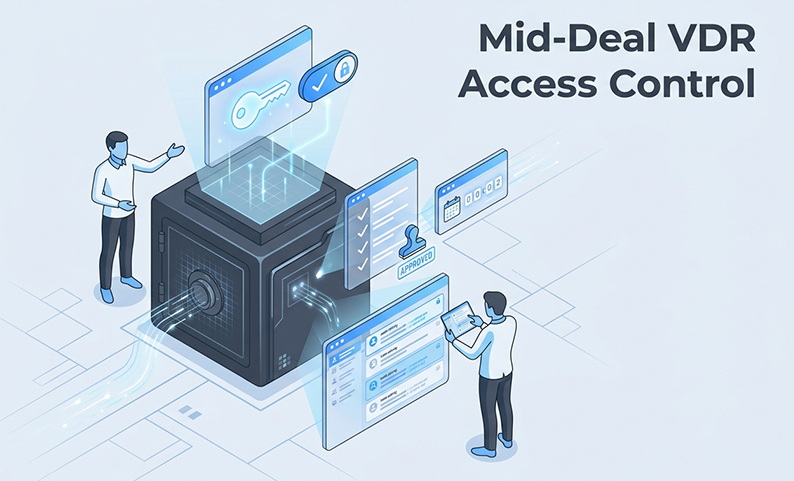
This is where deals leak. It’s not during the initial setup, it’s in the middle of diligence when access changes constantly and the process becomes informal. Think of mid-deal access governance as a deal-risk control, not just an administrative task. The only defensible approach treats access as dynamic. You must be able to grant, adjust, and revoke access in response to deal events, with a clear record of who approved what at every step.
Why Mid-Deal Access Changes Are Where Deals Leak (and Audits Fail)
Initial VDR setup gets all the attention, but mid-deal changes often don’t. A bidder gets added to a folder via a chat message. Someone’s access isn’t removed when their firm rotates personnel. These aren’t edge cases. They are the normal trajectory of any complex deal, and they create silent risk.
What “Defensible” Means in Practice
“Defensible” means you can reconstruct, on short notice, exactly who had access to what, when, and who approved it. Every single access change (request, grant, adjustment, or revocation) needs a clear record. If you’re pulling evidence for a regulatory inquiry from chat logs and emails, your process isn’t defensible. A defensible process captures its own evidence using tools like a VDR’s comprehensive audit trails and dynamic watermarking.
The Two Failure Modes: Slow Approvals vs. Uncontrolled Access
Most teams fall into one of two traps. The first is bottlenecked approvals, where access requests sit with one person and slow down diligence. The second is uncontrolled access, where requests get approved informally with no documentation or expiration date. Both are serious audit liabilities. The process below is designed to eliminate them.
The Mid-Deal Access Governance Model: Event-Driven, Not Admin-Driven
The core shift is to stop treating access governance as a background administrative function. Start running it as an event-triggered process tied to deal milestones and risk signals.
The Three Control Goals: Speed, Least Privilege, Evidence
Every access decision should be evaluated against three criteria:
- Speed: Can the right person get access quickly when the deal demands it?
- Least privilege: Is access scoped to exactly what the person needs and nothing more?
- Evidence: Will this change produce a record that holds up under scrutiny?
If your process fails on any of these, you have a governance gap.
Where Most Teams Go Wrong with “RBAC-Only” Governance
Role-based access control (RBAC) is the foundation, not the complete solution. RBAC defines what groups exist, but it doesn’t tell you what to do when someone’s role changes mid-deal. Teams that rely only on RBAC find that permissions drift, orphaned accounts linger, and the room’s access state no longer matches deal reality.
The 7-Point Checklist for Access Requests and Revocations Mid-Deal
This is your operating framework. Apply it as a repeatable process across every deal.
1) Define “Change Triggers” That Require an Access Decision
You need to know when to act. Build a list of events that automatically require an access review:
- A new party enters the process (bidder, lender, etc.).
- A party exits or is eliminated.
- Deal scope expands or a new data set is created.
- A team member is replaced or a firm rotates personnel.
- A deal milestone is reached, like an LOI is signed.
- A suspected leak, NDA breach, or insider-risk alert is raised.
- A diligence workstream concludes.
2) Standardize Request Intake (So You Can Prove Intent and Scope)
Ad hoc requests by chat or email are not defensible. Every access request must go through a standard intake that captures the requestor, the party being provisioned, the specific folders needed, the business rationale, a requested duration, and the designated approver. A simple form or structured email template works, as long as it’s used consistently.
3) Set Decision Rights and an Approval Chain (with SoD Baked In)
Establish clear ownership for approvals. No one should ever approve their own request.
- Deal lead / Senior banker: Approves any new external party access.
- Compliance lead: Approves access to restricted folders like financials.
- Client SPOC: Approves access for the issuer’s internal team.
- VDR admin / Deal ops lead: Executes provisioning but does not approve requests.
- Escalation rule: Requests outside standard scope go to the deal lead and compliance lead jointly.
4) Provision Least-Privilege Access Using Roles and Time Limits
Default to the minimum access necessary. This means assigning access at the folder level, not room-wide, and using role templates for consistency. For every external user, set an explicit expiration date tied to their specific task. For highly sensitive tasks, use just-in-time (JIT) provisioning where access is granted for a defined window and then automatically revoked.
5) Communicate Usage Rules to External Users at the Moment of Approval
Extend governance to the users themselves. Upon approval, every external user should receive a short communication that covers what they can access, prohibited actions (like forwarding or screenshots), their NDA obligations, and how to submit questions through the VDR.
6) Run Revocation Discipline: Scheduled Reviews and Milestone-Based Removals
Access revocation must be a scheduled process, not just a reaction.
- Weekly sweep: The VDR admin reviews current users against the active deal roster and removes anyone whose work is done.
- Milestone gates: At key milestones, conduct a mandatory access review and remove all parties whose scope was tied to that phase.
- Role changes: When personnel change, revoke the departing user’s access first, then provision the new user through the standard intake. Do not simply re-assign the access.
7) Emergency Revocation Runbook (Incident Mode)
When a leak or breach is suspected, you need a plan.
- Decision: Compliance and deal leads jointly authorize emergency revocation.
- Revoke: The VDR admin immediately removes the implicated user’s access.
- Preserve: Pull and preserve the user’s full activity log.
- Contain: Use DRM-level controls to reduce risk from downloaded files. DCirrus VDR’s features, like print/copy restrictions and expiry dates, help contain this residual risk.
- Notify: Inform internal stakeholders and legal counsel.
- Document: Compile all logs and communications into a single evidence package.
Implementation: Who Owns What (and How to Run It Across Multiple Rooms/Tools)
Turn the checklist into an operating rhythm with clear ownership.
Minimal Responsibility Matrix for Merchant Banker-Led Deals
| Step | Owner | Backup |
|---|---|---|
| Change trigger identification | Deal ops lead | Deal lead |
| Request intake and routing | VDR admin | Deal ops lead |
| Approval (external parties) | Deal lead | Compliance lead |
| Approval (restricted folders) | Compliance lead | Senior deal lead |
| Provisioning / deprovisioning | VDR admin | — |
| User communication | Deal ops lead | VDR admin |
| Weekly access sweep | VDR admin | Deal ops lead |
| Emergency revocation execution | VDR admin (authorized by compliance + deal lead) | — |
Multi-VDR / Multi-Platform Coordination Rules
For complex deals spanning multiple data rooms, designate one system as the authoritative access registry. When a user is revoked in one room, trigger an immediate check across all rooms. Mirror the access scope and expiration dates from the primary room to any secondary rooms.
Measure What Matters: Access and Revocation KPIs That Make the Process Defensible Over Time
A process without measurement will drift. These KPIs show if your governance is working.
Speed Metrics (Without Sacrificing Control)
- Approval turnaround time: The average time from request to provisioning.
- Request backlog aging: The number of open requests older than 24-48 hours.
Risk/Control Metrics
- Exceptions and overrides: How many grants bypassed the standard approval chain?
- Over-broad access instances: Users with room-wide access who shouldn’t have it.
- Expirations overdue: Active users whose access expiration date has passed.
- Emergency revocations per deal: A high number suggests you aren’t catching risks early.
Evidence/Readiness Checks
- Audit trail completeness: Can you produce a full access lifecycle record for any user on demand?
- Export readiness: How quickly can you generate a clean access history for a regulator?
To make this practical, you need reports you can generate without manual work. DCirrus VDR, for example, provides exportable indexes with clickable file links and usage graphs directly in Excel.
Summary and Next Steps: Make Access Change Management a Deal Control
Mid-deal access governance is a risk control, not an administrative burden. The best teams run a repeatable, event-driven process where every change is triggered, approved, and documented.
Start with the 7-point checklist. Define your change triggers, standardize your intake, and lock down your approval chain. By making this process a core part of your deal execution, you ensure that when someone asks who had access to what and why, the answer already exists.
Frequently Asked Questions
What’s the fastest defensible way to revoke VDR access during an active deal? The fastest way requires pre-assigned authority so revocation doesn’t wait for sign-off. An authorized admin removes the user immediately. Then, use DRM controls (like file expiry) to contain risk on downloaded documents. Log every action and compile the evidence record within the hour.
How do we implement just-in-time (JIT) access without slowing down diligence? JIT works when your intake is standardized and approvers are responsive. Set a short SLA for approvals, use role templates for fast provisioning, and set an explicit expiration date at the moment of the grant. Speed comes from an efficient approval chain, not from skipping governance.
Who should approve access requests for external parties (counsel, auditors, bankers) mid-deal? The deal lead should approve access for new external parties, while the compliance lead should approve access to restricted folders. No one should self-approve their own requests. All approvals must be documented before access is granted.
How do we prevent privilege creep when new parties keep joining during diligence? Default every external user to the minimum scope needed for their work. Set an expiration date tied to their engagement period, not the overall deal timeline. Finally, run a weekly sweep to deprovision users whose access is no longer needed.
What should we communicate to external users after granting access to reduce misuse? Send a brief confirmation covering what they can access, prohibited actions (forwarding, screenshots), how to use the VDR’s Q&A channel, and the consequences of misuse. This sets documented expectations and reduces accidental violations.
What KPIs best show whether our access requests and revocations are under control mid-transaction? Focus on approval turnaround time, request backlog aging, the number of exceptions or bypasses, and overdue expirations. A high frequency of emergency revocations is a lagging indicator that your process has gaps.
What questions should we ask a VDR vendor to ensure we can execute this process reliably? Ask about their support for granular, role-based permissions, time-limited access, and device or IP restrictions. Verify they provide comprehensive, immutable audit trails. Confirm they have DRM features for downloaded files. Finally, ask how easily you can export detailed reports for audits.
Want Tighter Mid-Deal Access Control Without Slowing the Transaction?
DCirrus VDR gives deal teams granular role-based permissions, comprehensive audit trails, dynamic watermarking, 2FA and IP/device controls, and DRM features. It has everything you need to run a defensible mid-deal access and revocation process.
Book a free demo to see how DCirrus supports the 7-point framework in a live deal environment.
Latest Posts


Buyer Engagement Analytics in a VDR: What Deal Teams Can Track
August 17, 2026

12 VDR Features Required for IPO Preparation in India
August 13, 2026

What Bankers and Auditors Need From an IPO VDR in India
August 12, 2026