A Stage-by-Stage Guide to Information Risk in Indian Capital Market Transactions
You’re weeks from a DRHP filing when a SEBI observation letter arrives. It isn’t about your financials. It’s about gaps in your diligence documentation. A disclosure can’t be traced to a source. A key Q&A thread is buried in an email chain. You know the answers exist, but you can’t prove it.
That’s information risk. It’s the most common cause of preventable delays, regulatory friction, and lost value in Indian capital market deals.
This guide makes one argument: treat information as a controlled asset from day one, not a cleanup task before filing. With stage-specific checks, clear ownership, and a constant evidence trail, you can reduce SEBI observations and protect confidentiality without slowing the deal.
The problem: information risk is the hidden deal-killer (and it’s preventable)
Market risk is real, but you can’t control it. Information risk, you can.
Most deal delays trace back to process failures. Think of missing documents found late, unverifiable disclosures, version mismatches, or sensitive data shared without an access log.
What we mean by “information risk” in a deal context
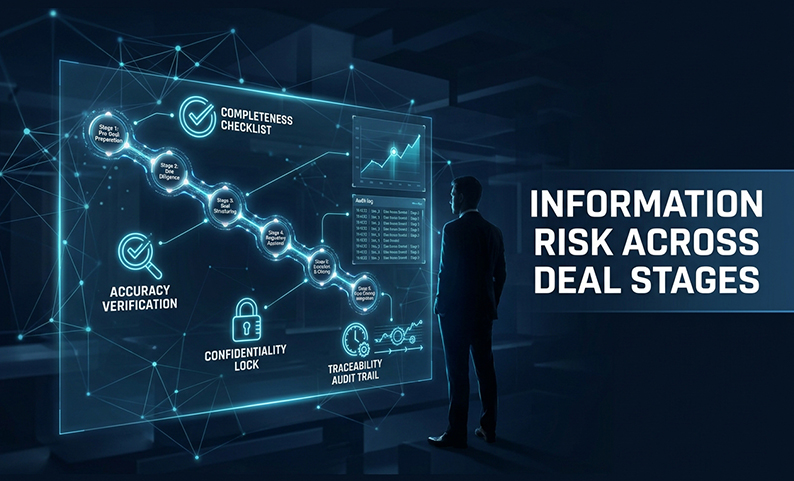
Information risk in a deal context falls into four buckets. Use them as a check at every stage:
- Completeness — Are all required documents present?
- Accuracy — Are the claims correct and cross-verified?
- Confidentiality — Is access limited only to parties who need it?
- Traceability — Can you prove who saw what, and when?
What this guide gives you (stage gates + controls + ownership)
We’ll walk through a six-stage framework for capital market deals. For each stage, we’ll cover the risks, controls, evidence, and ownership.
The framework: 6 stages where information risk shows up (and what “good” looks like)
Each stage has an entry condition (what must be true to start) and an exit gate (what must be confirmed to move on). Skipping a gate never speeds up a deal. It only creates rework later.
The four control pillars to apply at every stage
| Pillar | The check |
|---|---|
| Completeness | Is the document inventory current and gap-free? |
| Accuracy | Have figures been validated against sources? |
| Confidentiality | Is access scoped to current need, with controls enforced? |
| Traceability | Is there an evidence trail that survives a SEBI query? |
Applying this lens at each stage gate takes minutes but can save weeks of rework.
Stage 1 — Mandate kickoff & data-room readiness (stop chaos before it starts)
The decisions you make in week one determine whether you spend month four on filing prep or on rework. Get the folder structure and access design right at kickoff.
Checks to run before you invite external parties
- Define a master document inventory with owners and due dates.
- Set up folder logic and naming rules that match SEBI requirements. Don’t change them mid-deal.
- Tag every document entering the data room as v1.0 with owner sign-off.
- Confirm who must approve each document category before it becomes visible externally.
- Confirm data residency rules upfront. India’s DPDP Act and SEBI guidelines affect cross-border data, so ensure your VDR supports data localization.
Early confidentiality controls that reduce insider/leak exposure
Least-privilege access starts on day one. Before inviting any external party, create role-based access groups. Legal sees legal, auditors see financials, and so on. Insider trading risk is present from the start.
Stage 2 — Due diligence execution (completeness + validation without slowing the deal)
This is where information risk compounds fastest. Multiple parties are working at once, and Q&A happens across email and WhatsApp with no single view of what is missing.
How information risk manifests here
- Missing artifacts discovered late — A key contract surfaces in week eight that should have been available in week two.
- Stale versions in circulation — An auditor reviews a draft that legal already superseded.
- Unverifiable claims — The DRHP references a figure with no supporting document in the data room.
- Scattered Q&A — Critical answers are lost in messy email threads.
Best-practice controls (action checklist)
- Keep a weekly completeness tracker. Every open item needs an owner and a due date.
- Require dual-source validation for key financials. A figure in the DRHP must trace to both audited accounts and management schedules.
- Incorporate IT and cybersecurity diligence early to assess the issuer’s security.
- Log all Q&A in one searchable record, not email. Date-stamp each item and track it to closure.
- Apply an exception flag to any item that can’t be verified, with a documented plan for resolution.
- Retain the tracker history, Q&A log, and sign-off records from each party.
Where AI/SaaS helps vs. where it can create new risk
AI can speed up this stage, but the risk is trusting it too much. AI finds information; it does not validate it. A human must still sign off on any AI-flagged result before it goes into a DRHP. Any AI tool with access to confidential materials must sit inside your secure environment, not a public upload portal.
A platform like DCirrus integrates AI tools (like smart indexing and search) within its secure permission structure. This improves review speed without creating new access risks. Using the platform’s Q&A forums also keeps deal conversations out of email and inside an auditable record.
Stage 3 — Drafting, verification & SEBI readiness (make disclosures provable, not just plausible)
A plausible disclosure reads well. A provable one has a source document, a validation sign-off, and a version history. SEBI queries test for proof, not plausibility.
Disclosure verification: what to validate, and what evidence to retain
For DRHP disclosures, you must verify and retain evidence for:
- Financial disclosures — Trace every figure to audited accounts. Retain source extracts and auditor confirmation.
- Legal/regulatory disclosures — Back up claims with original orders and confirmation from legal counsel.
- Related-party and promoter disclosures — Verify against statutory registers and board resolutions.
- Forward-looking statements — Document every assumption and have it reviewed by at least two parties.
Version control and change management (prevent last-minute contradictions)
The most common pre-filing crisis is a mismatch between the legal draft and the financial schedules. The fix is a single master DRHP document. Every change should be logged with an author and reason. A VDR with version control enforces this discipline. DCirrus’s version control and audit trails can show exactly who saw which version and when, which is crucial if SEBI asks.
Stage 4 — Marketing & investor access (share enough to build confidence—without losing control)
The marketing phase is the highest-leak-risk window in any transaction. You are sharing sensitive information with parties who may also be looking at your competitors.
Managing information asymmetry: what to standardize vs. what to restrict
- Standardize the investor presentation. Everyone gets the same version.
- Restrict detailed operational data and internal forecasts to controlled meetings with logged access.
- Segregate anchor investor materials from general access using separate rooms or groups.
Access controls checklist for external audiences
- Assign access by investor group for easier auditing and revocation.
- Set time-bound access that expires when the roadshow closes.
- Require identity verification before first access (2FA is a minimum).
- Monitor who reviews which sections.
- Never send documents by email. Once a file leaves the platform, you have lost control.
DCirrus VDR turns these policies into automated rules using digital rights management, dynamic watermarking, 2FA, and IP restrictions. If a document leaks, you know its source.
Stage 5 — Allocation/closing + post-close (don’t lose your audit trail at the finish line)
Deals close. Information risk does not. Post-close is where your audit readiness is either preserved or lost.
Post-close retention: what you must be able to show later
Before closing the data room, you must:
- Archive the final versions of all key documents.
- Export the complete access log for every user and document.
- Save the Q&A record in its entirety.
- Revoke all external access in a logged sequence.
SEBI can ask questions months after listing. You need the answers ready.
Implementation: roles, responsibility matrix, and the “minimum viable” operating model
Simple responsibility matrix
| Activity | Issuer | Merchant Banker | Legal | Auditors | Underwriters |
|---|---|---|---|---|---|
| Document compilation | Owner | Supervisor | Contributor | Contributor | — |
| Disclosure validation | Contributor | Owner | Co-owner | Co-owner | — |
| Access administration | — | Owner | Reviewer | — | — |
| Q&A closure | Contributor | Owner | Contributor | Contributor | Reviewer |
| Version sign-off | — | Owner | Co-owner | Co-owner | — |
Tooling checklist: what your VDR must support to reduce information risk
Your platform must support the four control pillars:
- Completeness: bulk upload, index export, status tracking
- Accuracy: version control, cross-document linking, annotation with sign-off
- Confidentiality: role-based permissions, DRM, watermarking, 2FA, IP restrictions
- Traceability: immutable audit trails, Q&A archival, access history export
DCirrus VDR covers all four pillars. Its features keep communication inside the platform and out of email, and data localization options help with DPDP Act and SEBI compliance.
Common failure modes (and early warning signs) in Indian capital market information management
Most information crises are slow-building problems that were ignored for too long.
Red flags that signal you’re heading for SEBI observations or delays
- Diligence items are still open 60+ days into the process.
- Multiple “final” versions of the same document are circulating.
- Q&A threads are running over email.
- External parties are accessing documents you thought were restricted.
- Figures in the DRHP can’t be traced to a source document immediately.
- No single person can answer, “Who last approved this section?”
If two or more of these are true for your deal, you have a problem.
Summary and Next Steps: run information risk like a control system, not a cleanup task
Information risk is controllable if you manage it as a process, not a retroactive cleanup job. The key is to implement entry and exit checks at each stage, assign ownership early, and build your evidence trail as you go. This ensures your disclosures are provable, not just plausible.
For buyers and underwriters, this framework also serves as a checklist to evaluate an issuer’s diligence quality.
FAQ
How does information risk differ from market risk in capital market transactions? Market risk is about price moves you can’t control. Information risk is about the quality and security of your deal documents, which you can control. Most deal delays come from information risk.
What are the most important information-risk checks before DRHP filing? At minimum: trace every financial figure to a source with auditor sign-off, log all Q&A items as formally closed, maintain one master version of the DRHP, and keep a clean access log.
How do you verify disclosures in practice (and prove you verified them later)? Trace each disclosure to a source, get a sign-off, and record both. A VDR with an immutable audit trail is the best way to prove it later, unlike an email inbox.
What’s the safest way to handle investor access to sensitive documents during marketing/roadshows? Use a secure VDR, never email. Use group-based access with time limits, require 2FA, and apply dynamic watermarking and DRM. Log all activity.
How can AI be used in due diligence without creating new confidentiality or compliance risks? Use AI tools that are built into your secure VDR. Use them for search and review, but always have a human validate the results. Never upload confidential data to unsecured AI tools.
What should we ask a VDR vendor to confirm it supports SEBI-grade auditability and access control? Ask for: immutable audit logs, granular permissions, DRM controls, dynamic watermarking, 2FA, India data residency options, and an exportable access history. If they can’t show you these, the platform isn’t built for SEBI-grade compliance.
Want to reduce information leaks and improve audit-readiness without slowing your next deal?
DCirrus VDR is built for the kind of control this guide describes. It offers granular permissions, DRM, dynamic watermarking, AI-assisted review, built-in Q&A, immutable audit trails, and India data residency options in a single platform. Book a free demo to see how it maps to your deal workflow, stage by stage.
Latest Posts
Buyer Engagement Analytics in a VDR: What Deal Teams Can Track
August 17, 2026
12 VDR Features Required for IPO Preparation in India
August 13, 2026
What Bankers and Auditors Need From an IPO VDR in India
August 12, 2026