AI-Powered Due Diligence: A Guide to Reducing IPO Timelines with Smart VDR Features
Your analysts are buried. One is chasing a missing file over email while another manually re-permissions a folder for the third time this week. The Q&A log is split across six inboxes. Meanwhile, leadership wants the diligence room ready yesterday. That pressure is real. When it forces shortcuts, leak risk goes up and audit readiness goes down.
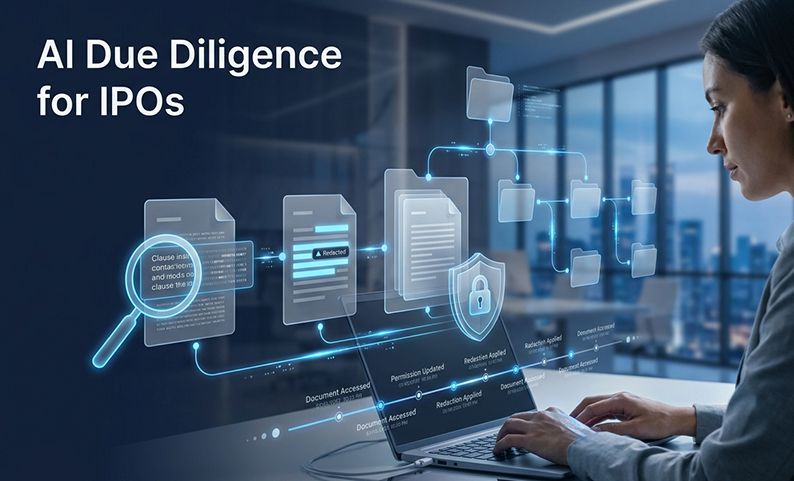
This is where AI-powered due diligence makes a measurable difference. It doesn’t replace legal judgment or banker instinct. Instead, it removes the operational drag that causes IPO timelines to slip: the indexing delays, the clause hunts, and the Q&A chaos. This guide gives you a 7-feature smart VDR checklist, a 5-day implementation sequence, and a clear rundown of the pitfalls that can derail adoption mid-deal.
Why do IPO timelines slip during due diligence (and where does AI actually help)?
Most IPO timeline slippage isn’t a judgment problem. It’s an operations problem.
The four biggest time sinks are:
- VDR setup and indexing: Manually building folder structures and tagging thousands of documents can eat days before a single reviewer gets access.
- Clause and data retrieval: Finding every “change of control” provision across 2,000 files is a week-long manual exercise with a real risk of error.
- Redaction and controlled release: Inconsistent redaction across large document sets, with no systematic review gate, creates both delays and exposure.
- Q&A coordination: When questions live in email, answers get missed, duplicated, or disconnected from their source documents.
AI accelerates all four. It doesn’t make materiality decisions or legal interpretations. Those calls stay with your team. The checklist below will tell you whether a VDR will actually compress your timeline or just add another tool to manage.
What are the 7 smart VDR features that reduce IPO due diligence timelines?
A VDR accelerates IPO due diligence only when AI document intelligence, controlled collaboration, and provable auditability come together in one platform. Piecemeal tools (like an AI search bolted onto a basic file share or Q&A running in email) won’t close the gaps that matter.
DCirrus VDR is an example of a platform that combines all seven capabilities below in a single environment, which is critical when you’re running a tight diligence sprint under SEBI-grade scrutiny.
1. AI smart indexing + automated categorization
- What it is: Automated folder structure creation, metadata tagging, and document categorization during or immediately after a bulk upload.
- Why it matters: It gets you to a “review-ready” room in hours, not days.
- What to check: Bulk ingestion speed, consistent foldering logic, version handling for updated files, and how quickly new uploads get categorized.
2. Smart search (metadata + content) + clause recognition
- What it is: Full-text and metadata search across PDFs, Word docs, and Excel files, with the ability to surface specific clauses.
- Why it matters: “Find every related-party transaction clause” becomes a 30-second query, not a three-day analyst task.
- What to check: Cross-format search accuracy, handling of scanned PDFs, and whether results are ranked or just listed.
3. AI-assisted redaction
- What it is: Automated identification of sensitive terms, names, or data fields flagged for redaction across large document sets.
- Why it matters: It reduces the chance of human error on high-volume redaction jobs and speeds up review cycles.
- What to check: Whether there is a mandatory human review and approval step before redacted documents are published.
4. Granular permissions + instant revocation
- What it is: Role-based access at the folder and file level, with the ability to revoke access instantly and manage groups across dozens of external parties.
- Why it matters: IPO due diligence involves tiered disclosures. Not every counterparty sees everything on day one.
- What to check: Group management ease, whether permission changes propagate in real time, and if “need to know” compartments can be set up from day one.
5. DRM that controls downloaded documents
- What it is: Document-level controls that restrict printing, copying, and sharing (including expiry dates on downloaded files).
- Why it matters: Once a file leaves the room, standard VDRs lose control of it. DRM keeps protection active after the download.
- What to check: Print and copy restrictions, expiry date customization, and what remains protected after the file is opened offline.
6. Centralized, auditable Q&A
- What it is: An in-platform Q&A module where questions are tracked by status, linked to source documents, and visible only to designated team members.
- Why it matters: Email Q&A creates a parallel, untracked record. One platform means one log and no missed responses.
- What to check: Status tracking granularity, the ability to link questions directly to documents, and whether the full Q&A thread is exportable for compliance.
7. Analytics + engagement tracking
- What it is: Real-time visibility into document views, download events, and reviewer activity across the entire room.
- Why it matters: You can see which reviewers are lagging, which documents are drawing the most attention, and where follow-up is needed.
- What to check: Drill-down capabilities by user or folder, download frequency reports, and export options for internal reporting.
What’s “nice-to-have” AI vs. must-have for IPO speed?
A must-have is anything that reduces setup time, retrieval latency, redaction error, or Q&A cycle time, with controls built in. A nice-to-have is advanced predictive analytics or workflow automation that your team doesn’t have the bandwidth for mid-sprint.
Here’s the practical filter: if it doesn’t reduce your analyst’s admin load or shorten the Q&A approval cycle, it won’t improve your IPO timeline. Don’t pay for features you can’t use under deal pressure.
How should you vet security, compliance, and AI risk before putting IPO documents in a VDR?
Treat AI features as part of your risk surface, not just your capability list.
Baseline controls to confirm:
- 256-bit AES encryption at rest and TLS 1.2/1.3 in transit
- MFA (SMS, email, or authenticator app), device-level approval, and IP restrictions
- Immutable audit logs covering every view, download, and permission change, exportable on demand
- Dynamic watermarking with user login, IP, and timestamp on every accessed document
- DRM policies enforced at the file level, including after download
Compliance posture to verify:
- ISO 27001-certified infrastructure and SOC 1/2/3 reports available on request
- Data localization support (especially relevant for India’s DPDPA 2023 and cross-border transactions)
- Cloud and on-premise deployment options for clients with specific data residency needs
DCirrus VDR meets all of these requirements, including 256-bit encryption, TLS 1.2/1.3, ISO/SOC reports, MFA with device-level controls, IP restrictions, DRM, watermarking, and data localization across AWS and Azure infrastructure.
AI-specific risk questions to ask any vendor:
- Where exactly does AI operate: indexing, search, redaction, or elsewhere?
- What human review steps exist before AI output reaches a disclosed document?
- How are errors in AI redaction caught before a document is published?
One practical warning: “hallucination” gets most of the press, but the bigger risks in IPO due diligence are privacy exposure from wrong permissions and uncontrolled downloads from inadequate DRM. Vet those first.
Who should own what during IPO diligence (so AI doesn’t become another tool your analysts babysit)?
Speed comes from clear ownership. Without it, even a well-configured VDR becomes a permission-management helpdesk.
Ownership map:
- Deal lead (AVP/Director): Approves the folder taxonomy, signs off on staged access releases, and escalates unresolved Q&A.
- VDR admin (senior analyst): Manages day-to-day permissions, user groups, upload workflows, and Q&A triage.
- Legal counsel: Owns redaction decisions and the publishing gates for sensitive folders.
- Finance controller/CFO office: Approves financial document releases and confirms version currency.
- Compliance: Reviews the audit export weekly and confirms DRM/watermarking policies are active.
Publishing gates: Follow a Draft → Redact → Permission Check → Publish workflow. Require a two-person sign-off for any folder containing material non-public information.
Q&A rhythm: The VDR admin should perform a daily triage, with a 24-hour response SLA for standard questions and escalation to the deal lead for anything touching disclosure.
What does a 5-day implementation plan look like for a “review-ready” smart VDR?
The biggest time loss on a deal isn’t the tool. It’s the setup chaos in the first week. The goal is to have a clean, fast diligence room before the first external reviewer logs in.
DCirrus features including smart indexing, automated categorization, Q&A forums, notifications, version control, and exportable indexes make this sequence repeatable across mandates.
- Day 1: Define the folder taxonomy and naming conventions. Set up user groups (internal, buy-side legal, buy-side financial, regulators). Flag “restricted” folders requiring two-person access from day one.
- Day 2: Bulk upload all available documents. Run AI indexing and categorization. Resolve version conflicts and duplicates. Apply initial permission templates by group.
- Day 3: Run the redaction workflow on sensitive documents. Legal must review and approve before any redacted file is published. Confirm watermarking and DRM policies are active.
- Day 4: Open the Q&A module. Set response SLAs and notification rules. Brief all parties on the single-channel Q&A mandate; no parallel email threads allowed.
- Day 5: Pull a baseline of analytics (engagement, downloads, permission status). Adjust access based on reviewer activity. Export the room index and initial audit log for deal leadership.
What are the most common ways AI-powered due diligence fails (and how do you prevent them)?
Most failures are process failures. AI just makes them happen faster.
- Over-permissioning early → Prevention: Start with default-deny. Release access in stages as counterparties progress through diligence.
- Redaction without human validation → Prevention: Require a two-step review before any redacted document is published. Run spot checks on high-volume batches.
- Q&A split across email and VDR → Prevention: Mandate all questions through the in-platform Q&A module on day one. Link every answer to its source document.
- No audit export readiness until late → Prevention: Run a weekly audit export drill from day one. Define the required report format before diligence opens.
- No adoption training → Prevention: Hold a 30-minute onboarding for all external parties covering three things: how to navigate, how to search, and how to ask questions.
How do you prove ROI in deal velocity and risk reduction using VDR analytics?
Track these metrics and report them weekly to deal leadership and compliance.
Operational metrics:
- Time from mandate kickoff to “review-ready” room (target: under 5 days)
- Average Q&A response time (benchmark against prior deals)
- Repeat question volume (a high volume indicates a findability problem)
Engagement metrics:
- Most-viewed documents (signals buyer priority areas)
- Dormant reviewers (flags adoption gaps that need follow-up)
- Q&A volume trend (rising late in diligence signals information gaps)
Risk and compliance metrics:
- Download frequency by user and document
- Permission change log volume (spikes can indicate instability)
- Watermark/DRM policy adherence
- Audit trail completeness (Can you answer “who saw what, when?” in under 10 minutes?)
Summary and Next Steps: what’s the single highest-impact move you can make this week?
AI accelerates operations. Your team keeps the judgment. That’s the only framing that holds up under SEBI scrutiny, buy-side pressure, and post-deal audit.
The single highest-impact move is to take the 7-feature checklist and run the 5-day implementation sequence on your next mandate, or on the deal you’re already in. Don’t wait for a perfect moment.
Standardize the structure, automate the indexing, mandate the Q&A channel, and export the audit log weekly. Every IPO that starts this way runs faster and stays cleaner.
FAQ
Does AI-powered due diligence replace lawyers or bankers? No. AI accelerates document retrieval, indexing, and Q&A triage. Legal interpretation, materiality calls, and disclosure decisions stay with your team.
What’s the fastest single win to reduce IPO diligence time? AI indexing combined with smart search and centralized Q&A. These three together eliminate the largest daily time sinks for analysts and improve deal velocity.
How do I prevent a data leak after someone downloads a file? Use DRM controls that restrict printing and copying, expiry dates on downloaded files, dynamic watermarking, and strict permission management. Protection needs to follow the document, not just the room.
How do I structure folders for IPO diligence? Use a consistent taxonomy agreed upon before day one. Create “restricted” compartments from the start, don’t try to retrofit them after documents are already uploaded.
What should I ask a VDR vendor about audit trails? Ask about granularity (every view, not just downloads), immutability, export formats, and whether the log covers who, what, and when for every action.
Is AI redaction safe? It’s safe when paired with a mandatory human review step and a publishing gate. Don’t allow an AI redaction to go live without approval.
How do I get buy-side adoption fast? Provide clear room navigation, strong full-text search, and one mandated Q&A channel. Reduce friction for the reviewer, and adoption will follow.
What metrics show deal velocity improvement? Time to room readiness, Q&A cycle time, document retrieval speed, and engagement patterns across the reviewer group.
Want to compress your IPO diligence timeline without increasing leak risk?
DCirrus VDR combines enterprise-grade security (including 256-bit encryption, TLS 1.2/1.3, MFA, and device-level controls on ISO/SOC-certified infrastructure) with AI-powered document intelligence, granular permissions, DRM, watermarking, and a fully auditable Q&A module. It’s built for deal teams that need speed and compliance readiness in the same platform, with data localization options to meet regional requirements. Book a free demo
Latest Posts
Buyer Engagement Analytics in a VDR: What Deal Teams Can Track
August 17, 2026
12 VDR Features Required for IPO Preparation in India
August 13, 2026
What Bankers and Auditors Need From an IPO VDR in India
August 12, 2026