From Chaos to Control: A Guide to Managing the M&A Process Inside Your VDR
Every merchant banker has lived this: a buyer’s advisor sends a question about a litigation clause via email. Your SME replies with a draft answer. Someone forwards it. A revised answer goes out from a different thread. Three days later, two conflicting responses are floating in inboxes across six parties, and none of it is in the data room.
That’s not a Q&A process. That’s a liability.
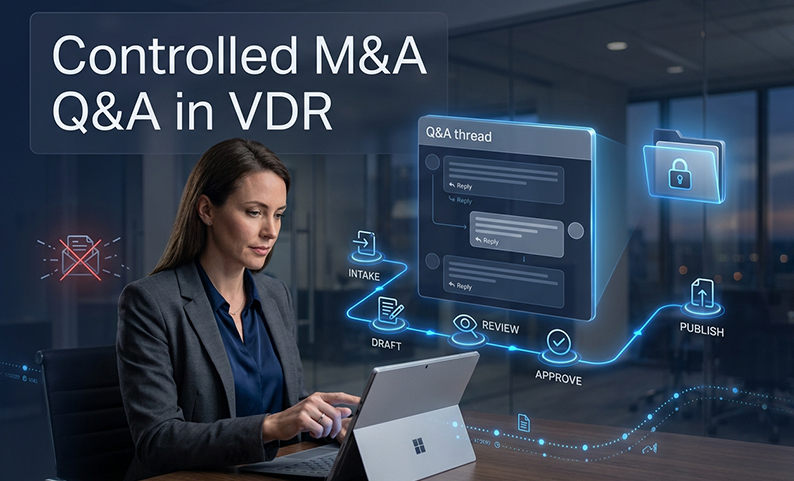
Q&A traceability means knowing who asked, who answered, who approved, and when, all linked to the source document. This only exists when Q&A lives inside the VDR, not in parallel email threads. A controlled Q&A process is centralized, permissioned, auditable, and driven by SLAs from intake to closure.
This guide provides a 7-step framework to build that process, along with a minimum RACI, a clarification template, fixes for common failure modes, and a 7-day implementation plan for your next deal.
What Does “Control” Mean for M&A Q&A Inside a VDR, and Why Does Email Break It?
Control means one channel, one record, and one accountable owner for every question. It requires four things that email cannot provide at scale:
- A single source of truth: Every question, response, and approval is in one place, not scattered across inboxes and chat threads.
- Complete Q&A traceability: A timestamped record of who asked, who drafted the answer, who approved it, and which document it references.
- Defined closure: A question is “closed” only when the answer is approved and posted, not when someone hits Reply.
- Permissioned visibility: The system enforces which buyer group sees which answers, you don’t have to rely on manually checking the BCC field.
Email fails on all four points. It loses context when threads branch, creates forwarding risk with sensitive answers, confuses document versions, and produces unauditable approvals like “sounds good, go ahead.” For SEBI-regulated teams, this isn’t just a headache. It’s a risk to your legal defensibility and an exposure to insider trading.
What 7-Step Framework Turns VDR Q&A from Chaos to Control?
The fastest path to a controlled Q&A process is a consistent lifecycle. When every question runs through the same seven steps, you get speed, compliance, and risk control together, not as a trade-off.
Here’s the framework:
- Set up governance (roles, SLAs, escalation ladder, taxonomy)
- Standardize intake (one-issue questions, document references, decision context)
- Route immediately (topic tag → SME → backup owner → time-based reminders)
- Draft with templates (short answer + detail + data room pointer + redaction flag)
- Review and approve (two-tier for sensitive topics; safe-to-disclose vs. redaction path)
- Publish and close (permissioned visibility + defined closure states)
- Measure and act (use audit analytics as deal intelligence, not just compliance logging)
This creates a repeatable process for both IPO and M&A mandates.
Step 1: How Do You Set Up Q&A Governance Before Opening Access?
Nothing stalls Q&A faster than starting without defined roles. When a question lands and nobody knows who owns it, it sits.
Minimum roles:
- Q&A Admin (merchant banker / deal PM): Owns intake rules, routing, deadlines, and escalations. This creates a single point of accountability.
- SMEs (finance, tax, legal, HR, ops): Draft responses within their domain.
- Reviewer/Approver (lead counsel / deal sponsor): Final sign-off on sensitive answers.
SLA defaults to set before Day 1:
- Acknowledge receipt: within 4 business hours
- SME draft turnaround: 24–48 hours
- Approval window: 12–24 hours for standard; same-day for urgent
Escalation ladder: SME → functional lead → deal sponsor, triggered automatically by an SLA breach.
Tagging taxonomy: Define topic buckets upfront (financials, legal, contracts, HR, IP), priority levels (standard / high / urgent), and a needs-redaction flag for sensitive information.
What Is the Minimum RACI for Q&A That Works on Tight Timelines?
| Role | RACI |
|---|---|
| Q&A Admin | Accountable — owns velocity and process |
| SMEs | Responsible — draft responses |
| Lead Counsel | Consulted/Approver — reviews sensitive answers |
| Client | Informed — receives output summaries |
You need one accountable owner for Q&A velocity. Without one, every delay becomes someone else’s problem.
Steps 2–4: How Do You Structure Intake, Routing, and Drafting So Questions Don’t Bottleneck?
Email creates chaos because it has no structure. Treat questions like support tickets. Standardize how they come in so routing becomes mechanical.
DCirrus VDR’s integrated Q&A forums, secure messaging, and document commenting keep all questions in a single, searchable environment with automated notifications. Nothing routes through personal inboxes, so context stays intact and the Admin can see the full picture.
Step 2 — Intake rules:
- Every question must reference a specific document or folder.
- One issue per question. No compound questions.
- High-impact queries must state: “What decision is this question informing?”
- Return vague or compound questions with a clarification template; do not answer them.
Step 3 — Routing:
- Route by topic tag and document owner. Assign a backup SME for each tag.
- Auto-notify the assigned SME and the Admin on routing.
- Use time-based reminders at 50% and 100% of the SLA window.
Step 4 — Drafting:
- Use a response template: (1) short direct answer, (2) supporting detail, and (3) a pointer to the relevant document and version in the data room.
- Any answer touching litigation, related-party transactions, pricing, or forward-looking projections gets a needs-redaction flag before it moves to review.
What’s a Practical Clarification Template to Reduce Back-and-Forth?
Return vague questions with this three-field form:
- Document reference: Which file or folder does this relate to?
- Precise question: What specifically are you asking about this document?
- Requested output: Are you looking for a number, a date, a definition, or a commitment?
This forces the buyer’s team to clarify what they actually need.
Steps 5–6: How Do You Review, Publish, and Close Answers While Controlling Confidentiality?
Speed is worthless if a sensitive answer goes to the wrong buyer group. Control at the publish stage is where you manage leak risk and insider-trading exposure.
DCirrus VDR’s granular permission controls (like granular permission controls, device approval, IP restrictions, and enforced 2FA) limit who sees which answers. DRM controls on downloaded files and dynamic watermarks with viewer details deter unauthorized distribution. These controls materially reduce risk. They don’t eliminate every scenario, but they significantly improve your security posture.
Step 5 — Review and approve:
- Sensitive categories (litigation, related-party, forward-looking statements) require two-tier review: SME draft followed by lead counsel sign-off.
- Every answer follows one of two paths: safe to disclose or redaction required.
- Answer the question asked. Do not volunteer extra context that expands disclosure scope.
Step 6 — Close:
- Define four closure states: Answered/Accepted, Answered–Pending Document, Answered–Pending Approval, and Withdrawn.
- Every closed answer must link to the specific document version it references. This prevents disputes later.
- Reopening a question requires a new submission, not a reply to the closed thread.
Step 7: What Should You Measure in the Audit Trail to Stay SEBI-Audit-Ready and Manage Deal Momentum?
The audit trail is not a passive log. It’s your earliest warning system for deal risk and timeline slippage, if you read it actively.
DCirrus VDR’s audit trails capture every user action with timestamps, IP addresses, and device records. These exportable reports provide a live picture of deal activity for internal reporting and audit readiness, supplementing your formal SEBI documentation.
Compliance and defensibility metrics to track:
- Who accessed which documents, with timestamps and IP/device records
- Full Q&A history: submitted → drafted → approved → published, with all edits logged
Deal-control metrics to act on:
- Average time to first response; percentage of SLA breaches; backlog by topic and SME
- Hotspot topics, where questions cluster, signal confusing documents or under-disclosed areas
- Engagement analytics showing which bidder groups are most active
What to do when a metric spikes:
- SLA breach rate rising → Add SME capacity or tighten intake rules.
- Question hotspot on a topic → Publish a clarifying memo or run a focused call.
- One bidder going quiet → Check engagement analytics; they may be stuck, not disengaged.
How Do You Prevent the 6 Failures That Derail VDR Q&A—and What to Do Instead?
Most Q&A breakdowns follow the same six patterns. None require a new tool to fix; they require a rule or template applied consistently.
- Duplicate questions → Fix: Publish a living Q&A index visible to all buyers. Enforce “search-before-ask” as an intake rule.
- Vague questions → Fix: Use the three-field clarification template. Return the question instead of guessing at its meaning.
- SME bottlenecks → Fix: Assign backup owners for each topic. Group similar questions for one SME session instead of routing them one by one.
- Offline/paper preference → Fix: Allow controlled downloads with DRM and file expiry dates. Define clear “offline review windows.”
- Accidental over-sharing → Fix: Use permissioned visibility by buyer group, enforced at the platform level. Require a reviewer for sensitive topics.
- “Answered but disputed later” → Fix: Link every closed answer to a specific document version. The immutable Q&A history is your record.
Summary and Next Steps: What Should You Implement in the Next 7 Days?
A governed Q&A process inside the VDR delivers speed, compliance, and leak control. Email gives you none of the three reliably. The framework is straightforward. The key is enforcing it from Day 1.
Your 7-day implementation plan:
- Day 1: Define roles, SLAs, escalation ladder, and tagging taxonomy.
- Day 2: Configure permissions and buyer groups.
- Day 3: Publish intake rules, the clarification template, and closure definitions.
- Days 4–5: Pilot with one bidder group, enforcing the single-channel rule.
- Days 6–7: Review audit metrics and fix bottlenecks before full launch.
The highest-priority action is to declare that Q&A and approvals happen inside the VDR only. No exceptions. One channel, with every question and answer on the record.
FAQ
What’s the minimum team size to run a controlled Q&A process? Three roles: a Q&A Admin, at least one SME per major topic, and one reviewer for sensitive answers. On a lean deal, one person can cover the Admin and an SME role, but the Admin function must be distinct to maintain discipline.
Should buyers be able to see other buyers’ questions? No, especially in competitive bids. Use permissioned visibility to separate buyer Q&A by default. If an answer is material to all parties, publish it to all groups simultaneously.
How do we handle questions that require new uploads? Log the question as Answered–Pending Document. Upload the new document with version control, notify the relevant group, and then link the closed answer to the new file.
What’s a reasonable Q&A SLA during peak diligence? Acknowledge in 4 business hours, draft a response in 24–48 hours, and get approval in 12–24 hours. A 72-hour total turnaround is defensible for complex questions if communicated upfront.
How should sensitive topics like litigation or HR be handled? These categories require mandatory two-tier review before any answer is published: an SME draft plus lead counsel sign-off. Apply the needs-redaction flag by default for these topics.
What should we evaluate in a VDR specifically for Q&A? Look for integrated Q&A forums, granular permission controls by buyer group, automated notifications and reminders, and immutable audit trails that capture the full Q&A history.
Want to Run Your Next Diligence Q&A with Complete Traceability—Without Email Chaos?
DCirrus VDR is built for exactly this: faster Q&A cycles with permissioned visibility, DRM and watermarking on every downloaded file, audit-ready logs that capture the full diligence record, and secure collaboration across multi-party deals—all in one platform.
Latest Posts
How Long It Takes to Launch a VDR for an IPO Mandate
August 06, 2026
VDR Features Merchant Bankers Need for IPO and M&A Execution
August 05, 2026
Top Deal Management Features to Look for in a VDR
August 03, 2026