A Guide to Using AI VDR Features for SEBI Due Diligence: Clause Recognition, Smart Indexing, and DRHP Verification
A merchant banker three weeks from a DRHP filing deadline discovers that two versions of the same audited financials are circulating in the room, and no one can tell which is current. External counsel is answering questions over email. An underwriter has access to documents they shouldn’t. The audit trail? A folder of screenshots.
This is not an edge case. It’s what happens when AI VDR features get layered onto a governance foundation that was never properly set up.
This guide gives SEBI Category I merchant bankers a practical 7-point checklist for using AI VDR features like clause recognition, smart indexing, and DRHP verification. The goal is to compress timelines and hold up to scrutiny. AI accelerates retrieval and issue-spotting, but humans remain accountable for the final sign-off. That distinction is key.
Why Do Most “AI VDR” Setups Fail in SEBI Due Diligence?
AI speed-ups are useless without defensible access control and logs underneath them. The most common breakdowns are predictable:
- Wrong permissions, creating insider trading exposure when parties see documents they shouldn’t.
- Multiple DRHP drafts, so no one knows which version is authoritative.
- A missing audit trail, leaving no time-stamped record when SEBI asks.
- Q&A handled over email, allowing contradictions to build with no traceability.
SEBI due diligence has real regulatory stakes. Time-stamped, defensible records aren’t a nice-to-have. They’re the minimum.
The principle is speed with traceability. Fast retrieval without an audit trail is a liability. DCirrus VDR provides the governed base layer: role-based permissions, DRM controls, dynamic watermarking, and complete audit logs. This foundation makes AI features safe for a live SEBI process.
What’s the Practical Framework for Using AI VDR Features in SEBI Diligence?
Think of AI VDR features as serving three distinct jobs, not just a list of features:
- Retrieval velocity: Smart indexing and metadata search so the right document surfaces in seconds.
- Issue-spotting: Clause recognition and AI-assisted redaction to accelerate first-pass review.
- Regulatory readiness: DRHP verification discipline (disclosure-to-evidence mapping, version control, and audit trails) to prove the process held.
These three jobs are the backbone of this checklist. If a feature doesn’t serve one of these outcomes, don’t waste time on it under deadline pressure.
How Do You Set Up the VDR So Smart Indexing Actually Works Under DRHP Pressure?
Smart indexing works when your folder taxonomy mirrors DRHP sections, not your org chart. When counsel asks for evidence for a disclosure, retrieval must be instant.
A practical IPO/M&A folder structure includes:
- Corporate documents (MOA, AOA, board resolutions)
- Audited financials + restated accounts
- Litigations and contingent liabilities
- Material contracts
- Related-party transactions
- Regulatory licenses and approvals
- Risk factors evidence
- Group structure and shareholding
- KMP disclosures
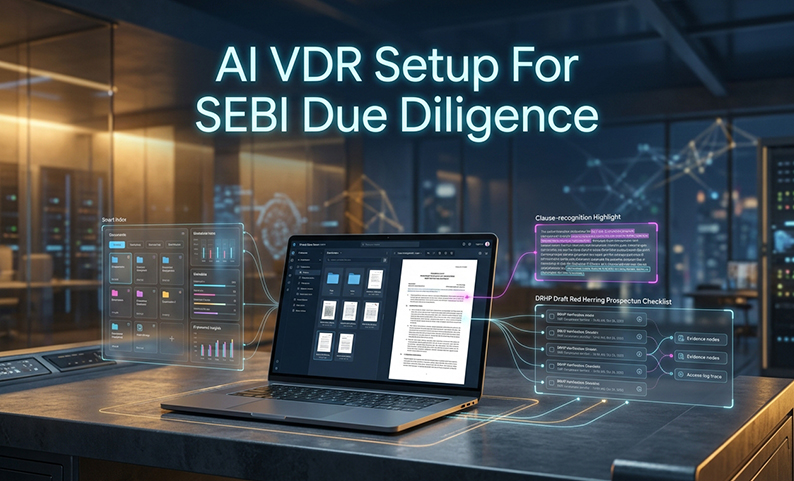
DCirrus VDR’s AI-powered smart indexing and automated categorization make search fast across this structure. You can export the index with clickable links to share a clean evidence map with counsel securely.
Do: Use consistent naming conventions. Avoid: Folder structures based on internal departments.
What Are 5 “Non-Negotiable” Indexing Fields for Merchant Bankers?
Every document should have these five metadata fields:
- Entity: Prevents cross-contamination in group structures.
- Disclosure section: Ties the document to a DRHP chapter.
- Period: Distinguishes FY23 from FY24 financials instantly.
- Doc status (Draft / Under Review / Final): Ends the “which version?” question.
- Owner/source: Establishes accountability for faster gap resolution.
How Should Clause Recognition Be Used Without Creating Compliance Risk?
When scanning thousands of pages of contracts, clause recognition cuts first-pass review time. But the governance around it is what matters.
Use clause recognition for:
- Change-of-control provisions
- Indemnity and termination language
- Related-party transaction hooks
- Restrictive covenants
- Contingent liability language
Don’t use it for:
- Final legal conclusions
- Replacing counsel sign-off
- Redaction without human review
DCirrus clause recognition surfaces relevant provisions faster in repetitive contracts, which is where it genuinely saves time. Every AI-flagged item must be logged as “pending review” until counsel validates it. That makes your process defensible. Know the limitations: OCR errors, false positives, and context nuance. Smart indexing finds the document, clause recognition flags the passage, and a human interprets it.
What Does “DRHP Verification” Mean Operationally (and How Do You Run It Weekly)?
DRHP verification isn’t a pre-filing scramble. It’s a repeatable weekly cadence that manages the chaos. In practice, it means:
- Disclosure-to-evidence mapping: Every claim in the DRHP is linked to a document in the VDR.
- Gap tracking: A live list of missing documents, with an owner and a deadline.
- Version discipline: One folder for the authoritative “ready for counsel” document set.
A workable weekly cadence:
- Monday: Refresh the gap list and flag new mismatches.
- Midweek: Owners upload missing evidence or escalate blockers.
- Friday: Review and sign off, freezing the “ready for counsel” set until the next cycle.
This discipline means you arrive at filing with a clean, auditable evidence base, not a week of panic.
Who Owns What in a 10-Party Diligence Room (So Nothing Slips)?
Q&A sprawl and unclear ownership create contradictions. The fix is a clear responsibility map enforced through the platform, not email.
- Merchant banker: Owns the workflow, sets permissions, and maintains the gap list.
- Issuer finance/legal: Provides the primary evidence.
- External legal counsel: Handles interpretation and sign-off.
- Auditors: Confirm financial evidence within their limited scope.
- Underwriters: Get limited, tracked access with no download rights unless granted.
Q&A traceability means every question is answered once, inside the platform, linked to the document. DCirrus’s integrated Q&A, secure messaging, and document-level comments replace email threads entirely.
What Are the Top Avoidable Mistakes (and the Controls That Prevent Them)?
Most blow-ups trace back to controls that were never set.
- Over-permissioning external parties → Insider trading exposure Control*:* Use role-based permissions and IP/device restrictions.
- Downloads without DRM → Documents circulating uncontrollably Control*:* Apply DRM that prohibits printing/copying and sets expiry dates.
- Uncontrolled versions → Counsel works from a superseded draft Control*:* Enforce strict version control, with only the merchant banker able to promote a document to “final.”
- Q&A over email → Contradictions at SEBI review Control: Mandate all Q&A occurs inside the VDR platform.
- Offline redaction → Document integrity disputed Control: Use AI-assisted redaction with audit logging and dynamic watermarks.
These aren’t hypotheticals. The controls exist in the platform, but you have to use them from day one.
How Do You Measure Whether AI VDR Features Are Paying Off?
Track operational metrics tied to your timeline and margin:
- Time-to-retrieve: How long it takes to find a document. If it’s over a few minutes, your taxonomy needs work.
- Q&A cycle time: Average time from question to validated answer. Long cycles signal ownership gaps.
- Rework rate: Number of superseded DRHP drafts. High rework means evidence is arriving too late.
- Audit readiness: Can you export a complete access log on demand? If not, your trail is inadequate.
DCirrus VDR can accelerate due diligence timelines by 40–60%, but only when the governance, indexing discipline, and Q&A workflows are properly configured.
DCirrus VDR can accelerate due diligence timelines by 40–60%, but only when the governance, indexing discipline, and Q&A workflows are properly configured.
Summary and Next Steps: What to Do This Week Before the Next DRHP Milestone?
AI VDR features are worthwhile when they improve three things with traceability: retrieval velocity, issue-spotting, and regulatory readiness. Treat AI as a governed tool, not a shortcut around accountability.
Three actions for your next milestone:
- Lock permissions and audit trail expectations: Configure roles, DRM, and watermarking before anyone enters the room.
- Implement a DRHP-mapped taxonomy and metadata fields: Set up the folder structure and the five non-negotiable indexing fields from day one.
- Pilot clause recognition on a contract subset: Run a first-pass review, log AI-flagged items, and get counsel sign-off on the workflow before scaling it.
FAQ
What’s the difference between full-text search and smart indexing in a VDR? Full-text search finds a keyword. Smart indexing adds metadata (like document type and date) so you can filter results instead of opening dozens of files. This is what makes search fast.
Will clause recognition replace legal review for DRHP disclosures? No. Clause recognition accelerates first-pass triage. Counsel must still validate every AI-flagged item and make the final disclosure judgment.
How do we handle multiple DRHP drafts without confusion? Use strict version control. Have a designated “final” folder that only the merchant banker can write to, and mark all other versions clearly as “draft” or “superseded.”
What audit trail details are most useful for regulators? Time-stamped logs showing who opened which document, when, and from where. Q&A records are also critical, showing the question, response, and timestamp.
How do we safely give investors limited access? Create a restricted group with view-only permissions, IP/device restrictions, and DRM to prevent downloads. Dynamic watermarking makes any screenshot traceable back to the viewer.
How should we structure Q&A to avoid contradictions? Centralize all Q&A inside the VDR. Assign one owner per question category (legal, financial, etc.) and require answers to link to the supporting document. No side conversations over email.
What’s the minimum setup time to get a VDR live for an IPO? With a pre-built taxonomy and clear roles, a VDR can be ready for external parties within a day. The key is deciding on the structure before setup begins.
How do data residency and DPDP Act considerations affect VDR selection? India’s DPDP Act 2023 requires careful handling of personal data. Choose a VDR provider with India-based data centers, like DCirrus, to ensure data doesn’t leave the jurisdiction.
Need a SEBI-Ready VDR That Accelerates Diligence Without Losing Traceability?
DCirrus VDR combines granular permissions, DRM controls, dynamic watermarking, comprehensive audit trails, AI-powered smart indexing, clause recognition, and integrated Q&A in one platform built for high-stakes transactions. Data localization options support India-specific compliance. Teams using DCirrus report deal timeline acceleration of 40–60% while maintaining the defensible audit records that SEBI due diligence demands, at a fraction of the cost of legacy VDR providers.
to see how DCirrus supports SEBI Category merchant bankers from VDR setup through DRHP filing.
Latest Posts

Buyer Engagement Analytics in a VDR: What Deal Teams Can Track
August 17, 2026

12 VDR Features Required for IPO Preparation in India
August 13, 2026

What Bankers and Auditors Need From an IPO VDR in India
August 12, 2026