The Indian IPO VDR Selection Framework: Why Generic Checklists are Insufficient for SEBI Compliance
One missing access log. One document shared a week too early. One Q&A thread that lived in WhatsApp instead of the platform. Any of these small mistakes can trigger SEBI observations, force disclosure rework, or expose your firm to insider-trading scrutiny. All while your filing deadline keeps getting closer.
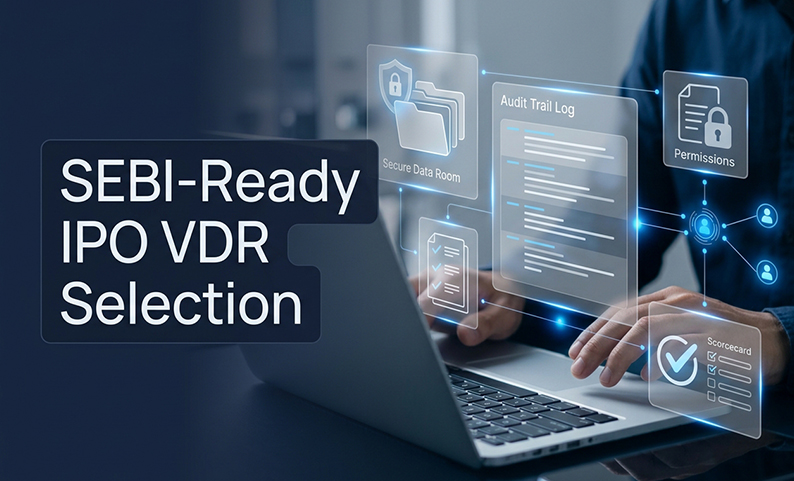
Generic VDR checklists don’t protect you from these risks. They tell you to look for “encryption,” but they don’t tell you if those controls will produce defensible evidence when SEBI asks who saw your DRHP draft and when. Choosing an IPO VDR isn’t about security marketing claims. It’s about building a provable, end-to-end evidence trail across more than ten parties over a 7–12 month cycle, and keeping it intact under pressure.
This article gives you the Indian IPO VDR Selection Framework: a set of SEBI-aligned pillars, a 6-point vendor scorecard, a simple governance model, and a pre-filing test you can run before DRHP submission.
Why do generic VDR checklists break down in Indian IPOs?
Because they weren’t built for the specific pressure an Indian IPO places on a data room, or for the specific ways things go wrong.
A typical IPO involves at least ten parties working for 7–12 months, with permission changes needed at each new phase. Generic checklists focus on features but miss the most common failure modes.
Three breakdowns happen repeatedly:
- Over-sharing early. Broad folder access is granted at the start and never tightened. This exposes DRHP-sensitive material to parties who shouldn’t see it.
- Incomplete evidence trail. Q&A happens over email and decisions get made on calls. When SEBI asks for the record, it’s scattered across inboxes, drives, and personal notes.
- Late-stage scrambles. Critical data wasn’t indexed properly. Finding and verifying it under filing pressure burns time and creates a high risk of errors.
The root problem is simple: these checklists ask “what does a VDR do?” instead of “what proof does SEBI require?” Your selection process has to start with the second question.
What is the Indian IPO VDR Selection Framework and what does it prioritize?
The Indian IPO VDR Selection Framework is a set of five SEBI-aligned pillars that translate directly into questions for vendors and checks for your setup.
It prioritizes:
- Confidentiality control: Managing DRHP sensitivity and containing insider risk.
- Audit defensibility: Proving who saw what, when, and what changed.
- Cloud security baseline: Verifying encryption, identity governance, and vendor oversight.
- Multi-party execution: Ensuring clear permissions, Q&A routing, and version discipline.
- Deal economics: Getting predictable pricing with low administrative overhead.
If a vendor can’t satisfy these pillars, you’re buying future risk, not a platform.
Which 6 checks should you use to select a SEBI-ready VDR for an IPO?
Use these checks as your vendor scorecard. A failure in any of these areas will create problems during or after the deal.
1. Access control depth for a multi-party reality Granular permissions are the foundation of confidentiality. Your VDR must have role-based access at the file and folder level (not just for the room) to isolate counsel, auditors, and underwriters. It should also let you restrict access by IP and device, which is critical for external users. Finally, check that you can delegate admin tasks without giving up root control.
2. Confidentiality enforcement beyond “NDA signed” A signed NDA doesn’t stop a screenshot. You need technical enforcement. Look for DRM controls to block printing and copying, and dynamic watermarks that embed the viewer’s identity, IP address, and timestamp on every document. This deters leaks and makes them traceable.
3. An audit trail that is evidence-grade, not “basic logs” A log showing “User A accessed Room B” is not enough. The trail must capture user identity, IP/device, timestamp, and the specific action (view, download, permission change). It must also be exportable in a readable format so you can produce it on short notice.
4. Structured Q&A traceability If your Q&A lives in email, it doesn’t exist as evidence. The VDR must tie Q&A to specific documents, with the full history preserved inside the platform. The complete record needs to be searchable and exportable with the rest of your diligence file.
5. Cloud security and vendor risk alignment SEBI’s frameworks require more than a marketing claim. Confirm the vendor uses AES-256 encryption for data at rest and TLS for data in transit, with MFA as a baseline. Ask for their ISO 27001 and SOC 2 reports to document your own due diligence. You should also verify that you can host your data in an India-region server to align with the DPDP Act.
6. Deal economics and timeline fit A VDR with unpredictable pricing is a liability. Demand transparent, fixed pricing with clear overage terms. A platform that requires weeks of manual setup will slow down your diligence, so evaluate the administrative overhead honestly.
What vendor questions should you ask in procurement to validate these 6 checks?
Don’t accept feature lists. Ask for a live demonstration.
- Show me how you restrict access by IP address and device.
- Export a sample audit report and explain what each field means.
- Demonstrate your full Q&A workflow, from question to export.
- How do we specify India-region hosting at setup?
- Give us a price for a 10-party, 2,000-document IPO, including any overages.
How do you configure permissions and governance for 10+ parties without creating leakage or evidence gaps?
The biggest risk isn’t choosing the wrong tool; it’s permission drift, where access starts narrow, expands informally, and is never documented.
Define four roles before you add anyone to the room:
- VDR Owner (Merchant bank): Has final authority and never delegates root access.
- Deal Admin(s): Manages uploads, indexing, and user provisioning.
- Functional Approvers (Legal/Finance): Approve access to sensitive folders.
- External parties: Counsel, auditors, and underwriters with role-scoped access.
To prevent drift, always start with least-privilege access, use separate folder workstreams for each function, and log every permission change with a stated reason.
What common SEBI-related VDR failures should you proactively test before DRHP filing?
Most compliance pain is preventable if you test for it before you file.
Run a pre-DRHP drill. Export your full audit pack (index, access logs, Q&A, version history) and check for these failure modes:
- Unpermissioned sharing: Are there any groups with overly broad access?
- Broken traceability: Is any Q&A happening outside the platform? If so, those decisions are not in your official record.
- Version confusion: Are there files named “final_v7”? If you have multiple “final” versions, you don’t have a single source of truth.
- Weak exportability: Can you produce a complete audit trail in under 30 minutes? If not, you have a gap.
- Retention ambiguity: What happens to the room after listing? Make sure you have a documented plan to keep an auditable archive.
How do AI, automation, and reporting improve IPO diligence speed without weakening control?
The tradeoff between compliance and speed is mostly false. The right automation reduces manual steps while keeping permissions and traceability intact. Practical tools for an IPO data room include:
- Full-text search to find specific clauses or terms in seconds.
- AI-assisted redaction to reduce the risk of accidental exposure.
- Smart indexing to automatically classify documents and reduce manual filing errors.
When these tools are part of a single system, your audit trail is complete by default, not assembled after the fact. Activity dashboards can also give you an early signal of unusual access patterns, like heavy off-hours activity on sensitive folders.
Summary and Next Steps: What Should You Do This Week?
The Indian IPO VDR Selection Framework isn’t a features wish list; it’s a defensibility standard. If your VDR can’t meet these requirements, it’s a liability.
This week:
- Build a 1-page scorecard from the 6 checks and assign an owner for each one.
- Run a proof-based demo with vendors. Ask them to perform the key tasks on our list.
- Lock in pricing before you sign. Understand the complete cost, including any overages.
A platform like DCirrus, which provides DRM, granular permissions, dynamic watermarking, comprehensive audit trails, and AI-powered tools with data localization options, gives you a concrete benchmark. The goal isn’t to find a vendor who claims compliance, but one who can demonstrate it in your workflow.
FAQ
What audit trail exports should a merchant banker be able to produce on short notice? At minimum: a full user-activity log, document version history, a complete Q&A record, and a log of all permission changes. These should be exportable in minutes without needing technical support.
How should we handle external counsel and auditors — separate rooms or role-based segregation? Role-based segregation in a single room is more efficient and easier to audit. Use folder-level permissions to isolate each party.
What’s the minimum acceptable authentication and access control setup for IPO data rooms? MFA is non-negotiable. Add IP restrictions for any external parties. Single-factor password access is not acceptable for DRHP-sensitive material.
How do watermarking and DRM differ, and when do you need both? Watermarking makes a document traceable to a specific viewer. DRM technically prevents actions like printing or copying. For an IPO, you need both.
How do we evaluate data localization needs for Indian IPO documentation? The practical requirement is the ability to use an India-region server. This avoids cross-border data questions under the DPDP Act. Confirm this is a standard option with your vendor.
What pricing model is safest for IPO deal economics and what hidden costs should we watch? Fixed deal pricing is safest. Watch for hidden costs like per-user or per-page overages that can create unpredictable cost exposure.
Can a VDR replace email for diligence Q&A without slowing the team down? Yes, if the platform sends automatic notifications. Teams adapt quickly when they don’t have to manually log in to check for updates.
Want to see what SEBI-ready VDR governance looks like in a live IPO workflow?
DCirrus combines enterprise-grade security and AI-powered document intelligence with data localization options for India-region hosting. It’s built for the multi-party, evidence-grade compliance that Indian IPOs require.
and see exactly how it performs against the six checks in this framework.
Latest Posts
Buyer Engagement Analytics in a VDR: What Deal Teams Can Track
August 17, 2026
12 VDR Features Required for IPO Preparation in India
August 13, 2026
What Bankers and Auditors Need From an IPO VDR in India
August 12, 2026