12 VDR Features Required for IPO Preparation in India
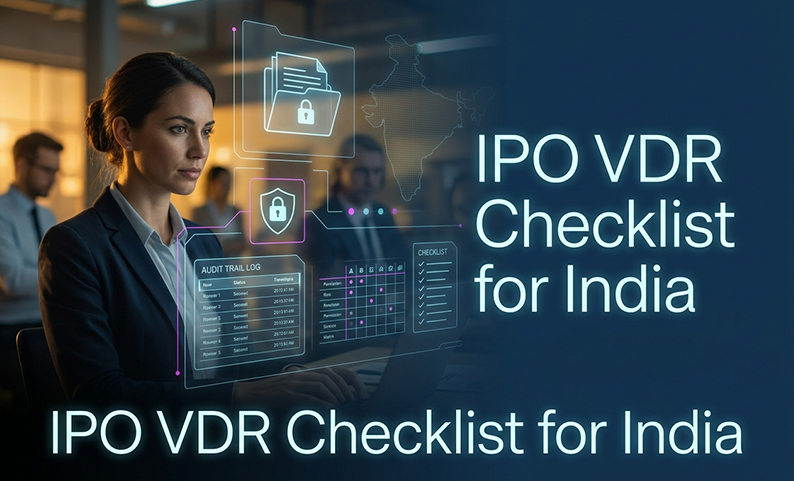
If your IPO team is still moving sensitive files by email attachment, shared-drive folder, and spreadsheet, you already know the failure mode: the wrong version gets reviewed, the wrong external party sees a file, a question gets answered without a defensible record, and later nobody can show what was relied on during diligence. For an IPO in India, a virtual data room should solve that problem, not add another layer of confusion. This article gives you a 12-point IPO VDR India checklist so your deal team can test the room before external users ever get access.
What makes an IPO VDR different from a shared drive?
A commercial VDR is not just cloud storage with a login. It is a controlled transaction workspace built for permissions, evidence, document review, and handoff. That matters in an IPO because the merchant banker must maintain due-diligence records, preserve them for the required period, and be able to show what was reviewed, by whom, and when.
It also matters because the VDR is not the SEBI exchange repository. Use the room as the working and evidence environment, then maintain the required repository separately and make the handoff auditable. A vendor’s feature list or certification does not make the issuer or merchant banker compliant on its own.
The 12 VDR features every IPO team should test
- Can the room protect IPO documents at rest, in transit, and during recovery?A room for IPO work needs security around the document store, not just the login page. If the files, backups, or connections are weak, the rest of the workflow does not matter.
- Confirm encryption for data at rest and in transit.Verify TLS versions, certificate handling, tenant isolation, and who can access content during support.Ask how backups are encrypted, where they are stored, and how restore tests are run.Review current SOC or ISO reports, including scope, dates, and exceptions.Ask for the incident notification path and shared-responsibility model.
- Can we verify every identity and block untrusted login paths?In an IPO, shared credentials are a problem. You need to know exactly who entered the room, from where, and on what device.
- Require unique accounts for every user.
- Enforce MFA for internal and external users.
- Test login failure, session timeout, password reset, lockout, and recovery.
- Check behavior on an unapproved device or unfamiliar IP.
- Remove access immediately when an adviser leaves.
- Can each adviser see only the files and answers assigned to that role?This is the least privilege test. It is what keeps legal, audit, underwriting, and issuer workstreams from bleeding into one another.
- Create separate groups for each adviser type.
- Set folder- and file-level permissions.
- Separate view, download, print, copy, upload, answer, and admin rights.
- Test read-only access, no-download access, revocation, and reapproval.
- Check that Q&A threads and annotations stay isolated where needed.
- Can we stop documents from being redistributed after access is granted?Digital rights management is what limits damage after a file leaves the room or is viewed by the wrong person. If you only disable download, you have not finished the job.
- Disable printing, copying, and sharing for sensitive files.
- Set expiry dates for downloads and access.
- Revoke a user and confirm access disappears as expected.
- Test cached browser sessions and offline behavior.
- Ask directly about screenshots, screen capture, and mobile photography.
- Can every viewed or downloaded page be traced to a person and session?Watermarks are useful only if they tie a file event to a real user and session. A login-screen watermark alone is not enough.
- Apply watermarks with user identity, email, IP address, and timestamp.
- Test the watermark on browser view, download, print, and export.
- Confirm the watermark changes by user and event.
- Check that it cannot be removed by renaming or reformatting the file.
- Ensure watermark settings are versioned and logged.
- Can we produce a defensible, exportable record of what happened in the room?A dashboard is not an audit trail. For IPO work, you need a record that can be exported and reconciled.
- Capture identity, action, document or folder, timestamp, IP address, and device context.
- Include login, failed login, view, download, print attempt, upload, deletion, permission change, invitation, Q&A, and redaction events.
- Make logs searchable and exportable.
- Reconcile exported logs to test events.
- Preserve Q&A history with named respondent and response timestamp.
- Can the team ingest and organize the IPO record without manual folder chaos?A good virtual data room should support a clean document index, not force the team to build one by hand after the fact.
- Bulk upload mixed file types and preserve metadata.
- Assign owner, workstream, confidentiality, review status, and source fields.
- Support index export with every file and current version.
- Maintain clear revision history.
- Test controlled replacement of a draft contract or schedule.
- Can search find meaning inside scanned PDFs and inconsistently titled clauses?IPO diligence is not just filename search. The room has to find content inside scanned files and awkwardly named clauses.
- Test OCR on scanned PDFs, native PDFs, spreadsheets, and mixed formats.
- Search inside the document, not only by filename.
- Test both exact terms and concept-based searches.
- Use metadata, date, owner, workstream, and document-type filters.
- Measure false positives, false negatives, and time to the right page.
- Can AI propose redactions without hiding its uncertainty or exposing the original?AI-assisted redaction can help with repetitive review, but it does not replace legal judgment. The safe pattern is simple: AI suggests, a named reviewer approves, and the original stays restricted.
- Detect PANs, personal identifiers, signatures, bank details, and sensitive commercial terms.
- Require approve or reject at item level.
- Log who suggested, approved, rejected, changed, and released each redaction.
- Keep the unredacted original inaccessible to external users.
- Check source traceability for AI-generated summaries or extracted data.
- Can every diligence question be asked, answered, and retrieved inside the room?
This is where Q&A traceability matters most. Email threads are hard to follow, hard to audit, and easy to lose.
- Link each question to a document or folder.
- Assign owner, due date, status, and reviewer.
- Keep answers isolated where confidentiality requires it.
- Preserve comments without changing the source document.
- Export the full Q&A history with attribution.
DCirrus’s supplied product brief lists Q&A forums, secure messaging, comments, notifications, and version control. Confirm the actual workflow and export fields in the demo.
- Can the room support Indian compliance, controlled data location, and a clean regulatory handoff?
This is where the IPO VDR India requirement becomes more than a feature list. The room has to support the merchant banker’s process without pretending software alone satisfies SEBI, DPDP, or contractual obligations.
- primary data, backups, logs, and AI processing occur.
- Identify the legal entity, subprocessors, and transfer paths.
- Decide what stays in the working room and what goes to the exchange repository.
- Export the index, audit logs, Q&A, and approval records in a reconcilable form.
- Close or suspend external access at the right milestone, then preserve required records.
DCirrus publicly says data can be protected in the user’s geographic region through AWS data centers. The public material reviewed here does not identify a specific India region or verify the full export workflow, so ask for a written data-flow diagram and a live export test.
- Can the room remain available, recoverable, and usable throughout the deal?
Availability is not a convenience. In a seven-to-twelve-month transaction, a weak restore process can become a deal problem.
- Confirm backup frequency, retention, restore procedure, and disaster communication.
- Run a restore exercise with permissions, versions, watermark settings, audit logs, and Q&A intact.
- Ask how outages are detected and escalated.
- Assess supplier and subprocessor risk.
- Test mobile access only if the team will actually use it.
DCirrus publicly states data is stored and backed up at multiple locations. The supplied product brief mentions web and mobile access and real-time dashboards, but the public material reviewed here does not prove RPO, RTO, or uptime. Get those commitments in writing.
How to implement the checklist before inviting external users
Start with the control boundary. Name the room owner and backup administrator, list every participant, identify personal and privileged data, and decide what will stay in the working room versus what will be exported to the repository.
Then build the index and permission matrix. Use the issuer-specific diligence checklist, not a generic template. Map roles to view, upload, download, print, copy, annotate, answer, approve, and admin permissions.
Next, run security pass-fail gates. Enforce unique accounts, MFA, session timeout, device approval, least privilege, DRM, and watermark rules. Generate test events and export the log before any real users are invited.
Finally, run a representative pilot. Upload a mixed sample, test search and OCR, run the redaction workflow, create Q&A threads, and verify the export reconciles to the audit trail. Keep the human review gate mandatory for AI outputs.
Common failures to catch early
Most VDR problems are not subtle. They usually show up as control gaps that were never tested.
- Treating a private VDR as the SEBI repository.
- Using a shared account.
- Giving every adviser the whole room.
- Assuming download blocking prevents all redistribution.
- Watermarking only the login screen.
- Relying on a dashboard instead of an exportable audit record.
- Letting OCR miss scanned evidence.
- Accepting AI output without human review.
- Leaving Q&A outside the evidence file.
- Creating version confusion between drafts.
- Skipping data-flow and subprocessor review.
- Claiming backup readiness without a restore test.
If you detect any of these, fix the control, not the spreadsheet that describes it.
Summary
The main point is simple: before anyone shares a sensitive IPO document, the virtual data room has to prove three things on representative data. Only the right person can access it. Every meaningful action is traceable. The team can retrieve, review, export, and preserve the evidence.
That is the real purpose of the VDR features checklist. It turns a generic software decision into a practical go/no-go test for IPO preparation in India.
FAQ
Is a commercial VDR mandatory for an Indian IPO?
No. The SEBI repository circular requires merchant bankers to maintain and upload specified records through the exchange Document Repository platform. A commercial VDR is the controlled workspace and evidence pipeline, not the statutory repository.
How long should IPO diligence records be kept?
The repository circular points to a minimum five-year preservation period for the records covered by Regulation 16. Use the longer period if another rule, contract, or legal hold requires it.
Does hosting in India automatically make a VDR compliant?
No. Data location is only one control. You still need to evaluate access, encryption, backups, processing locations, subprocessors, incident response, retention, deletion, and the roles of the issuer, merchant banker, and vendor.
What should an IPO VDR audit trail contain?
At minimum: identity, action, document or folder, timestamp, IP address, and device context. Stronger logs also include invitations, permission changes, downloads, print and copy attempts, Q&A, redaction approvals, and administrative actions.
Can AI replace legal or financial diligence?
No. AI can organize, retrieve, and propose a redaction, but a named human must validate material outputs. The unredacted original must stay restricted.
How do we test OCR and AI search before opening the room?
Use a representative mixed-format sample. Test scanned PDFs, native files, and nested folders. Measure true hits, false negatives, false positives, and time to the source page.
Can one adviser see another group’s Q&A?
Not unless the workflow intentionally allows it. Create separate groups, link questions to the right document or folder, and test cross-group visibility before go-live.
Are print, copy, and screenshot controls the same thing?
No. Print and copy restrictions do not automatically prove screenshot blocking, mobile capture prevention, or control of cached files. Test each path separately.
What should happen when the IPO closes?
Freeze and export the final index, versions, audit trail, Q&A, and approvals. Remove or expire external access. Complete the repository handoff, preserve required records, and delete working copies only after the retention decision is cleared.
What is the fastest way to select an IPO VDR?
Do not count feature names. Make encryption, identity, least privilege, DRM, auditability, and resilience pass-fail gates, then test them on representative material before inviting external users.
Can your IPO data room prove every access, answer, and redaction?
Book a free DCirrus demo and test the security, permissions, document intelligence, and audit workflow against a representative IPO sample before the deal team goes live.
Latest Posts
Buyer Engagement Analytics in a VDR: What Deal Teams Can Track
August 17, 2026
12 VDR Features Required for IPO Preparation in India
August 13, 2026
What Bankers and Auditors Need From an IPO VDR in India
August 12, 2026
How a VDR Supports the India IPO Journey Step by Step
August 10, 2026