How regional data privacy regulations impact virtual data room compliance requirements
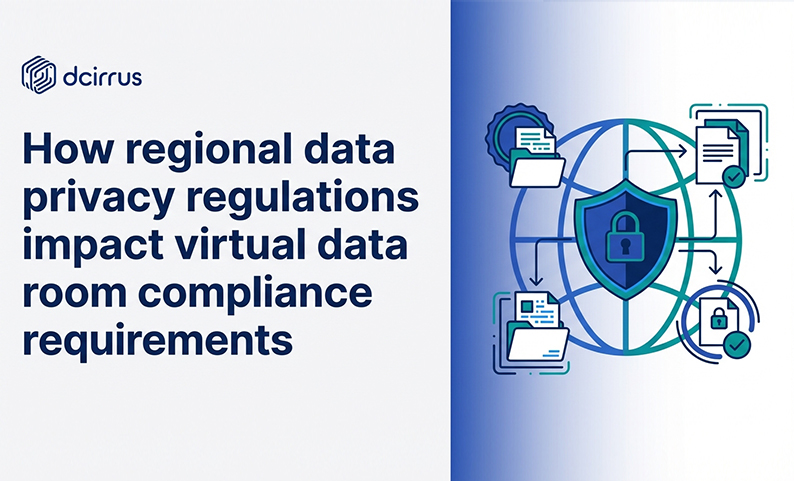
Regional data privacy regulations change what “good enough” looks like in a virtual data room (VDR). The same deal team may need different controls depending on where data subjects live, where counterparties access files, and where the VDR stores or processes information.
So this means VDR compliance is not just “use a secure tool.” It’s a combination of regulatory adherence, security measures (like encryption, multi-factor authentication (MFA), and access controls), and operating discipline. Think data minimization, retention control, incident response. It’s also a shared responsibility between your organization and your VDR provider (especially when you’re running cross-border M&A, fundraising, IPO, or regulatory reviews).
Modern VDR solutions such as DCirrus VDR leverage multi-region cloud infrastructure powered by AWS and Azure, allowing clients to align data storage with regional privacy laws while using 256-bit encryption protocols that help meet global compliance requirements.
What is a Virtual Data Room?
A virtual data room is a secure, controlled online environment used to store and share confidential documents with internal and external stakeholders. Organizations use VDRs for high-stakes transactions where confidentiality and traceability matter (M&A due diligence, IPO preparation, audits, restructurings, and fundraising).
Compared to consumer file-sharing tools, a VDR is designed for stricter document governance. That usually means stronger access controls and detailed audit trails. Features that help reduce leakage risk during sensitive collaboration.
The Meaning of Compliance in Virtual Data Rooms
In a VDR context, compliance means your data room setup, processes and vendor choices support applicable data privacy obligations. Plus the security and governance expectations that regulators, auditors, investors and counterparties will look for.
It typically includes:
- Meeting privacy principles like lawfulness, fairness, transparency, purpose limitation and accountability
- Implementing security controls that protect confidentiality and integrity (encryption and role-based access control)
- Enforcing operational practices like data retention control, data classification and auditability
- Being able to demonstrate regulatory adherence through evidence: policies, logs, access reviews and third-party assurance
The important nuance? A VDR can provide compliance-enabling capabilities, but your organization still must configure and use them correctly.
Key Regional Data Privacy Regulations Affecting VDR Compliance
Privacy regulations don’t all say “use a VDR,” but they create requirements that strongly influence VDR configuration, hosting choices and workflows. A practical way to think about it: regulations shape what data you can share, how you share it, where it can live and what proof you need afterward.
How does GDPR shape VDR compliance?
The GDPR is one of the most influential privacy regimes because it applies broadly (including to organizations outside the EU that handle EU personal data in certain contexts). For VDR operations, GDPR implications commonly show up in these areas:
- Purpose limitation and access discipline. Only share what is necessary for due diligence, and restrict access to people who truly need it.
- Accountability and auditability. You need defensible records of who accessed personal data, when and what they did with it. This makes audit trails and reporting critical.
- Data minimization and retention control. Avoid loading entire systems of record into a VDR “just in case,” and have clear retention and deletion practices after the transaction.
- Breach readiness. Incident response and notification protocols need to exist before you open the room to dozens (or hundreds) of external users.
If you’re using a VDR for a process that includes employee data, customer lists or contracts with personal data, GDPR-aligned controls become operational requirements. Not theoretical principles.
India’s Digital Personal Data Protection Act and Emerging Markets
India’s Digital Personal Data Protection Act (DPDPA) is a major driver for organizations running India-linked transactions or handling personal data connected to India-based operations. Practically, it increases attention on:
- Document classification: Teams need a reliable way to identify which data room content includes personal data and which is purely corporate or financial
- Controlled access and logging: Strong access controls paired with audit trails help prove appropriate handling
- Operational governance: How your organization collects, uses, shares and retains personal data becomes more scrutinized (especially when multiple third parties join the data room)
In emerging markets more broadly (including parts of Latin America and Africa), privacy regimes are evolving. That uncertainty affects VDR compliance requirements in two ways. You need a compliance operating model that can adapt quickly as rules change. And you often need conservative baseline controls because they are defensible across many regimes. Encryption, MFA, least-privilege permissions and documented retention practices.
China, Russia, Brazil, and Other Data Localization Laws
Data localization and data sovereignty requirements are where regional differences most visibly impact VDR architecture. Even when laws don’t use identical terminology, the compliance impact is similar: regulators may expect sensitive categories of data (or sometimes broad classes of personal data) to be stored and processed within national or regional boundaries, or to meet strict conditions before cross-border transfer.
Here’s how these pressures commonly translate into VDR decisions:
- Server location becomes a compliance control (you may need the ability to choose where data is hosted, not just whether it’s “in the cloud”)
- Cross-border access needs governance. Even if data is stored in-country, international deal teams may still need access. That can require stricter access rules, stronger authentication and clearer policies about what can be downloaded.
- Export and off-platform sharing become risk points. If users download documents, email them or store them elsewhere, localization efforts can be undermined.
For teams working across China, Russia, Brazil (LGPD context) and other jurisdictions with stronger localization expectations, a VDR is not only a security tool. It’s part of your compliance architecture. This is where multi-region hosting options and enforceable document controls matter.
Essential Compliance Certifications and Standards for Virtual Data Rooms
Privacy laws define obligations. Certifications and standards help you evaluate whether a provider’s security program is mature enough to support those obligations.
What SOC 2 and ISO 27001 Cover and Why They Matter
SOC 2 and ISO 27001 are common trust signals used in vendor selection and security assurance.
SOC 2 reports (often aligned to trust services criteria) help organizations understand whether a provider has controls in place and whether those controls have been evaluated. ISO 27001 focuses on information security management systems, emphasizing a structured approach to managing risks and controls.
For VDR compliance, these matter because they support vendor risk management (you can map your internal compliance checklist to recognized control areas). Also audit readiness. When auditors or counterparties ask “how do you secure this data room,” certifications help provide a credible baseline. And ongoing control discipline—standards encourage repeatable processes rather than one-time security setups.
That said, a certification does not automatically mean a provider meets every regional or industry requirement you have. You still need to validate specific controls like data residency options, encryption and logging depth.
Vendor Due Diligence and Third-Party Audit Considerations
A practical provider assessment goes beyond “Do you have SOC 2?” and gets into whether the provider’s controls match your risk profile and regulatory scope.
Vendor due diligence commonly includes:
- Reviewing third-party audit coverage and scope. What systems and services are included, and what period does it cover?
- Clarifying shared responsibility boundaries. What does the provider secure by default, and what must your team configure (permissions, retention, user lifecycle, exports)?
- Evaluating incident response alignment. How the provider supports investigation, evidence collection and notification protocols when something goes wrong.
- Confirming data handling practices. Where data is stored, how it is encrypted and how access is logged and monitored.
If your VDR will be used in regulated transactions, your due diligence should be documented so it becomes evidence of accountability. Especially when regulators expect you to demonstrate proactive vendor selection.
How Regional Regulations Shape VDR Security Features and Operational Procedures
Regional regulations influence both the “hard” controls (technical security) and the “soft” controls (how people operate the room day to day). The most defensible approach? Treat the VDR as a governed environment with policies that are enforced through platform features.
Data Storage Location and Data Localization Requirements
Data localization requirements can force architectural decisions that aren’t negotiable. In VDR terms, this often becomes a question of which region the VDR is hosted in, whether you can select specific data center regions for a given transaction and how cross-border access is managed without creating uncontrolled copies of the data.
If you anticipate localization-driven constraints, plan early. Before the room is populated. Retrofitting residency after sharing begins is difficult because you may already have created exports, downloads or replicated copies.
DCirrus VDR is powered by AWS and Azure infrastructure with multi-region data center availability and supports data localization, allowing clients to choose server locations for compliance with regional data protection laws.
Key Security Controls: Encryption, Multi-Factor Authentication, Access Controls
Most privacy regimes do not prescribe exact technologies, but they strongly imply the need for safeguards appropriate to risk. In a VDR, the baseline expectations typically include:
- Encryption (protect data at rest and in transit so documents are not exposed if storage or network traffic is compromised)
- Multi-factor authentication (MFA). Reduce account takeover risk for external users who may not follow your internal password standards.
- Granular access controls. Enforce least privilege using role-based access control and limit access by folder/file where needed.
- Zero trust mindset. Treat every user and device as untrusted until verified. Avoid broad default access.
Advanced features like document-level digital rights management, granular role-based permissions and comprehensive audit trails enable organizations to operationalize compliance requirements precisely and maintain full visibility of data access and usage.
Operational Practices: Audit Trails, Data Minimization, Role-Based Access
Operational procedures are where compliance often fails. Not because tools are missing but because processes aren’t defined or enforced.
Three practices matter across most regions:
- Audit trails. Detailed logs help you prove compliance, investigate suspected misuse and support legal defensibility in disputes.
- Data minimization. Only upload what is relevant to the transaction and avoid over-sharing personal data or sensitive datasets.
- Role-based access and reviews. Define roles (buyer counsel, investor, banker, internal finance) and perform periodic access reviews, especially in longer deals.
These practices should be written down in your data handling policies, then implemented in the VDR through permissions, watermarking, download restrictions and user lifecycle controls.
Building Cross-Functional Workflows for VDR Governance
Multi-jurisdiction compliance is hard when legal/privacy and security teams operate in parallel. The best outcomes usually happen when you treat the VDR as a joint governance program with clear workflows and ownership.
A workable model is to define who owns which part of compliance and then build a shared workflow for change management and approvals.
A cross-functional VDR governance workflow often includes:
- Privacy/legal defines what data can be shared, under which legal basis and what restrictions apply by jurisdiction
- IT/security defines how controls are implemented (MFA rules, encryption expectations, device policies, monitoring)
- Deal teams define who needs access, the timeline and what “minimum necessary” means in practice
This is also where the shared responsibility model becomes real. The provider supplies tools and security posture, while your organization configures permissions, approves user access and enforces internal policies.
Continuous Compliance Monitoring and Incident Response Preparedness
Because regulations evolve and threats change, compliance can’t be a one-time setup at deal kickoff. Continuous compliance monitoring typically means regular access reviews (confirm users still need access and remove dormant or offboarded accounts). Also monitoring and alerting. Watch for unusual access patterns that may indicate compromised accounts or insider risk. Evidence readiness matters too—ensure logs, reports and approvals are retained so you can demonstrate accountability later. And incident response drills. Align internal incident response with vendor processes so notification protocols and investigation steps are clear.
This preparation reduces scramble during an actual incident and improves your ability to respond without derailing the transaction.
Risks and Consequences of Non-Compliance with Regional Data Privacy Laws in VDR Usage
Non-compliance isn’t only about fines. In transaction contexts, the immediate impact is often deal risk (delays, renegotiations, loss of trust or failed diligence).
Common Compliance Failures and How to Avoid Them
Here are frequent VDR-related compliance breakdowns that show up across regions:
- Over-sharing documents “for speed” instead of applying data minimization
- Using broad permissions that grant external parties access to unrelated folders
- Allowing downloads without controls, creating uncontrolled copies outside the VDR
- Weak authentication for external users, increasing account takeover risk
- Missing or incomplete audit trails that can’t answer basic questions like “who accessed this file?”
- No retention plan (leaving data available long after the transaction ends)
- Poor coordination between privacy and IT/security, causing policy-control mismatches
Avoiding these failures usually comes down to disciplined configuration, documented approvals and continuous review. Not just buying a platform.
Penalties, Fines, and Deal Risks Associated with VDR Non-Compliance
Regulatory penalties can be severe. GDPR is often referenced because it includes high maximum administrative fines (up to €20 million or 4% of global annual turnover, depending on the case). Other regional regimes can also trigger enforcement actions, contractual liabilities and litigation exposure.
In VDR-driven transactions, common deal-specific consequences include buyers or investors pausing diligence until controls are improved. Counterparties requiring additional representations, warranties or indemnities. Increased scrutiny from auditors, regulators or boards. And reputational damage if sensitive documents leak during a deal.
The business lesson is simple. VDR compliance failures can become transaction failures.
Evaluating and Selecting Compliant Virtual Data Room Providers
Provider choice is a compliance decision. The right evaluation process focuses on your jurisdictions, your data types and how the VDR will actually be used by deal teams.
Compliance Features to Prioritize When Selecting a VDR
A compliance-oriented VDR selection checklist typically prioritizes:
- Data localization options and clear data residency controls
- Encryption for data at rest and in transit
- MFA and strong authentication support
- Granular role-based access control and device/IP restrictions
- Audit trails that are detailed, exportable and retained appropriately
- Digital rights management (DRM) controls to limit printing/copying/sharing
- Watermarking and document tracking to discourage misuse
- Support for data retention control and end-of-deal cleanup
- Third-party assurance such as SOC reports and ISO-aligned practices
DCirrus VDR includes document-level DRM controls, role-based access at folder and file levels, device-level approval, IP restrictions, two-factor authentication (2FA), customizable watermarking and comprehensive audit trails.
Questions to Ask Vendors About Compliance and Security
Use vendor questions that map directly to regulatory adherence and audit readiness:
- Which regions can you host data in, and can we select a specific server location for this transaction?
- How do you support data localization requirements in practice (storage, backups, processing)?
- What encryption is used for data at rest and in transit, and how are keys managed?
- What MFA options do you support for external parties, and can we enforce MFA for all users?
- How granular are permissions (folder, file, time-bound access), and can we restrict downloads?
- What does your audit trail include, and how long are logs retained?
- How do you support incident response, investigation and notification protocols?
- What SOC reports and ISO certifications apply, and what is in scope?
- What is the shared responsibility model? What security and compliance tasks remain on our side?
These questions help avoid a common pitfall: selecting a VDR that looks secure in a demo but can’t meet specific regional compliance requirements when the deal goes live.
AI and Automation in Supporting VDR Compliance
AI and automation are increasingly used to reduce manual risk and improve consistency (especially when teams manage large document sets and multi-jurisdiction stakeholders).
AI-Driven Anomaly Detection, Automated Redaction, and Compliance Reporting
In VDR environments, AI-powered capabilities can support compliance by identifying unusual user behavior patterns that may signal misuse or compromised credentials. They accelerate redaction workflows so teams can remove sensitive personal data before sharing. Improve classification and search so users can find necessary documents without bulk exporting or over-sharing. And produce more consistent compliance reporting by turning logs and metadata into usable evidence.
DCirrus VDR includes AI-powered document intelligence such as smart indexing, automated categorization, clause recognition, metadata search and AI-assisted redaction capabilities.
Benefits of Automation for Multi-Jurisdictional Compliance
Automation helps when regulations and deal requirements collide with real-world constraints like time, volume and human error. Key benefits include more consistent application of policies like “minimum necessary” sharing. Faster preparation for audits because evidence is captured continuously. Reduced dependence on manual checklists that vary by team or region. And better scalability when multiple transactions run simultaneously across different jurisdictions.
Automation is not a substitute for governance, but it can make governance achievable at deal speed.
FAQ
What are the key regional data privacy regulations that impact virtual data room compliance?
Commonly relevant regulations and frameworks include GDPR, CCPA, HIPAA, LGPD, PIPL and India’s Digital Personal Data Protection Act, plus assurance standards like SOC 2 and ISO 27001 that support vendor assessment and audit readiness.
How do GDPR, India’s Digital Personal Data Protection Act, and other laws influence VDR security and operational requirements?
They drive requirements around data minimization, access limitation, accountability, audit trails, incident response readiness and (depending on the jurisdiction) data localization and cross-border transfer governance.
What compliance certifications like SOC 2 and ISO 27001 should VDR providers have?
SOC 2 reports and ISO 27001-aligned security management are commonly requested because they help demonstrate structured security controls and support vendor due diligence. You should still confirm scope and whether specific services (and regions) are covered.
How do data localization and regional server requirements affect VDR architecture?
They can require you to select specific hosting regions, restrict where data is stored and backed up, and tightly manage cross-border access and downloads to avoid uncontrolled copies that undermine localization goals.
What security features are essential for VDR compliance with regional privacy laws?
Core features typically include encryption, MFA, granular access controls, role-based permissions, audit trails and operational safeguards such as watermarking and DRM to reduce unauthorized distribution.
How can organizations ensure audit readiness and continuous compliance monitoring in VDR usage?
Use documented workflows, periodic access reviews, continuous log retention and reporting, and aligned incident response processes with clear notification protocols. Treat compliance as ongoing operations rather than a one-time configuration.
What risks and penalties do organizations face if their VDRs do not comply with data privacy regulations?
Risks include regulatory fines, litigation exposure, reputational harm and transaction disruption. Under GDPR, maximum administrative fines can reach €20 million or 4% of global annual turnover (depending on the case). Non-compliance can also trigger deal delays or loss of counterparty trust.
What key questions should be asked when selecting a compliant VDR provider?
Ask about data residency options, encryption, MFA enforcement, permission granularity, audit trail depth and retention, incident response support, third-party audit scope (SOC/ISO) and how shared responsibility is split between your organization and the provider.
Ready to secure your transactions?
Ready to secure your transactions?
Book a free demo of DCirrus Virtual Data Room today and experience enterprise-grade data protection with encryption, access controls, and compliance-ready localization.
Latest Posts
Buyer Engagement Analytics in a VDR: What Deal Teams Can Track
August 17, 2026
12 VDR Features Required for IPO Preparation in India
August 13, 2026
What Bankers and Auditors Need From an IPO VDR in India
August 12, 2026