5 Legacy VDR Gaps That Put Your SEBI-Regulated IPO at Risk
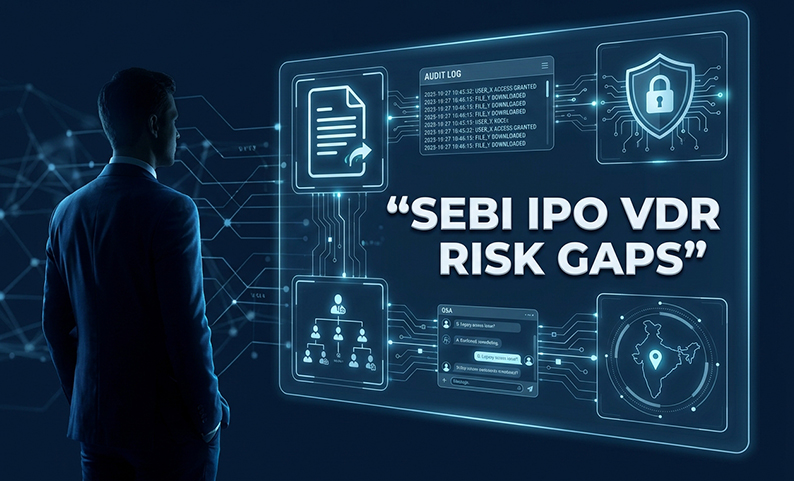
Your DRHP filing deadline is eight weeks out. You have twelve external parties in the data room. And your audit log can’t tell you who opened which document, when, or from what device.
This is the scenario merchant bankers discover mid-deal when they pressure-test a legacy VDR against actual SEBI scrutiny. “Secure file sharing” is not the same as SEBI-grade traceability. Generic M&A data rooms don’t get the difference between a lead manager and a pre-IPO investor. And a watermark on a document is not a control that prevents it from being forwarded.
This article gives you a 5-gap diagnostic built for SEBI-regulated IPOs, not for fundraising or general deal work. Use it to evaluate your current setup or stress-test a vendor before you sign.
The problem: “good enough” VDRs create SEBI risk under deadline
The VDR that worked for your last M&A deal is likely creating risk on your current IPO. The failure modes are different, SEBI scrutiny is more intense, and stakeholder counts are higher. The consequences of a gap, like a leak or an incomplete audit trail, are regulatory, not just operational.
What this article gives you
A 5-gap diagnostic with specific red flags, a checklist to fix each gap, and a 2-week remediation sprint you can run on a live deal.
Frame the solution: the SEBI IPO VDR Risk Check (how to evaluate beyond generic security)
SEBI-grade isn’t a feature tier. It’s an outcome. Can you prove to a regulator exactly who had access to what, what they did with it, and how every question was answered and by whom?
The four outcomes your VDR must protect
- Defensible compliance through complete, exportable logs that survive a regulatory query.
- Leak deterrence with controls that make unauthorized distribution difficult and traceable.
- Diligence speed using folder architecture and Q&A workflows that don’t kill your timeline.
- Stakeholder trust from clean permission boundaries that give each party only what they need.
Every gap below maps to at least one of these outcomes.
1) Audit-trail gaps: you can’t prove diligence when it matters
This is the highest-risk gap. A legacy VDR logs logins. A SEBI-ready audit trail logs every document view, download, print attempt, Q&A action, and permission change with the user’s identity, timestamp, IP address, and device.
Red flags to look for in a live IPO data room
- The audit export is a raw, unfiltered CSV file.
- Failed access attempts aren’t logged.
- Q&A threads are not part of the audit trail.
- Permission changes don’t show who made them or when.
- Log retention is shorter than the full IPO lifecycle.
Remediation checklist
- Enable logging for all event types, including views, downloads, prints, and failed logins.
- Confirm Q&A actions appear in the same audit log as document actions.
- Test the export. Filter by user and document and verify timestamps are in IST.
- Set log retention to cover the IPO lifecycle plus 12 months post-filing.
- Assign one person as the audit log owner and schedule weekly exports.
Teach-first product note: what “comprehensive audit trails + access governance” looks like
When evaluating replacements, look for a VDR that captures device-level activity, not just user-level. For example, DCirrus VDR combines comprehensive audit trails with device-level approval, IP restrictions, and 2FA. This lets you answer not just “who accessed this?” but also “from what device, from which network, and was that access authorized?” That level of specificity makes a log defensible.
2) Permission-model gaps: role confusion leads to overexposure or rework
IPOs involve 10 to 12 distinct parties, such as legal counsel, auditors, and investors, each with different access needs at different stages. Legacy VDRs often use broad groups and inherited permissions, which results in overexposure.
A practical IPO permission blueprint
Structure access in three tiers:
- Deal team (internal): Full access across all folders.
- Transaction advisors (legal, auditors): Folder-specific access. No visibility between firms. Disable downloads on sensitive exhibits.
- Underwriters and anchor advisors: Staged access. Enable the financial folder only after the red herring filing.
Never grant access by copying an existing group. Build each party’s permissions from scratch.
Remediation checklist
- Audit every current user. Confirm their firm, role, and folder access.
- Remove group-level inheritance. Set permissions explicitly at the folder level.
- Create a staged disclosure schedule mapping folders to IPO milestones.
- Disable print and download by default. Enable it selectively by party and document.
- Document the permission structure as part of your compliance evidence pack.
3) DRM + watermark gaps: “watermarks” that don’t prevent leaks
A watermark displaying a user’s name is a deterrent, not a control. If a document can be downloaded and forwarded, the watermark only tells you who leaked it. After the fact. For an IPO with insider trading exposure, that is too late.
What works in practice (and what doesn’t)
Static watermarks are cosmetic. Real leak deterrence combines controls that make unauthorized distribution difficult and identifiable.
- Print and copy restrictions that can’t be overridden.
- Download expiry dates that revoke access to downloaded files.
- Dynamic watermarks tied to the viewer’s identity, IP address, and timestamp.
- Remote revocation that kills a document’s accessibility even after it’s been downloaded.
Remediation checklist
- Enable print and copy restrictions for all parties outside the internal deal team.
- Set download expiry for all downloaded documents (for example, 30 days).
- Confirm watermarks include the user’s login, IP address, and timestamp.
- Enable remote revocation for documents shared with pre-IPO investors.
- Test the watermark. Download a file and verify it contains the correct dynamic fields.
Teach-first product note: implementing DRM + dynamic watermarking
DCirrus VDR’s DRM controls prohibit printing, copying, and forwarding at the document level. Downloaded files carry configurable expiry dates, and dynamic watermarks embed the viewer’s login, IP, and timestamp. Enable these controls on day one, before you invite external parties into the VDR.
4) Q&A workflow gaps: email threads destroy traceability and slow answers
If your diligence Q&A is happening over email, you have no verifiable record for SEBI. You cannot prove what was asked, what was answered, and who authorized each response.
The minimum viable “Q&A traceability” standard
Every diligence question must show the question text, who asked it, when it was submitted, who it was assigned to, the response, who approved the response, and the final timestamp. That is the record SEBI can request.
Remediation checklist
- Ban email for diligence Q&A. Route all questions through the VDR.
- Assign every incoming question to a named owner with a deadline.
- Require manager approval on all Q&A responses before release.
- Confirm Q&A threads are included in your audit log export.
- Archive the full Q&A record before DRHP submission.
Teach-first product note: how integrated Q&A/collaboration reduces risk
DCirrus VDR includes built-in Q&A forums and secure messaging, so diligence discussions never leave the governed system. Comments and annotations stay attached to the relevant document. Automated notifications alert owners when questions are assigned or overdue, creating a Q&A record that’s already formatted as evidence.
5) Data residency + cross-party access gaps: sovereignty risk hides in “global” setups
International co-counsel and offshore investors introduce a key question. Where does the data live, and does that satisfy India’s DPDP Act 2023 and SEBI’s expectations? Storing IPO documents with personal data of Indian users on servers outside India without safeguards creates regulatory exposure.
How to decide where data should live (and what to document)
If all parties are India-based, choose an India-region server and document that choice. If international parties are involved, confirm whether the VDR routes data through offshore infrastructure. Some “global” VDRs do this by default.
Remediation checklist
- Ask your VDR provider which cloud region stores your data.
- If documents contain personal data of Indian nationals, confirm DPDP Act alignment.
- Enable IP address restrictions for international users to limit access to known corporate IPs.
- Enable device-level approval for any external party accessing from outside India.
- Document server location and privacy compliance in your deal file.
Implementation: a 2-week pre-DRHP remediation sprint
Days 1–2: Rapid audit
Check your audit log coverage first. Export your current log and verify it captures user identity, timestamp, document name, action type, and IP address. Then pull your user list and flag any party whose access scope you can’t justify.
Week 1: Reconfigure controls + restructure access
Work folder by folder, resetting permissions from scratch. Enable DRM controls like print/copy restrictions and expiry before adding any new party. Set up Q&A inside the VDR and communicate the change to all parties.
Week 2: Run an access review + export your audit evidence pack
Conduct a formal access review signed off by the deal lead. Export your full audit log, Q&A archive, and permission history. Store them in a secure location outside the VDR as an evidence pack for any potential regulatory query.
Vendor Evaluation: The Questions That Expose Legacy Risk
Choosing the right VDR isn’t about brand names. It’s about finding a partner whose controls map to the realities of a SEBI IPO.
Vendor questions to ask before signing
- Auditability: Can I export a filterable audit log for a specific user and document, including Q&A, in under 5 minutes? Are timestamps localized to IST?
- Permissions: Can I create staged disclosures that automatically release folders on a specific date? Can I see a log of all permission changes, showing who made them and when?
- DRM: Can I remotely revoke a downloaded file? Do your watermarks include the user’s IP and timestamp by default?
- Data Residency: Can I choose to have my data hosted exclusively in an India-based data center? How do you help us comply with the DPDP Act 2023?
Contract and pricing red flags
- Per-page or per-user pricing: These models create cost uncertainty. Look for flat, predictable subscription fees.
- Overage charges for storage or users: A surprise bill mid-deal can force risky workarounds. Get clarity on all potential overages in writing.
- Long-term contracts for a single deal: Avoid a multi-year agreement for a project with a 6 to 9 month lifecycle.
Teach-first product note: localization-ready infrastructure
DCirrus VDR runs on AWS and Azure with multi-region availability. This lets you choose your server location to pin Indian IPO data to an India-region deployment. It supports compliance with both the DPDP Act 2023 and GDPR, which is critical when international advisors are in the room.
Summary and Next Steps
Legacy VDRs fail quietly. An incomplete audit log, a forwarded document, a Q&A thread in an inbox, an IPO file on a Frankfurt server. Together, these create a compliance exposure profile that a SEBI-regulated IPO cannot afford.
Run this 5-gap diagnostic on your current data room today. Start with the audit log. If you can’t export a complete, filtered, timestamped record in under ten minutes, you have a gap that needs fixing before your next filing milestone.
FAQ
What are the most common legacy VDR gaps that trigger SEBI concerns during an IPO? The two most frequent are incomplete audit trails that don’t capture document-level actions and overly broad permissions. Both create problems when SEBI questions the integrity of the diligence process.
How should we structure permissions for underwriters, legal counsel, auditors, and investors without slowing diligence? Build permissions by party and stage, not by a role template. Each firm gets its own access group with explicit folder-level permissions. Enable staged access so financial folders open at the appropriate milestone. Default to view-only and enable downloads selectively.
What should a SEBI-ready audit trail include, and how do we export it for review? It must include at minimum: user identity, timestamp in IST, document name, action type (like view or download), IP address, and device identifier. The export must be filterable by user, document, and date range and should be retrievable in minutes.
Do dynamic watermarks actually prevent leaks, or do we need DRM controls too? Watermarks alone don’t prevent leaks. They only identify the source after the fact. You need both DRM controls (like print restrictions and remote revocation) to make distribution harder, and dynamic watermarks (with identity, IP, and timestamp) to make any distributed copy traceable.
How do we move IPO diligence Q&A out of email while keeping accountability and approvals clear? Migrate to the VDR’s built-in Q&A system and enforce it as a policy. Assign every question to a named owner, require manager sign-off before responses are released, and confirm the thread appears in your audit export.
What should we ask a VDR vendor about data residency and India’s DPDP Act compliance for an IPO? Ask them which cloud region stores data by default and if you can choose an India-region deployment. Ask how the platform handles personal data under the DPDP Act 2023 and if you can restrict access by IP or device. Get documentation of these choices for your compliance file.
Ready to De-Risk Your IPO Data Room Before DRHP?
If any of the five gaps in this article describe your current setup, the time to fix them is now, not the week before filing. DCirrus VDR is built for exactly this challenge. It provides SEBI-grade audit trails, granular permission controls, DRM with dynamic watermarking, and integrated Q&A, all on an India-region data-localized platform.
Book a free demo to see how DCirrus VDR supports SEBI-compliant IPO diligence from day one.
Latest Posts