The VDR as Evidence Infrastructure: A Framework for Building a Defensible Due Diligence Record for SEBI
Buyer counsel emails at 9 PM: “Please provide a complete access history and all Q&A correspondence for the data room.” Your team scrambles. The access log is somewhere in the VDR admin panel. The Q&A is split across three email threads and a WhatsApp group. You can’t produce a clean answer, and you know it.
This is the evidence gap, and it’s more common than anyone admits.
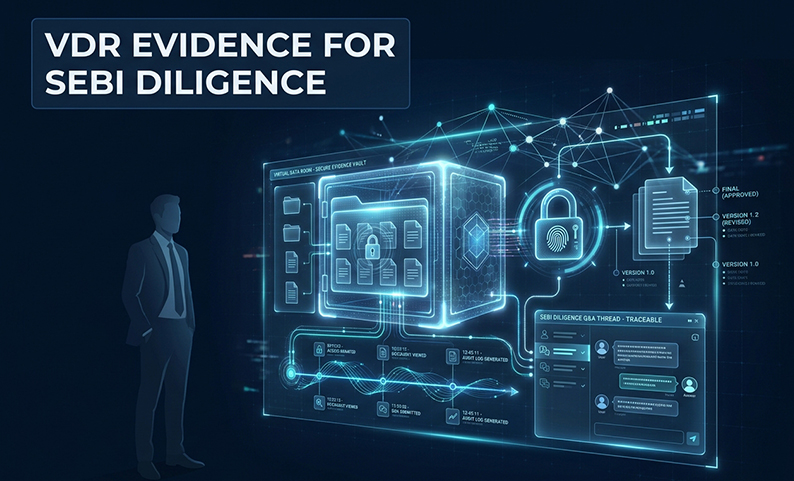
The shift is simple but consequential: stop treating your VDR as a document repository and start treating it as evidence infrastructure. This means designing your data room to continuously capture proof of access, control, and process, not just store files.
Here is a seven-point framework for building a defensible due diligence record, a simple responsibility model, and a look at the common pitfalls that create evidence gaps even when teams are already using a VDR.
What Is “Evidence Infrastructure” in a SEBI-Facing Due Diligence Context?
A defensible due diligence record isn’t just a complete document set. It’s the combination of documents and tamper-resistant proof that the right people had the right access, changes were tracked, and every question was handled on the record.
To be ready for a regulatory query, you must be able to prove:
- Who accessed which documents and when
- What changed, version by version, with timestamps
- How questions were raised, assigned, and answered
- What controls were in place at each stage (permissions, DRM, watermarks)
Generic cloud drives and email chains break every one of these requirements. You can’t verify distribution, traceability is fragmented, and version history is guesswork.
A purpose-built VDR addresses this directly. DCirrus VDR, for example, is built around granular permissions, a comprehensive audit trail, DRM controls, and a centralized Q&A module. It’s a practical starting point for teams that need evidence-grade controls, not just file sharing.
What Must Your VDR Capture to Withstand Regulatory Queries?
Treat proof artifacts as first-class outputs of your deal process, not afterthoughts. Here’s the minimum evidence set to be query-ready:
- Immutable audit trail: Every view, download, print, login, and Q&A action, timestamped and tied to a specific user
- Permissioning history: Who was granted or revoked access, when, and at what scope (folder vs. file level)
- Document version lineage: What changed in each file, when it was replaced, and who uploaded the new version
- Q&A traceability: Every question linked to its relevant document, with timestamps, an assigned owner, and the final answer on record
- Watermarking/DRM policy state: Which folders had print/copy restrictions and dynamic watermarks applied, and when those policies were active
The real test is exportability. When counsel or a regulator asks for proof, you need to generate a clean, readable report, not dig through admin panels under pressure.
What Is the 7-Point Framework for Building a Defensible SEBI-Ready Due Diligence Record?
Defensibility doesn’t happen by accident. You design it into the room before the first buyer logs in.
1. Scope what’s “SEBI-relevant” and segregate it
- Build a folder architecture that isolates SEBI-relevant material from general business data.
- Define what enters and exits the room at each deal phase.
- A restricted scope means a smaller audit surface and faster retrieval when queries arrive.
2. Enforce least-privilege access by role, not by person
- Create named groups: buy-side, legal, auditors, internal deal team.
- Apply permissions at the folder and file level for each group.
- Build a rapid revoke process to cut access when a phase ends or a party exits.
3. Harden identity and access conditions
- Require MFA for all users; add device-level approval for high-sensitivity workstreams.
- Apply IP restrictions for external parties accessing the most sensitive folders.
- Maintain an offboarding checklist to run at each phase gate (teaser → IOI → confirmatory).
4. Control distribution, not just access
- Apply print/copy restrictions to all sensitive documents by default.
- Set expiry on downloaded files so stale copies lose access automatically.
- Enable dynamic watermarking on view, download, and print. Every user’s identity follows the document.
5. Make logs “audit usable”
- Verify that every event type (view, download, print, Q&A, login) is captured and exportable.
- Define a retention period aligned to your deal lifecycle and firm policy.
- Run a simple weekly evidence export to an internal archive during the active deal phase.
6. Replace email with an auditable Q&A workflow
- Centralize all questions inside the VDR. No deal Q&A over email or messaging apps.
- Assign each question to an owner and track status against an SLA.
- Link every question to the document it references. Keep the final answer in-system.
7. Operationalize “ready-to-answer” reporting
- Prepare standard packs: who-accessed-what reports, most-viewed documents, and permission snapshots at key dates.
- Write a one-page query response runbook before you need it.
What Should the Folder Structure Look Like So Evidence Is Easy to Retrieve Later?
A top-level structure aligned to common diligence areas gives reviewers predictability:
- Corporate & Ownership / Financials / Legal & Contracts / Regulatory / HR / IP / Litigation
Add evidence-first folders that most teams skip:
- Policies & Approvals (access decisions, exception logs)
- Q&A Exports (periodic exports of the full Q&A transcript)
- Audit & Log Exports (weekly evidence packs)
- Version History Notes (change summaries for major document updates)
Use consistent naming (like dated, owner-tagged folders) to remove ambiguity when you’re reconstructing a timeline months later.
How Do You Assign Roles So Your Team Stops Being the Helpdesk?
Defensibility improves when ownership is explicit. Here is a simple breakdown:
| Role | Responsibility |
|---|---|
| VDR Owner (AVP/Director) | Policy decisions, access approvals, escalation |
| Analyst / Admin | Uploads, indexing, permission execution, Q&A routing |
| Legal | Redaction standards, disclosure boundaries |
| Compliance / InfoSec | Access conditions, retention expectations, vendor oversight |
This practical cadence keeps the system working:
- Daily: Q&A triage to route new questions and flag overdue responses.
- Weekly: Evidence export and report review.
- Phase-gate: Full permission review before each new access stage.
When roles are clear, analysts stop fielding one-off access requests and start spending time on analysis.
Where Do SEBI-Facing Diligence Teams Create Evidence Gaps?
Teams create evidence gaps through inconsistent operations, not bad intent. Watch for these:
- Permission sprawl: One-off invites outside the role structure, leaving no clean group-to-person mapping.
- Side-channel Q&A: Questions answered over email or WhatsApp “for speed,” leaving no traceable record.
- Inconsistent watermarking: Applied to some folders but not others, creating uneven coverage.
- Version confusion: Files re-uploaded without a clear version note or change summary.
- No log export rhythm: Reports are never pulled until a crisis, by which point the value of continuous capture is gone.
Early warning signals to watch:
- Repeated “where is this file?” questions from analysts.
- Multiple documents with near-identical names in the same folder.
- A sudden spike in downloads in the final week before signing.
If you’re seeing any of these, the evidence record is already degrading.
How Should You Handle Vendor Oversight, Cloud, and Data Residency So Accountability Is Provable?
Your defensible record must cover platform governance, not just deal content. Document these details inside a dedicated “Platform Governance” folder:
- Hosting region decision: Where data sits and the rationale for that choice (data localization).
- Security assurances: Certifications and audit reports available from the provider.
- Contract basics: Audit rights, breach escalation, subcontractor awareness, and retention expectations.
DCirrus runs on AWS and Azure infrastructure with multi-region availability and a data localization option. Clients can specify their preferred server region to support data protection compliance. Data centers are ISO 27001 certified, and SOC 1, 2, and 3 reports are available. For teams with stricter requirements, an on-premise deployment option exists.
These aren’t marketing points. They are the artifacts you may need to produce if your firm’s compliance team asks how you governed the platform.
How Can You Use AI and Redaction to Move Faster Without Creating New Compliance Risk?
AI features can accelerate two high-value diligence tasks: finding specific clauses across large document sets and preparing redacted versions for controlled disclosure.
High-value use cases:
- Clause recognition and metadata search: Locate every instance of “change of control” or “assignment restrictions” across thousands of files in minutes, not days.
- AI-assisted bulk redaction: Remove PII and sensitive fields from documents before granting access, reducing manual review time.
DCirrus AI document intelligence (which includes smart indexing, clause recognition, and AI-assisted redaction) addresses both. Exportable indexes and usage graphs support fast responses to a diligence or regulatory query.
Operational guardrails to keep it defensible:
- Restrict AI tool access to lead analysts and legal.
- Run spot-check reviews on redacted outputs before distribution.
- Version-control every redacted document and keep a record of what was removed and why.
Speed and defensibility aren’t in conflict here. They require the same discipline.
Summary and Next Steps: What Is the Single Highest-Leverage Change You Can Make This Week?
Defensibility is designed, not hoped for. The teams that produce clean evidence records under pressure built the system before the deal got complicated, not after.
Your one-week plan:
- Lock a roles and permissions template before the first external login.
- Move all Q&A into the VDR. Shut down deal Q&A over email immediately.
- Start exporting a weekly evidence pack: access logs, Q&A transcript, permission snapshot.
That’s the operating system. Run it consistently across every deal, and you’re not starting from scratch each time a query lands.
Frequently Asked Questions
What’s the difference between an audit trail and a defensible evidence record? An audit trail is a log of system events. A defensible evidence record is a curated, exportable package (including the audit trail, permission history, and Q&A transcripts) organized to answer a specific query quickly and completely.
How long should we retain VDR logs and Q&A transcripts for a deal? Retention depends on your firm’s policy and regulations, but a practical baseline is five to seven years post-close for M&A and IPOs. Confirm with your compliance team; the VDR should support this.
Can we use Google Drive or Dropbox and still be “audit-ready”? Not reliably. Consumer cloud storage lacks an immutable audit trail, granular permission history, DRM controls, and integrated Q&A. You can store documents there, but you can’t produce the proof artifacts a regulator expects.
What should we export when a buyer’s counsel asks “who accessed what”? Export the full user activity report for that party showing views, downloads, prints, timestamps, and document names. Add a permission history snapshot showing when access was granted and at what scope.
How do we prevent “download and forward” leakage in practice? Apply DRM restrictions (no print/copy) and set expiry dates on downloaded files. Enable dynamic watermarking so every copy carries the recipient’s identity. This creates a strong deterrent and a clear evidence trail.
What’s the minimum folder structure for a sell-side process? Corporate & Ownership, Financials, Legal & Contracts, Regulatory, HR, IP, and Litigation. Also include evidence folders: Policies & Approvals, Q&A Exports, Audit & Log Exports, and Version History Notes.
How do we handle access changes between IOI and confirmatory diligence? Treat each phase gate as a full permission review. Revoke access for parties not progressing, then create a new permission snapshot. Document the review in your Policies & Approvals folder.
Should we allow AI features in regulated diligence workflows? Yes, with guardrails. Restrict AI tool access to defined roles, standardize redaction review with spot checks, and version-control all AI-assisted outputs. AI accelerates high-volume tasks; discipline keeps the output defensible.
Want a VDR That’s Built for Evidence-Grade Due Diligence- Not Just File Sharing?
Book a free demo of DCirrus VDR to see how granular permissions, DRM controls, centralized Q&A, AI-powered search, and exportable audit trails help your team run faster diligence while staying audit-ready.
Latest Posts