Virtual Data Room Features That Matter for Concurrent IPO and M&A Deals
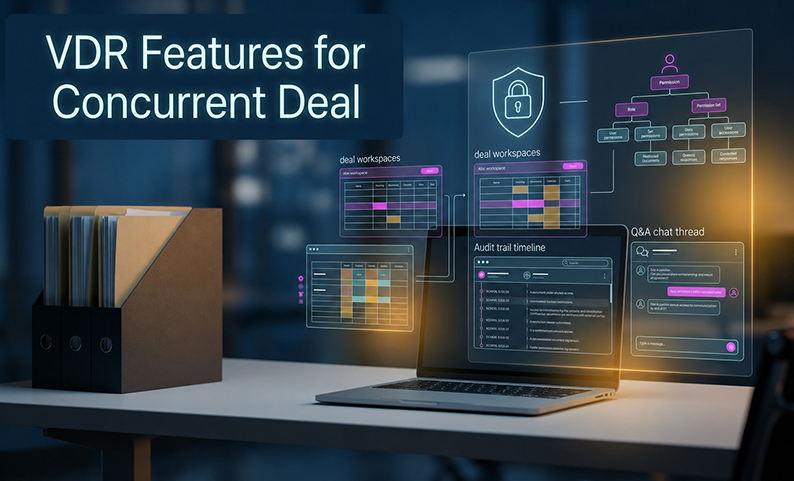
When you are running an IPO and an M&A mandate at the same time, the real risk is not slow upload speeds. It is one bidder seeing another deal’s file, one reviewer getting the wrong version, or one audit trail failing to reconstruct what happened when SEBI asks questions. That is why the right answer is not a bigger file repository. It is a VDR with top deal management features built around isolation, least privilege, evidence, workflow, and operating scale. In this guide, you will get a practical framework for evaluating virtual data room features so you can separate what is essential from what is just nice to have.
Why concurrent deals need a transaction operating model, not just storage
A room for live capital-markets work has to do more than hold documents. It has to keep each deal boundary intact, control who can see what, preserve a defensible record, and let a small team manage several workstreams without turning into a super-user bottleneck.
That is the difference between generic file sharing and real deal management features. The platform must support the merchant banker’s accountability, not blur it. SEBI expects substantive due diligence, structured records for sensitive information, and evidence that can stand up to internal, client, and regulatory review. The VDR is part of that evidence system. It is not the substitute for judgment.
The 10 features that matter most in a VDR with top deal management features
1. Can the platform isolate every live transaction?
Concurrent deal safety starts with hard boundaries. An IPO room and an M&A room should not share users, Q&A, exports, or search results by accident.
Look for:
- separate deal workspaces or equivalent tenant isolation
- separate administrators and deputies for each room
- separate Q&A queues and export sets
- approved templates that do not inherit the wrong users
- a test that proves a portfolio administrator cannot cross the boundary
If a vendor says “multi-project” but cannot prove isolation in a live test, that is not enough.
2. Does permissioning follow least privilege?
Folder-only access is usually too blunt for diligence. You need role-based access with file-level exceptions, especially for models, litigation, personal data, and privileged advice.
Test for:
- default deny access
- separate view, search, download, print, copy, upload, and admin rights
- time-bound access for external parties
- device approval, IP controls, and fast offboarding
- effective-permission reporting, not just role templates
This is one of the core virtual data room features that determines whether the room is actually controlled or just looks controlled.
3. Can the platform restrict what happens after access is granted?
That is where DRM matters. A user may be allowed to open a file, but that does not mean they should be able to print, forward, or keep an uncontrolled copy forever.
Check for:
- separate policies for view, download, print, copy, and expiry
- dynamic watermarks with identity and time
- watermark behavior on view, print, and download
- revocation or remote shred support, if offered
- fence view as an extra layer, not a guarantee
DCirrus publicly describes encryption, DRM restrictions, expiry, dynamic watermarks, user-based IP identification, and device-level approval. Treat those as product claims to verify in a demo against your own files and browsers.
4. Will the audit trail stand up to scrutiny?
A login log is not enough. You need a chronology that shows who did what, when, from where, and against which document or permission.
Ask whether logs cover:
- invitation, approval, login, failed login, MFA, and device approval
- view, preview, download, print, copy attempt, search, and watermark events
- upload, replacement, version creation, deletion, restore, and export
- role changes, permission changes, revocation, and offboarding
- Q&A activity, redaction, administrator actions, and integrations
Also check whether the export is machine-readable, human-readable, time-synced, and easy to reconstruct. For a merchant banker, that is not a nice extra. It is core evidence.
5. Does Q&A replace email chaos with controlled disclosure?
The best deal management features do not just move messages into a new box. They create a controlled workflow with ownership, due dates, approvals, and selective publication.
A solid Q&A flow should support:
- question submission tied to a document or section
- triage for scope, privilege, and duplicate requests
- assignment to the right subject-matter owner
- draft, review, approval, and publication states
- question history, reassignment, and closure
- selective visibility so one bidder does not see another bidder’s exchange
If email still carries the real decision path, the room is not doing its job.
6. Can reviewers find the right clause across mixed-format files?
Search is only useful if it works on real diligence content. That means scanned PDFs, not just clean text files.
Baseline checks:
- OCR on scanned documents
- full-text search with exact-page results
- metadata filters for type, owner, date, status, and privilege
- controlled taxonomy for disclosures, contracts, litigation, and regulatory filings
- permission-aware search so users do not learn about content they cannot access
DCirrus product materials describe smart indexing, metadata search, clause recognition, and AI-assisted redaction. Those are useful, but they should be tested against your own scanned files, not accepted on the slide alone.
7. Is redaction permanent and reviewable?
Redaction is not a black box over text. It is a release-control process. If hidden text, OCR layers, or prior versions survive, the control has failed.
A good review process should confirm:
- permanent rendering of the redacted version
- human approval before release
- checks for hidden text, metadata, comments, bookmarks, thumbnails, and attachments
- a redaction log with source version, reason, reviewer, and release time
- no accidental overwrite of the approved version
AI can help suggest what to redact, but it should not make the final decision.
8. Can the room coordinate multiple stakeholder groups without leakage?
An IPO or M&A room usually involves legal, audit, registrar, underwriter, finance, technical advisers, and investors. The platform needs to support that complexity without turning into a shared email thread in disguise.
Look for:
- secure messaging, comments, annotations, and notifications
- permission-aware discussion threads
- version control for documents that change often
- role-based stakeholder groups by deal phase
- offboarding and handoff at closeout
This is where a VDR with top deal management features can reduce friction. But only if communication stays inside the room and remains tied to the transaction record.
9. Can the team see progress across rooms without becoming a super-user risk?
Portfolio reporting should help the firm manage several mandates at once. It should not let one person see everything in a way that breaks deal boundaries.
Useful reporting includes:
- documents requested, uploaded, reviewed, missing, and superseded
- Q&A ageing and overdue items
- active users, failed logins, and permission changes
- download spikes, repeated access to sensitive folders, and unusual activity
- upload-to-searchable time and question-to-answer time
- backup, restore-test, and incident status
Analytics are helpful, but they do not replace daily human review. They are an operating aid, not a compliance defense by themselves.
10. Can the room launch and repeat efficiently?
If setup takes too much manual effort, teams will cut corners. That is where repeated mandates start to drift.
DCirrus’s public setup claim is under ten minutes for basic room creation, while its deployment playbook describes a more complete CFO-led rollout in five blocks. For a live transaction, the question is not just speed. It is repeatability.
Check whether the vendor supports:
- reusable IPO and M&A templates
- bulk upload and automated indexing
- role-based permissions from the start
- logging and MFA before invitations go out
- a go-live test with an external-style user
- a clear path for data-location selection, backup, and sign-off
Which virtual data room features are essential versus nice to have?
For concurrent transactions, the essential set is smaller than most vendor decks suggest. Focus on the controls that prevent leaks and preserve evidence first.
Essential
- deal isolation
- role- and file-level permissions
- MFA, device approval, and fast offboarding
- DRM and dynamic watermarks
- complete audit trails with export
- controlled Q&A
- OCR and full-text search
- redaction and version control
- secure messaging and notifications
- backups, retention, and recovery
- reusable templates and bulk upload
Nice to have after the basics work
- AI clause recognition
- automated categorization
- portfolio analytics
- mobile access
- branding and custom domain
- advanced anomaly alerts
- integrations and API support
If the foundation is weak, advanced features only make the room prettier. They do not make it safer.
Who should own what in a concurrent-deal setup?
A good room needs clear ownership. Without it, the admin team becomes the hidden source of risk.
| Workstream | Accountable | Key contributors |
|---|---|---|
| Room boundary and go-live | CFO or lead merchant banker | Deal ops, legal, compliance, security |
| Content quality | Finance or legal lead | Issuer, auditor, counsel |
| Identity and access | IT or security lead | VDR admin, vendor |
| UPSI and access review | Compliance officer | Merchant banker, deal ops |
| Q&A and response bank | Deal operations owner | Finance, legal, technical SMEs |
| Retention and closeout | Records owner | Room admin, vendor, legal |
That structure matters because the merchant banker remains accountable even if a vendor hosts the data.
Common failure modes to catch early
Most problems in a VDR show up in the same few ways.
Watch for:
- one room used for every mandate
- folder-only permissions with no file-level exceptions
- shared links or emailed attachments
- a single administrator with no backup
- AI suggestions treated as final truth
- visual-only redaction
- Q&A split between the room and email
- logs that cannot be exported cleanly
- overly broad mobile or offline access
- unsupported “SEBI-compliant VDR” claims
- no subprocessor or support-access review
- pricing surprises tied to users, exports, or archives
- no dry run before inviting external users
These are not edge cases. They are the usual ways deal rooms fail when pressure rises.
How to connect the VDR to a broader operating model
The best way to think about a VDR is as part of the firm’s transaction control system. It should help you prove who saw what, who approved what, and when the disclosure path changed.
That means measuring the workflow, not just counting features. Track things like:
- upload-to-searchable time
- question-to-approved-answer time
- percentage of questions answered on time
- percentage of files with owners and review status
- permission exceptions per deal
- offboarding speed for external users
- audit-export completeness
- restore-test success
If you want the room to support several live deals at once, this is where the payoff comes from. The real value of deal management features is not convenience. It is control you can repeat.
Summary and next steps
For concurrent IPO and M&A work, buy and configure the VDR around three priorities: deal isolation, least privilege, and evidence. Everything else comes after that. If a platform cannot keep rooms separate, control permissions tightly, preserve a usable audit trail, and support disciplined Q&A and redaction, it is not ready for live capital-markets work.
The shortest path to a better decision is a scripted test. Run three isolated rooms, six stakeholder groups, one file-level exception, one Q&A exchange, one scanned-PDF search, one permanent redaction, one audit export, one revocation, and one restore test. Then judge the platform on what it actually does.
FAQ
Which VDR features are essential for concurrent IPO and M&A deals?
Deal isolation, file-level permissions, MFA and offboarding, DRM and watermarks, complete logs with export and retention, controlled Q&A, OCR/full-text search, redaction QA, version control, secure coordination, backup/recovery, and reusable templates.
Are folder-level permissions enough?
Usually not. Sensitive models, litigation, privileged advice, and personal data often need file-level exceptions and separate view, download, print, and copy rules.
Can a VDR replace the merchant banker’s internal structured records?
No. It can support the evidence trail, but the merchant banker still owns the structured record and the accountability that goes with it.
How long should logs be kept?
Use a documented retention schedule that matches the applicable obligations. The research basis here points to five years for relevant merchant-banker records, two years for uniquely identified logs under the CSCRF baseline, and a secure rolling 180 days for CERT-In ICT logs.
Does DRM stop screenshots?
Not absolutely. It can restrict printing, copying, downloads, forwarding, and add watermarks, but screenshots and camera capture still need to be treated as a real-world risk.
Is AI redaction safe without review?
No. AI can help triage, but a named reviewer must approve the final release and check OCR, metadata, attachments, and prior versions.
Is India data residency always required?
The research does not show a universal rule. Data location still matters, but the correct setup depends on law, contract, client needs, and the transaction context.
Is mobile access essential?
No. It is useful in some workflows, but it should be treated as a separately tested, risk-based feature because unmanaged devices and offline copies can weaken control.
What should a vendor demo prove for Q&A?
It should show question intake, routing, due dates, draft and approval states, selective publication, notification behavior, and a complete exportable history.
What is the fastest way to compare two VDRs?
Use the same scripted test: three rooms, six groups, one file exception, one Q&A, one scanned-PDF search, one redaction, one audit export, one revocation, and one restore test.
Ready to run concurrent deals without losing control?
Book a free DCirrus demo and ask the team to run the three-room isolation, permissions, Q&A, redaction, audit-export, and revocation tests against your IPO and M&A workflow. Evaluate the security evidence, operating controls, and total cost, not just the feature list.
Latest Posts
How to Choose a VDR for IPO Preparation and Due Diligence
August 19, 2026
Buyer Engagement Analytics in a VDR: What Deal Teams Can Track
August 17, 2026
12 VDR Features Required for IPO Preparation in India
August 13, 2026