M&A Due Diligence Documents Checklist (By Workstream: Legal, Finance, HR, IT)
You’re three weeks into a deal, and the seller flags that three material contracts are “being located.” Your buy-side counsel is waiting, the timeline is fixed, and you have no clear record of your request. That single gap, a missing document with no audit trail, can stall a closing, reopen valuation, or create regulatory risk.
You don’t need a longer checklist. You need a system. It should be workstream-owned, tiered by priority, and built for traceability from day one. This article provides that system. It’s a practical, by-workstream request list that gives you priority tiers, deal-structure adjustments, and a playbook for handling missing documents. The goal is a clear path from the documents you collect to the risks you can quantify and the actions you need to take.
The problem: a “complete” checklist still fails if it isn’t executable under deal pressure
Most due diligence checklists are comprehensive by design but useless in practice. They give you hundreds of line items and leave you to figure out what to request on day one versus week four, who owns each item, and what to do when half the documents never arrive. This leads to deal teams either over-requesting early (creating noise), under-requesting critical items (missing risks), or running reviews without structure (creating version confusion).
The solution is to treat your diligence list as an executable system. This system is owned by workstream leads, staged across priority tiers, and anchored to a secure, traceable data room.
The framework: run diligence as four workstreams + three priority tiers (so you don’t drown in documents)
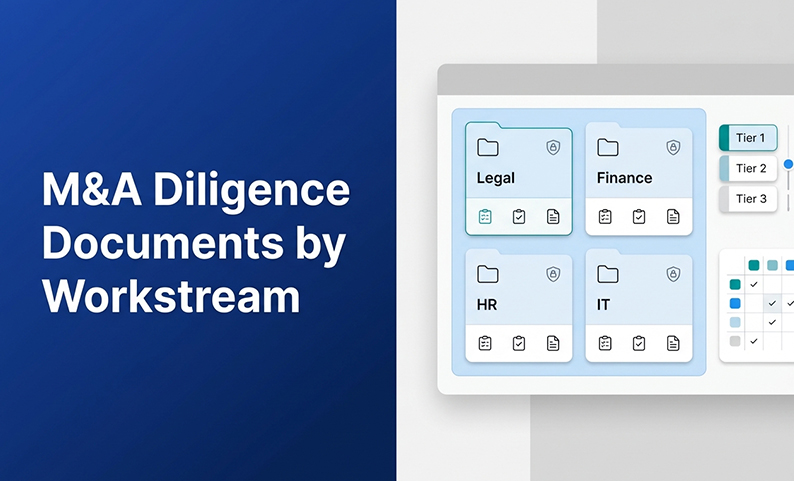
Workstreams and tiers work together. Each workstream (Legal, Finance, HR, IT) has a dedicated owner who manages all requests, reviews, and escalations for that area. Priority tiers control the sequence, so you know what you need immediately versus what you pull only if a red flag appears.
What “Tier 1 vs Tier 2 vs Tier 3” means in practice
- Tier 1 — Deal-critical. These are documents that can block closing, materially shift valuation, or create undisclosed liability. Request them on day one and escalate immediately if they are missing.
- Tier 2 — Material but not blocking. These items affect integration complexity, cost estimates, and purchase price adjustments. Request them in parallel with your Tier 1 review.
- Tier 3 — Confirmatory or contingent. These are pulled only if a Tier 1 or Tier 2 item raises a red flag. Requesting them prematurely just wastes time.
How to set up a due diligence data room to match the workstreams
- Structure: Create four top-level folders that mirror your workstream ownership: Legal, Finance, HR, and IT.
- Permission: Apply folder-level permissions before inviting anyone. Legal counsel sees the Legal folder only. Financial advisors see Finance. Log every permission change.
- Index: Keep a master index or document list. This should map each requested item to its folder location, the responsible party, the date requested, and its current status. This is your operational control mechanism.
When a secure VDR becomes non-negotiable
Permissioning a shared folder or emailing documents creates unmanageable risk. There’s no audit log of who saw what and no recourse if a document leaks. Both regulators and courts want to see a defensible record of document access and review.
A secure data room provides this control. DCirrus VDR, for instance, has granular access controls at the folder and file level, with device approval, IP address restrictions, and 2FA. Each party sees only what they’re authorized to see. Every user action is logged with timestamps and IP data, creating an audit trail that holds up under scrutiny. For any deal involving SEBI oversight, that level of control is not optional.
1) Legal workstream documents checklist (Tiered)
Legal diligence is central. The ownership, authority, contract, and litigation risks discovered here can change the deal price, structure, or viability itself.
Tier 1 (deal-critical): corporate authority, ownership, material contracts, litigation/regulatory
- Corporate authority and ownership: Certificate of incorporation, articles of association, current share register (cap table), shareholder or voting agreements, and board and shareholder minutes for the last 3 to 5 years.
- Material contracts: Top customer and supplier agreements (especially those with change-of-control clauses), joint venture or partnership agreements, and financing or credit agreements.
- Litigation and regulatory: A list of all pending, threatened, or settled litigation from the last 5 years. Also include any government investigations, regulatory notices, and environmental compliance records.
Tier 2: IP, real estate/leases, insurance, compliance programs/policies
- Intellectual property: Patent and trademark registrations, trade secret policies, and IP assignment agreements that confirm company ownership.
- Real estate and leases: Titles for owned property, surveys, and all premises or equipment lease agreements.
- Insurance: Current D&O, E&O, cyber, and general liability policies with claims history for the last three years.
- Compliance programs/policies: Anti-bribery and corruption policies, data privacy policies, and required operational licenses or permits.
Tier 3: historical/ancillary items and “confirmatory” evidence
- Predecessor agreements from prior restructurings.
- Superseded contracts where current versions are already reviewed.
- Historical annual filings beyond the five-year window.
Deal-structure modifier: what changes in an asset purchase vs stock purchase vs merger?
- Asset purchase: Your focus shifts to confirming clean title on each asset and the rights for contract assignment. Many contracts prohibit assignment without consent, so that becomes a key checklist item.
- Stock purchase: You buy the entity and all its liabilities, both known and unknown. Change-of-control provisions in every material contract are now critical.
- Merger: Both entities’ legal documents are in scope. Focus on regulatory approval requirements and shareholder approval thresholds.
2) Finance workstream documents checklist (Tiered)
Financial diligence answers two questions: What is this business actually worth? Where are the liabilities hiding?
Tier 1: audited financials, management accounts, debt schedule, cash/AR/AP, budgets/forecasts
- Historical financials: Audited financial statements for the last 3-5 years (P&L, balance sheet, cash flow) and management accounts for the last 12 months.
- Debt and liabilities: A complete debt schedule of all loans and facilities, including terms and covenants. Also include any related-party transactions.
- Cash, receivables, payables: Bank statements for the last 12 months, plus AR and AP aging reports.
- Forecasts and budgets: The current-year budget versus actuals and three-year financial projections with their stated assumptions.
Tier 2: tax filings/positions, contingent liabilities, customer concentration economics
- Tax returns for the last 3-5 years for all jurisdictions.
- Transfer pricing documentation for any cross-border structures.
- Customer concentration analysis, showing revenue percentage by top 5–10 customers.
- Known contingent liabilities, such as warranty claims, dispute provisions, or earn-out exposures.
Tier 3: deep historicals and supporting schedules
- Financials beyond the five-year window.
- Granular cost center breakdowns (unless margin by segment is already unclear).
- Prior-year budget-to-actuals beyond the current review period.
How to quantify diligence findings into valuation or terms
Use this structure to make findings actionable: Risk → Likelihood → Financial Impact → Deal Lever → Owner. For example, a high customer concentration (35% of revenue) is a high-likelihood risk. The deal lever could be a purchase price reduction or an escrow tied to customer retention. This lever is owned by the buy-side CFO and keeps your findings tied to concrete actions.
3) HR workstream documents checklist (Tiered)
HR diligence validates the people and cost base. It also tells you what it will take to retain and integrate the workforce.
Tier 1: org charts, headcount/comp, key employee contracts, disputes/claims, statutory compliance proof
- Current organizational chart (by function, level, and location).
- Headcount report with roles, tenure, compensation, and employment type.
- Contracts for key employees and senior leadership.
- Pending or historical employment disputes and claims.
- Proof of statutory compliance for PF, ESI, gratuity, and labor licenses.
Tier 2: benefits, incentives/ESOPs, policies, training/disciplinary records
- Employee benefits programs and the cost per head.
- ESOP and equity incentive plan documentation, including vesting schedules and acceleration triggers.
- HR policies for leave, code of conduct, and performance management.
Tier 3: culture/reputation signals you can capture systematically
- Attrition rate by department and level for the last two years.
- Themes from any documented exit interviews.
- Internal survey scores and public employer reviews.
Integration bridge: what HR findings must become Day-1 actions
- Key-person dependency: Prepare retention packages before closing.
- ESOP acceleration: Account for this financial impact in the final deal consideration.
- Labor compliance gaps: Assign a remediation owner and a deadline in the integration plan.
- Policy misalignment: Create a harmonization timeline to avoid ambiguity on day one.
4) IT workstream documents checklist (Tiered)
IT and cybersecurity is where late-stage surprises often live. You need to surface these issues early.
Tier 1: systems inventory, access controls, incident history, backups/DR, critical vendor contracts
- Full IT systems inventory (ERP, CRM, production systems, cloud).
- Access control documentation showing who has admin rights and how access is reviewed.
- Security incident history for the last three years, including breaches and ransomware attempts.
- Backup and disaster recovery documentation with the last tested date.
- Contracts for critical vendors like SaaS, cloud infrastructure, and managed services.
Tier 2: cybersecurity policies, vulnerability assessments, data maps, privacy/compliance posture
- Cybersecurity policies and frameworks (for example, ISO 27001 alignment).
- Results from the most recent vulnerability assessment or penetration test.
- Data maps showing what personal data is collected and where it is stored.
- Privacy compliance posture (for instance, DPDPA 2023 compliance in India or GDPR for cross-border data).
Tier 3: architecture diagrams, logs, historical tickets (pull if risk signals appear)
- Detailed architecture diagrams.
- Historical security logs (relevant only if an incident is under investigation).
- IT helpdesk ticket volumes and their common themes.
Advanced speed-ups beyond “just use a VDR”
Long IT checklists fail when reviewers can’t find information. A secure folder helps, but the real answer is a search layer that works across thousands of documents. DCirrus VDR’s AI-powered document intelligence can find specific contract terms or compliance certifications without manual scanning. Smart indexing, clause recognition, and metadata search can turn two days of work into two hours.
Implementation guide: owners, timelines, and controls (so the checklist actually runs)
Simple RACI: who requests, uploads, reviews, and signs off per workstream
| Role | Requests | Uploads | Reviews | Signs Off |
|---|---|---|---|---|
| Workstream Lead (Buyer) | ✓ | — | ✓ | ✓ |
| Seller’s Designated Contact | — | ✓ | — | — |
| External Advisor (Counsel/Auditor) | — | — | ✓ | ✓ |
| Deal Lead (Merchant Banker) | ✓ | — | — | ✓ |
Version control + audit trail rules you should enforce from day one
- Use one naming convention, always. For example:
FIN-AuditedFS-2024-v1. Make no exceptions. - Archive, don’t delete. When a document is updated, move the old version to a dedicated “Superseded” folder.
- Log every request. Note the date, responsible party, expected date, and status. This log is your negotiation record if documents are withheld.
Keeping Q&A, versions, and tracking inside the VDR
Using email for Q&A and version updates creates chaos and erases the audit trail. A purpose-built VDR keeps all diligence activity in one defensible place. For example, DCirrus VDR includes integrated Q&A forums, version control with a full history, and dynamic watermarking on every document. This setup ensures that every question, answer, and document view is tracked and auditable, which prevents disputes over who knew what and when.
Common failure points (and how to prevent them before they cost you weeks)
What to do when documents are missing, inconsistent, or withheld
This is a frequent blocker. Use a simple playbook.
- Log the gap formally. Use your master index to mark the document as “Pending – Overdue” with the requested date. This creates a time-stamped record.
- Request alternative evidence. If the original doesn’t exist (like historical board minutes), ask for a sworn affidavit or a certificate from the company secretary confirming the facts.
- Escalate with a deadline. If a Tier 1 document is withheld without reason, the workstream lead must escalate to the deal lead. The deal lead can then set a firm deadline before the issue affects valuation or closing.
How to manage intense time pressure without sacrificing diligence quality
Time pressure is a given in any deal. Your best defense is the system you’ve already set up.
- Stick to the tiers. Don’t let reviewers get pulled into Tier 3 items when Tier 1 documents are still outstanding.
- Run workstreams in parallel. Empower your workstream leads to review their own documents at the same time. A well-structured data room enables this.
- Use your index to track progress. The master index provides a real-time dashboard of what’s done and what’s blocking you, letting the deal lead focus only on exceptions.
Summary and Next Steps: treat the checklist as a system, not a list
A document checklist is only a starting point. A system is what gets a deal done on time and without surprises. This system needs workstream owners, priority tiers, and a secure, auditable data room.
Your immediate next step is to assign your workstream leads and set up the tiered folder structure in your data room. That single action will structure the entire process for success.
FAQs
1. How long does M&A due diligence typically take, and what makes it run longer? Timelines vary from 30 to 90 days. The most common cause of delay is a disorganized seller providing incomplete or missing documents. A clear, prioritized request list and a well-structured data room can significantly shorten this.
2. What goes in a due diligence data room first if we only have a week to start? Focus exclusively on Tier 1 documents. This includes the certificate of incorporation, cap table, shareholder agreements, audited financials for the last three years, the debt schedule, and contracts for top customers.
3. How do I handle missing or incomplete due diligence documents without stalling the deal? First, log the gap formally in your master index. Second, request alternative evidence, like a sworn affidavit. Finally, if the document is deal-critical (Tier 1), escalate to the deal lead with a clear deadline.
4. What are the key differences in due diligence for an asset purchase vs a stock purchase vs a merger? In an asset purchase, you focus on clean title to assets and contract assignability. In a stock purchase, you inherit all liabilities, so diligence on contracts, litigation, and taxes is more extensive. In a merger, diligence covers both companies, with a heavy focus on regulatory and shareholder approvals.
5. What’s the best way to maintain version control and audit trails during diligence? Use a secure VDR with built-in tools. Enforce a strict file naming convention, move superseded files to an archive folder instead of deleting them, and use the VDR’s Q&A module instead of email to keep all communications auditable.
6. How do diligence findings translate into integration plans and synergy targets? Each finding should be mapped to a potential impact (financial, operational, or legal) and assigned an owner. For example, an HR finding about misaligned compensation becomes a Day-1 action item for the HR integration lead to create a harmonization plan.
Want a due diligence data room that stays secure, searchable, and audit-ready under deadline pressure?
Book a free demo of DCirrus VDR to see how granular permissions, audit trails, AI search, and integrated Q&A support faster, defensible diligence.
Latest Posts