Managing the M&A Diligence Q&A Process_ A Framework for Control and Clarity
You’re managing a live deal. Questions are arriving through three email chains, a shared drive, and a WhatsApp message to a finance SME who hasn’t replied in 48 hours. Legal wants to review every answer. The buyer’s counsel wants responses by Thursday. You have no idea what’s been answered, what’s pending, or if your CFO’s comment yesterday contradicts what your tax advisor said last week.
This is what a diligence Q&A breakdown looks like. It’s not a communication problem. It’s a control problem.
The diligence Q&A process is the control system for the entire deal. It isn’t admin work or document management. It’s the system that determines whether your deal closes on time and on your terms. When you run Q&A reactively, answering questions as they arrive through random channels, you create inconsistent disclosures, miss red flags, and build a deal record that can’t defend itself in post-close disputes.
A lightweight Q&A operating framework fixes this without new technology or a complete process overhaul. It just requires clear ownership, a repeatable workflow, and a few explicit rules that every party follows from day one.
Why diligence Q&A breaks down (and what “control + clarity” actually mean)
Most diligence processes have a data room and a checklist. Very few have a real Q&A operating system, a defined path from question intake to published answer to logged record.
The failure modes are predictable. Questions arrive through email, calls, and chat with no central capture point. SMEs answer without approval, creating inconsistencies. Answers don’t reference source documents. Sensitive information gets shared with the wrong people. When a dispute surfaces post-close, there’s no clean record of who said what.
“Control” means every question is captured, assigned, approved, and answered through a defined process with traceable records. “Clarity” means every stakeholder, internal and external, knows the rules, the timeline, and the single place where answers live.
What you’re optimizing for: speed, defensibility, and confidentiality
These three goals require explicit trade-offs. Speed means having a process that doesn’t bottleneck on one person. Defensibility means every answer is documented, sourced, and approved. Confidentiality means sensitive information gets tiered access, not blanket sharing.
Every decision in the Q&A process should pass a simple test: does this make the process faster, more defensible, and more confidential? If it trades one for another without a good reason, you should reconsider.
The Q&A Control Framework (a 7-step operating system you can run on any deal)
This article walks through a seven-step structure:
- Centralize intake with one channel and consistent fields.
- Triage by risk and impact, not arrival time.
- Assign owners and set SLAs so work moves forward.
- Draft consistent, evidenced, and negotiation-aware responses.
- Apply approvals and confidentiality controls before sharing.
- Publish, log, and reuse answers to build the diligence record.
- Convert findings to deal protections at the negotiation table.
This is a process you can implement at deal kickoff. The tools matter less than the discipline, but the framework only holds if Q&A lives in one place.
The minimum artifacts you need (even on small deals)
You don’t need sophisticated software to run this well, but you do need four things:
- An intake channel: One place (a forum, form, or portal) where all questions enter.
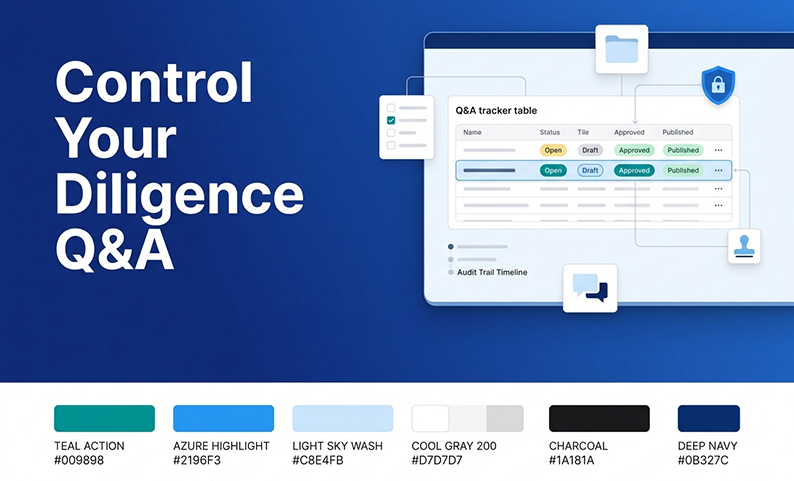
- A tracker: A log with status, owner, workstream, sensitivity, and linked documents.
- Defined approval gates: Clarity on who must review an answer before it’s published.
- A source-of-truth location: Where final answers live, accessible only to authorized parties.
A VDR with built-in Q&A capability handles all four in one environment. The risk of using email or a spreadsheet is that these artifacts fragment across inboxes, which defeats the purpose.
DCirrus VDR addresses this with built-in Q&A discussion forums, secure messaging, automated notifications, and audit trails. The entire process stays inside a single, permissioned workspace. When questions, answers, and documents all live in the same place, the “which email thread had the final answer?” problem disappears.
1) Centralize intake so every question is captured and categorized
The single biggest source of Q&A chaos is intake fragmentation. A buyer’s legal counsel emails the deal lead. The financial advisor calls the CFO. A question comes through the data room’s comment feature. Another comes up during a management presentation with no record.
Each of these is an untracked disclosure risk.
The fix is a defined intake channel with a non-negotiable rule: all questions go through one mechanism. That mechanism can be a Q&A forum in your VDR, a structured form, or a designated inbox. It must be singular, and it must be enforced.
Every question that enters outside the channel should be redirected, not answered in place. A simple response like, “Thanks. Please submit this through the deal Q&A portal so we can track it properly,” is all you need. It’s not rude; it’s professional discipline.
Intake rules buyers/advisors must follow
Post these rules in writing at deal kickoff and get acknowledgment from every party.
- One question per submission. Bundled questions get split, categorized separately, and take longer.
- Include your workstream and context. “Legal, corporate governance” is more useful than “quick question.”
- Reference any document you’ve already reviewed. This tells the response team if the answer already exists in the data room.
- State your deadline. If you need an answer by a specific date, say so in the submission, not in a follow-up email.
- No direct outreach to management or SMEs. All requests must route through the Q&A channel.
That last rule is the most important. Direct outreach to operational SMEs creates unreviewed, unlogged disclosures that can contradict official responses.
Q&A “data fields” to capture for traceability
Every question in your tracker should log these details:
| Field | Why it matters |
|---|---|
| Question ID | Reference in negotiations and post-close |
| Submitter name/firm/role | Tracks who received what information |
| Date submitted | SLA tracking and timeline documentation |
| Workstream (legal/fin/ops/HR/IT) | Routing and status reporting |
| Sensitivity tier (standard/restricted/deal-sensitive) | Controls approval path |
| Assigned owner (drafter) | Accountability |
| Approver | Sign-off chain |
| Status (open/draft/approved/published) | Real-time deal visibility |
| Linked source documents | Prevents contradictions |
| Red flag tag (yes/no) | Feeds risk register |
| Date published | Audit trail |
This log is your diligence Q&A audit trail. It’s also the document your attorneys will want if a warranty claim surfaces 18 months after the deal closes.
2) Triage questions by risk and deal impact (not by arrival time)
A busy deal generates dozens of questions a week. Not all of them deserve equal attention. A question about payroll processing is not as urgent as one about an undisclosed environmental liability.
Processing questions in the order they arrive is fair but not smart. It lets low-stakes questions consume SME bandwidth while high-stakes issues sit in the queue.
Triage means reviewing every incoming question within one business day and assigning it a priority tier before routing it for a response.
A simple triage rubric: risk, valuation impact, regulatory exposure, and effort
Score each question on four dimensions, each rated Low, Medium, or High.
Risk level: Does a weak or incomplete answer create legal, financial, or reputational exposure? Questions about litigation, IP ownership, data breaches, and regulatory compliance all score High.
Valuation impact: Does the answer materially affect how a buyer values the business? Revenue recognition, customer concentration, EBITDA adjustments, and cap table questions score High here.
Regulatory exposure: Does the answer touch a compliance obligation, a pending investigation, or a filing requirement? These get elevated treatment regardless of other scores.
Response effort: How long will it take to produce a defensible answer? High-effort questions need early assignment so they don’t cause last-minute delays.
Any question that scores High on risk or valuation impact goes to the top of the queue. Medium questions get standard SLAs. Low-priority questions can be parked or batched.
What to do with “nice-to-have” questions
Some questions are genuinely low-stakes and not time-sensitive. The temptation is to answer them quickly to show responsiveness. The smarter move is to park them and set expectations.
A direct response works well: “We’ve received this and categorized it as non-critical. We’ll address it in our next Q&A batch no later than [date]. If this is time-sensitive for your workstream, please let us know.”
This keeps the buyer informed without burning SME time on questions that don’t move the deal forward.
3) Assign owners and set response SLAs (so SMEs don’t become the bottleneck)
Ownership ambiguity kills Q&A momentum. When a question sits in a tracker with no assigned drafter, it doesn’t get answered. When two SMEs each think the other is handling it, it still doesn’t get answered. When legal thinks finance is reviewing it and vice versa, the answer goes out late, unreviewed, or inconsistent.
Clear ownership means every question has one person responsible for drafting the response, and every response has one person responsible for approving it before publication.
Recommended roles (Q&A captain, workstream owners, approvers, redaction reviewer)
Q&A Captain: The deal lead or a coordinator who owns intake, runs triage, monitors the tracker, and manages SLAs. This person ensures every question has an owner and nothing stalls.
Workstream Owners: Functional leads (legal, finance, operations, HR, IT) responsible for drafting responses in their domain. They know the source documents and the risks. They own the accuracy of their answers.
Approvers: A single layer of review before publication. For standard questions, the workstream owner may be both drafter and approver. For sensitive information, financial representations, or legal exposure, a senior approver (like deal counsel or the CFO) must sign off.
Redaction Reviewer: Someone who reviews responses for accidental overexposure before answers go to the buyer. This is often legal counsel but can be delegated for standard questions.
Example SLA ranges and escalation triggers (practical, not theoretical)
| Priority | Draft SLA | Approval SLA | Total target |
|---|---|---|---|
| High (risk/valuation) | 24 hours | 24 hours | 48 hours |
| Medium (standard) | 48 hours | 24 hours | 72 hours |
| Low (non-critical) | Batched | Batched | 5-7 business days |
Escalate when a question is 24 hours past its draft SLA, an approver hasn’t responded, or a new answer contradicts information already in the data room. Escalation isn’t panic. It means the Q&A Captain flags it in the next daily check-in and assigns a resolution owner.
4) Draft responses that are consistent, evidenced, and negotiation-aware
This is where most Q&A frameworks fall apart. Responses get drafted quickly by whoever is available, without a consistent structure. This creates the exact contradictions and unintended admissions that hurt deals.
A well-drafted response is short, direct, supported by evidence, and written with the awareness that a lawyer will read it in a negotiation.
A standard response format (answer + evidence + assumptions + next step)
Use this structure for every substantive response:
- Direct answer: Lead with the actual answer, not background context.
- Supporting evidence: Reference the specific document(s) in the data room that support the answer. Include the folder path or file reference.
- Assumptions or qualifications: Note any conditions (for example, “as of the date of the most recent audit” or “subject to contract review by buyer’s counsel”).
- Next step (if applicable): If the answer requires follow-up, specify what, who, and when.
Here’s an example for a financial question: “Revenue for FY2023 was $12.4M as reported in the audited P&L (Folder: Financial / Audited Statements / FY2023). This includes $1.1M of one-time project revenue excluded from normalized EBITDA, as detailed in the Adjusted EBITDA schedule in the same folder. All figures are under IFRS. If your team requires segment-level detail, we can provide a supplemental schedule by [date].”
This format takes more effort per question but dramatically reduces rework.
How to link answers to source documents without creating contradictions
Every factual claim in a response should tie to a specific document version in the data room. Don’t say “see the financials.” Say “see FY2023 Audited P&L, version 2, uploaded [date].”
Loose references create the “doc says X, email says Y” problem. When a buyer’s counsel compares your Q&A answer to the data room document and finds a discrepancy, it creates deal risk and negotiating leverage for them.
DCirrus VDR’s smart indexing and search helps workstream owners find the right file quickly, ensuring responses reference the correct version. Version control tracks updates, so you can always confirm which document version an answer was based on.
Language examples for sensitive areas (confidentiality-safe phrasing)
When a question touches sensitive territory, you need to respond without stonewalling or overexposing. Silence reads as evasion, while oversharing creates liability.
For questions about undisclosed litigation: “We are aware of this type of matter and are prepared to discuss details in a privileged legal call with buyer’s counsel directly. We are not publishing details in the Q&A record at this stage. Please coordinate with [deal counsel] to arrange.”
For questions about customer concentration or pricing: “Customer-level detail is available under enhanced NDA conditions. Please confirm your counsel has countersigned the supplemental confidentiality schedule, and we will provide the summary in a restricted access folder.”
For questions that exceed the current diligence scope: “This falls outside the scope of the current diligence workstream. If the buyer wishes to expand the scope, please submit a formal request through the Q&A channel for review by the deal lead.”
5) Put approvals and confidentiality controls where they belong
The most common confidentiality failure in diligence is not a malicious leak. It is an unreviewed answer that goes out with too much detail or a document uploaded to the data room without the right access controls.
Approval gates are your last check before information leaves your control.
Define sensitivity tiers (what can be shared, with whom, and when)
A practical three-tier classification works well.
Tier 1, Standard: Financial statements, corporate structure, and low-sensitivity contracts. Available to all authorized diligence parties with an NDA in place.
Tier 2, Restricted: Customer lists, pricing schedules, key employee compensation, and proprietary technology specifications. Available only to senior members of the buyer’s team with explicit approval from deal counsel.
Tier 3, Deal-Sensitive: Strategic plans, board materials, security incident history, and regulatory investigation details. Available only under specific conditions, typically in a separate limited-access folder or a privileged session, not as a published Q&A answer.
Any Q&A response involving Tier 2 or Tier 3 information requires sign-off from the approver. No exceptions.
Common confidentiality failure points (and how to block them)
Broad folder permissions: Uploading documents to a data room without setting workstream-specific access. Fix this by configuring role-based access before the room goes live.
Uncontrolled downloads: Documents can be downloaded, copied, and forwarded outside the secure environment. Fix this by applying DRM controls that restrict printing and copying and set expiry dates.
Screenshot risk: Sensitive tables captured on-screen with no record. Fix this with dynamic watermarks that embed the viewer’s identity, IP address, and timestamp on every view.
Forwarded Q&A responses via email: A buyer team member forwards your answer to someone outside the NDA. Fix this by keeping all Q&A inside the permissioned VDR, not in email.
DCirrus VDR’s DRM controls, including print and copy restrictions with customizable expiry dates, combined with granular access controls and dynamic watermarking, create a secure perimeter that reduces leakage risk while enabling diligence to move forward.
6) Publish, log, and reuse: turn Q&A into a durable diligence record
Once a response is drafted, evidenced, and approved, the final step is to publish it in a way that builds a clean, searchable record for everyone. This prevents duplicate questions and creates a single audit trail.
Create a “single source of truth” Q&A library by workstream
Instead of just marking a question “closed” in your tracker, publish the final question and answer to a central library inside your VDR. Organize this library by workstream (Legal, Financial, HR, Operations).
This lets the buyer’s team self-serve answers to questions that may have already been asked by another team member. It also gives your internal team a single reference point, preventing SMEs from re-answering the same question in slightly different ways.
Tag red flags and decision points as they emerge
As you process questions, some answers will reveal issues that need to be tracked as deal risks. Use your Q&A tracker to tag these “red flag” items. A simple “yes/no” tag is a good start.
These tagged items should feed directly into a separate deal risk register, which the core deal team reviews weekly. This ensures a minor issue flagged in an HR question doesn’t get lost, only to reappear as a major problem during final negotiations.
7) Convert Q&A findings into deal protections and better negotiation
The Q&A process is not an academic exercise. It is a tool for price discovery and risk allocation. Every red flag or uncertainty uncovered during Q&A is a data point that should inform your negotiation strategy and the deal’s legal structure. The framework’s output is leverage.
Mapping issues to actions: renegotiate, remediate, or protect
For every significant issue identified through Q&A, your team has three primary paths.
- Renegotiate: If a finding materially impacts valuation (like lower-than-expected revenue or unfunded liabilities), use the evidence from the Q&A log to adjust the purchase price.
- Remediate: If an issue can be fixed before closing (like a missing contract signature), make its resolution a closing condition.
- Protect: For risks that will persist post-close (like pending litigation or potential tax liabilities), negotiate specific protections in the deal agreement. This could include targeted warranties, special indemnities, or an escrow holdback.
The questions you should ask your own team before signing
Before the final sign-off, use the Q&A log to conduct a reverse diligence exercise on your own process.
- Did we answer every high-priority question with sufficient evidence?
- Are there any contradictions between our Q&A responses and the final representations in the purchase agreement?
- For every red flag we tagged, do we have a corresponding price adjustment, closing condition, or contractual protection?
- Is the full Q&A log archived and ready to defend our disclosures in a potential post-close dispute?
Implementation kit: run the process with a simple RACI + communication cadence
A framework is only as good as its implementation. For complex deals, you need a clear responsibility matrix and a non-negotiable communication rhythm.
A lightweight RACI for diligence Q&A
| Role | Responsible (Does the work) | Accountable (Owns the outcome) | Consulted (Provides input) | Informed (Kept up-to-date) |
|---|---|---|---|---|
| Q&A Captain | Triage, tracking, escalation | Q&A process integrity | Deal Counsel, Workstream Leads | All stakeholders |
| Workstream Owner | Drafting responses | Accuracy of workstream answers | Subject Matter Experts (SMEs) | Q&A Captain, Deal Counsel |
| Deal Counsel | Approving sensitive answers | Deal risk, confidentiality | Workstream Owners, Management | Deal Lead, CFO |
| CFO / Deal Lead | – | Final deal terms | Deal Counsel, Advisors | Board, investors |
Status reporting that works: daily triage + weekly steering
- Daily Triage (15 mins): The Q&A Captain and key Workstream Owners meet to triage new questions, assign owners, and check the status of questions approaching their SLA deadline.
- Weekly Steering (1 hour): The core deal team (Deal Lead, CFO, Deal Counsel) meets to review the Q&A status report, discuss any escalated red flags, and decide how findings will impact negotiation strategy.
As deals scale, the need for a clean, exportable record of “who saw what and when” becomes critical. Platforms like DCirrus VDR provide comprehensive audit trails and exportable reports, allowing the Q&A Captain to generate status updates for these meetings in minutes, not hours.
The most common Q&A process failures (and early warning signs)
Even with a framework, old habits can creep back in. Watch for these signals that your process is breaking down.
“We answered it already” — why duplicates happen and how to stop them
If you keep getting the same question from different teams, your “single source of truth” isn’t working. It usually means answers are being sent in one-off emails instead of being published to a central, searchable library. It could also mean the library itself is poorly indexed and hard to navigate.
“Legal is blocking everything” — how to balance speed with control
When legal review becomes a bottleneck, it’s often because all questions are getting the same level of scrutiny. The fix is to use the triage system. Implement fast lanes for low-risk, standard questions that can be answered with pre-approved language, reserving deep legal review for high-risk or deal-sensitive inquiries.
Summary and Next Steps
Running diligence Q&A reactively through email and spreadsheets is a high-stakes gamble. It creates a fragmented, indefensible deal record that invites inconsistent disclosures, missed red flags, and post-close disputes.
A controlled Q&A process, built on a simple 7-step framework, turns chaos into a strategic asset. By centralizing intake, triaging by risk, enforcing ownership, and maintaining a clean audit trail, you accelerate the deal timeline while systematically reducing risk.
Your next step is direct. On your next deal, don’t just open a data room. Implement this framework from day one with explicit owners, rules, and a single, designated channel for all Q&A.
FAQ
1. What’s the best way to centralize M&A due diligence questions without slowing the deal? Mandate a single intake channel from day one, like a dedicated Q&A forum within a Virtual Data Room (VDR). This prevents questions from getting lost in email. To maintain speed, couple this with a rapid triage process to prioritize high-impact questions and set clear response SLAs.
2. How do you prioritize diligence questions when multiple stakeholders are demanding answers? Prioritize based on deal impact, not who is asking the loudest. Use a triage rubric that scores questions on risk, valuation impact, regulatory exposure, and the effort required to answer. High-risk and high-valuation-impact questions always go to the top of the queue.
3. What should be included in a defensible audit trail for diligence Q&A? A defensible audit trail should log for every question: a unique ID, the submitter’s details, submission date, the assigned workstream and owner, its priority/sensitivity, the final approved answer, any linked source documents, the approver’s identity, and the publication date.
4. How do you answer sensitive diligence questions without oversharing confidential information? Use tiered access controls and careful phrasing. Classify information into standard, restricted, and deal-sensitive tiers. For highly sensitive requests, respond by offering a secure, privileged discussion with counsel instead of publishing details in the general Q&A log.
5. Who should own the diligence Q&A process: legal, finance, or the deal lead? A dedicated “Q&A Captain,” often the deal lead or a transaction manager, should own the process (intake, triage, tracking). Functional leads like legal and finance own the content and accuracy of the answers within their workstreams.
6. How do diligence Q&A findings translate into negotiation tactics and deal terms? Significant findings from Q&A become negotiation points. A financial discrepancy might lead to a purchase price adjustment. A contractual risk could be mitigated with a specific warranty or indemnity. An operational issue might become a pre-closing condition. The Q&A log provides the evidence to support these negotiations.
Want tighter control over diligence Q&A without email chaos?
Book a free demo of DCirrus VDR to centralize Q&A, control access, and maintain audit-ready traceability for your due diligence.
Latest Posts