What Are Equity Securities? A Guide to Managing Pre-IPO Document Access Risk
One draft of the cap table leaks to a prospective investor. A financial model circulates over WhatsApp. Suddenly you’re not running an IPO. You’re running damage control. You’re explaining to your client how a restricted document left the data room, fielding calls from legal, and trying to figure out if SEBI needs to be notified.
Equity securities (ownership claims in a company) are the valuable asset at the center of every pre-IPO transaction. Because they represent a stake in the company’s future, the non-public information around them is price-sensitive. This makes document access a regulatory and reputational matter, not just an operational one.
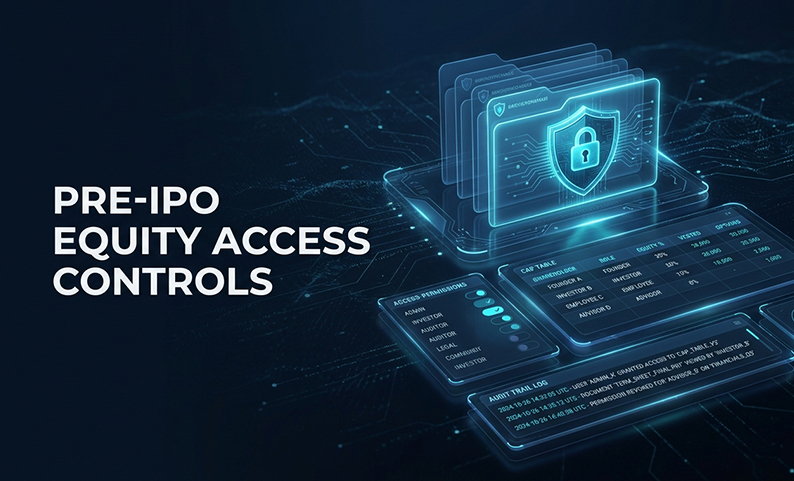
The fix isn’t a new email policy. It’s treating pre-IPO document access as a governed system with clear roles, rules, logs, and traceability. This system must be built before diligence begins, not after the first fire drill. This guide provides a framework and a 7-point checklist to get it done.
What Are Equity Securities—and What Do They Mean in a Pre-IPO Context?
Equity securities are ownership instruments. When you hold equity, you hold a claim on the company’s assets and earnings. You benefit if the business does well and bear risk if it underperforms.
In a pre-IPO context, this often includes private placements and pre-listing share sales. These deals typically have lock-up restrictions, which prevent early investors from selling immediately after listing. The pricing also reflects the illiquidity and risk of a non-public company.
Operationally, this matters because price discovery and allocation hinge on “who knows what, when.” Documents like a draft RHP, a financial model, or risk factors can move the perceived equity value before a single share trades publicly. This isn’t a theoretical risk; it’s why information control is non-negotiable.
How Are Equity Securities Different from Debt in Terms of Information Sensitivity?
Debt instruments like bonds are sensitive, but their value is mostly anchored to creditworthiness and fixed cash flows. Equity value is shaped more by growth narratives, forward-looking assumptions, and risk factor framing. A draft risk factor or a revised revenue projection isn’t just an internal document. It becomes potential market-moving information the moment it leaves a controlled environment.
Why Does Equity Securities Work Create Pre-IPO Document Access Risk?
The stakes are concrete. Here are the specific risks merchant bankers must account for:
- Unauthorized disclosure: Non-public financials, KPIs, or pricing assumptions get into the wrong hands, creating insider trading exposure.
- Selective access: Some parties see updated documents before others, creating fairness and allocation issues that are hard to fix.
- Regulatory inconsistency: If SEBI asks who saw what and when, and you can’t answer cleanly, the process looks unmanaged, regardless of whether misconduct occurred.
There’s a tension between confidentiality and transparency. Confidentiality reduces leak risk. But opacity erodes trust when parties can’t verify they have the right information. Control plus traceability resolves this tension. You protect information without making the process opaque, because every access event is recorded and every version is accountable.
What’s the Pre-IPO Document Access Risk Framework Every Merchant Banker Should Run?
The answer isn’t a longer policy document. It’s a short, repeatable system you can set up in a single kickoff meeting.
Call it the CLEAR Framework:
- Control: Enforceable restrictions, not guidelines.
- Least privilege: Access only to what’s needed, for as long as it’s needed.
- Evidence: Logs, versions, and Q&A records that can be exported on demand.
- Alignment: Shared rules and folder logic that every party operates within.
- Repeatability: Standard templates and role definitions you reuse for every deal.
How Do You Run the 7-Point Checklist to Control Pre-IPO Document Access Without Slowing Diligence?
1. Classify Documents by Sensitivity
Not every document carries equal risk. Start by tagging your documents into three tiers:
- Public/near-public: Annual reports, public filings.
- Confidential: Board minutes, contracts, HR data.
- Highly price-sensitive: Draft financial models, risk factor narratives, KPI dashboards, draft RHP sections.
For each tier, decide upfront: view-only or downloadable? Price-sensitive documents should be view-only unless a party has a documented need to download.
2. Map Stakeholders to Minimum-Needed Access
An IPO involves over ten parties. Each needs a clearly scoped lane.
- Issuer finance team: Full access to financials and operational documents.
- Legal counsel: Disclosure documents, contracts, regulatory correspondence.
- Auditors: Financial diligence set, working papers requests.
- Registrar and underwriters: Allocation materials, cap table, prospectus drafts.
Separate workstreams by function. Legal doesn’t need compensation data. Auditors don’t need roadshow materials. Role-mapping takes 30 minutes and saves weeks of cleanup.
3. Enforce Least-Privilege Permissions + Time-Boxing
A written policy that says “share only what’s needed” is a reminder, not a control. Enforceable least privilege means the system prevents oversharing.
- Set permissions at the role level, not the individual level.
- Limit external parties strictly to their assigned workstreams.
- Remove access when a party’s scope ends.
DCirrus VDR supports granular role-based permissions, plus 2FA, device-level approval, and IP address restrictions. Access is tied to a verified identity and device, not just a login. This closes the most common leak vectors.
4. Control What Happens After Download
Most controls focus on who can see a file. The harder problem is what happens after download.
- Default to view-only for all highly sensitive folders.
- Where downloads are necessary, set expiry dates on the files.
- Prohibit print and copy for folders with draft financials or risk factors.
DCirrus’s DRM controls allow you to block printing, copying, and sharing at the document level and set file expiry dates. It’s not a perfect shield against screen captures, but it creates meaningful friction.
5. Make Every View Attributable
Deterrence matters. When a viewer knows their identity is embedded on every page, casual forwarding becomes a calculated risk, not an impulse.
- Apply dynamic watermarking with viewer identity and a timestamp to every document.
- Communicate this policy to all parties during onboarding.
DCirrus applies dynamic watermarks with user info, IP address, and a timestamp. This creates an attribution trail that discourages unauthorized sharing and helps investigate leaks.
6. Lock Version Control
“Final_v7_reallyfinal.xlsx” is not a document management system. Version sprawl is a compliance problem. If parties work from different drafts, process integrity is compromised.
- Maintain a single canonical version of every document.
- Log who uploaded each version and when.
- Archive superseded versions instead of deleting them; you may need them for a regulatory inquiry.
7. Centralize Q&A to Create Defensible Traceability
Don’t let questions and answers get lost in email. When an auditor’s question is answered in a side thread, that context never makes it back to the data room. Six weeks later, you’re digging through emails to answer a regulatory query.
Traceable Q&A is both audit defense and diligence speed. Questions answered once in a central forum don’t get asked again. DCirrus’s integrated Q&A forums and document commenting keep all deal communications inside the secure environment, tied to specific documents.
Who Owns What During Implementation?
| Role | Responsibility |
|---|---|
| Merchant banker / deal lead | Overall access model, approvals, permission blueprint |
| Issuer SPOC | Document sourcing, internal coordination, uploads |
| Legal counsel | Disclosure document changes, privileged material |
| Auditors | Financial diligence request management |
| VDR admin | Permissioning, groups, user onboarding, log exports |
Beyond the roles, three disciplines prevent things from falling apart: a single naming convention, one access request process, and a 10-minute weekly access review.
What Are the Most Common Pre-IPO Document Access Failures?
Most failures are visible before they become crises. Watch for these signs:
- Email Q&A drift: Conflicting answers appear in email threads. Fix this with a centralized Q&A forum.
- Permission creep: You get “just give them access to the whole room” requests. Use time-boxed groups and a weekly review.
- Version sprawl: Multiple “final” drafts circulate. Enforce a single canonical document with versioning.
- Untracked downloads: Documents appear in unauthorized inboxes. Default to view-only for sensitive files and use watermarking.
- Missing audit evidence: Scrambling to reconstruct who saw what. Routinely export access logs and Q&A history.
How Do You Measure Whether Your Access Controls Are Working?
These three metrics give you an honest read without adding overhead:
- Audit readiness: Can you produce “who accessed what, when” reports within a few hours? If not, the system isn’t working.
- Diligence velocity: Track the average time-to-answer for diligence questions. It should decrease as you build a centralized knowledge base.
- Exposure concentration: The number of users with access to highly sensitive folders should shrink over the deal cycle, not grow.
Summary and Next Steps: What to Do on Your Next Mandate
Equity securities represent ownership value, making every non-public document in your data room legally and economically sensitive.
The CLEAR Framework provides the structure. The 7-point checklist provides the execution path.
One next step: Before the first diligence request arrives on your next mandate, run a 30-minute kickoff to set roles, define your permission blueprint, and establish your folder taxonomy. The cost of setting this up early is trivial. The cost of rebuilding it mid-deal is not.
FAQ
What is the simplest equity securities definition for a non-finance stakeholder? An equity security is an ownership stake in a company. If the company’s value grows, the owner benefits. If it loses value, they bear that loss.
Are equity securities only “shares,” or do they include other instruments? Shares are the most common form, but the term also includes warrants, convertible notes, and employee stock options.
Why are lock-up periods common in pre-IPO equity sales? Lock-ups prevent early investors from selling immediately after listing, which would suppress the share price. They help protect price stability in the early trading period.
What documents are typically the most price-sensitive in a pre-IPO data room? Draft financial models, revenue projections, risk factor narratives, cap table details, and pricing discussions. These can all influence valuation perception before listing.
What should an audit trail include to be considered “defensible” in practice? At a minimum: user identity, document accessed, timestamp, IP address, and the action taken (viewed/downloaded). A complete trail also includes version history and Q&A records.
How do we give auditors and legal counsel what they need without giving “everyone everything”? Use role-based permissions for specific workstream folders. Auditors get the financial diligence set; legal counsel gets disclosure documents. This is manageable with a good VDR.
Should we allow downloads in a pre-IPO process? Default to view-only for sensitive documents. If a download is required, apply DRM controls like expiry dates and print restrictions. The key question is whether it’s operationally required or just convenient.
How early should we set up access control? Before the first document is uploaded. Setting up roles, folder taxonomy, and permission rules after documents are in circulation creates gaps you can’t close retroactively.
Want Tighter Control Over Pre-IPO Document Access?
DCirrus VDR is built for high-stakes, multi-party collaboration. Get granular permissions, DRM controls, dynamic watermarking, integrated Q&A, and exportable audit trails—all in one secure platform.
Latest Posts