The Concurrent Deal Framework: A Strategic Playbook for Managing Parallel IPO & M&A Workflows in a VDR
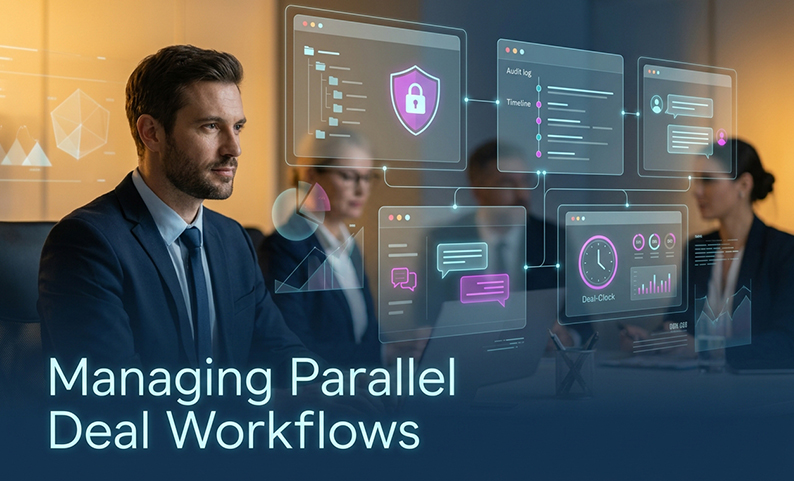
When you are running concurrent deals, the real failure mode is not lack of effort. It is cross-contamination: the wrong draft, the wrong counterparty, the wrong watermark, or the wrong Q&A thread slipping into the wrong mandate. In a market where one team may be handling two DRHPs, a QIP, and an open offer at once, a single-deal tool is the wrong mental model. You need pipeline management and multi-deal orchestration, not project tracking.
That is the gap this playbook closes. It gives you a practical framework for running parallel workflows in one VDR without losing control of permissions, audit trails, or deal velocity. If you are trying to stand up a compliant data room in under 4.5 months, keep SEBI inspection-ready records, and stop email from slowing diligence by 2 to 3 weeks, this is the structure to use.
Why concurrent deals need a different operating model
A merchant banker’s live pipeline is a portfolio, not a queue. That matters because the same counterparties, the same documents, and the same compliance obligations often appear across multiple mandates at the same time.
The operating problem is simple: generic project tools assume one owner, one timeline, one set of files. But IPO and M&A work demands isolated workspaces, strict role separation, and a clean record of every action taken inside each deal. That is why the framework below is built around pipeline management at the workspace level.
It also fits the regulatory reality. For public issues, the DRHP must follow Schedule VI disclosure logic, merchant bankers must maintain a Repository of Documents, and PIT rules require structured logging of UPSI sharing. In other words, the workflow has to satisfy compliance first, speed second, and convenience third.
The 10-step framework for multi-deal orchestration
1) Stand up one isolated workspace per mandate
Start with isolation. Every deal gets its own workspace, tenant, audit trail, and retention policy, even when you are running three to five live mandates.
- Create a separate workspace for every IPO, M&A buy-side, M&A sell-side, or pre-IPO restructuring mandate.
- Use a unique tenant identifier and deal code.
- Avoid issuer names in URLs or document IDs.
- Preload default permission templates by deal type.
- Enroll users in SSO or MFA before first access.
Why this matters: it prevents permission leakage, watermark cross-contamination, and accidental reuse of prior deal material.
2) Build the folder spine around Schedule VI
Do not use a generic M&A folder tree. For IPO work, the folder structure should mirror the disclosure order in Schedule VI so diligence maps directly to the DRHP.
- Organize the top level around incorporation, capital structure, business overview, financial information, management, related-party transactions, risk factors, use of proceeds, and litigation.
- Split each section into filings, supporting documents, and third-party reports.
- Reserve
99_Repository_SEBIfor the Repository of Documents. - Reserve
98_Audit_Trail_Exportsfor immutable audit exports. - Tag each upload with deal code, upload date, and uploader identity.
This gives you faster retrieval and cleaner disclosure alignment when SEBI asks how a point was supported.
3) Lock down role-based access before the first external login
This is where most teams get loose. Once ten-plus counterparties start entering the room, access must be role-based, not ad hoc.
- Predefine roles such as Issuer CFO, Issuer CS, Statutory Auditor, Legal Counsel on both sides, Book Runner Lead, Co-Manager, Registrar, Printer, and SEBI Observer.
- Map each role to specific folders and permissions.
- Use view, download, print, and annotate controls deliberately.
- Disable print and download by default for sensitive folders.
- Set shorter session timeouts for non-issuer users.
This is how you support parallel workflows without exposing working papers across counterparties.
4) Turn on immutable audit trails from day one
If SEBI asks how diligence was handled, your answer has to be in the log. The Repository of Documents regime and PIT requirements both depend on a tamper-evident record.
- Log login, logout, view, open, download, print, share, and permission changes.
- Capture IP address, device fingerprint, and timestamp for every action.
- Lock the audit log so it can only be appended to or exported.
- Export audit logs weekly into
98_Audit_Trail_Exports. - Cross-stamp monthly exports to the issuer’s compliance officer.
This is not a back-office feature. It is the operational proof that your process was controlled.
5) Replace email Q&A with a central hub
Email is where deal flow slows down. It also creates the exact kind of unstructured record that is hard to defend later.
- Use one Q&A workspace per mandate.
- Route legal questions to counsel, accounting questions to the auditor, and commercial questions to management.
- Set response SLAs at 24 hours for routine questions and 4 hours for urgent ones.
- Track question owner, status, and resolution date.
- Export Q&A history weekly to compliance.
If you are trying to compress diligence and stop the usual 2 to 3 week slippage, this is one of the biggest leverage points in the entire framework.
6) Apply dynamic watermarks before any external download
Every external view or download should leave a trace. That is basic discipline in regulated transactions.
- Embed viewer email, IP address, and timestamp in dynamic watermarks.
- Use different watermark treatments for issuer and BRLM materials.
- Apply full-page watermarks for highly confidential documents.
- Block screen capture and printing by default.
- Log every print attempt and screen-block event.
This does two things at once: it deters leakage and it makes trace-back possible if a document shows up where it should not.
7) Run a visible deal-clock dashboard
When three or more deals are live, deadlines do not stay in one person’s head. They need to be visible to every internal stakeholder.
- Show DRHP filing date, RHP date, issue open and close, listing date, and post-issue milestones.
- Surface SEBI observation windows and other regulatory SLAs.
- Show Q&A SLA performance.
- Show audit export cadence.
- Push daily deadline digests to every role group.
This is the practical backbone of pipeline management. It gives bankers, lawyers, and compliance one shared timeline instead of separate spreadsheets.
8) Use AI to accelerate indexing and response prep
AI is not the replacement for judgment. It is the multiplier that stops a small team from drowning in document volume.
- Auto-tag uploads against the Schedule VI spine.
- Surface related-party, materiality, and risk-factor language.
- Use semantic search to draft Q&A responses faster.
- Assist with redaction of sensitive personal data.
- Flag duplicate or stale uploads.
Used well, this turns document retrieval from a manual hunt into a controlled process, which is exactly what multi-deal orchestration needs.
9) Rehearse compliance before listing
By the time you are in the final stretch, surprises are expensive. Rehearsal is what converts unknowns into knowns before the deal clock gets tight.
- Begin weekly rehearsals about six weeks before listing.
- Simulate SEBI observation responses with mock queries.
- Run a book-building dry run with the syndicate team.
- Rehearse allotment and listing-day logistics with the registrar and exchanges.
- Store rehearsal notes in
99_Rehearsal_Notes.
This is where you reduce avoidable friction in the final mile.
10) Lock and archive the workspace without losing the record
Closing a deal is not the same as deleting its history. The record has to stay available for the regulatory retention window.
- Lock the workspace on listing day plus 30 days.
- Export the full audit trail to immutable storage.
- Preserve
98_Audit_Trail_Exportsand99_Repository_SEBI. - Keep the Repository of Documents index for the life of the listing.
- Maintain an off-platform disaster-recovery copy with quarterly restore tests.
This is how you keep the process defensible after the deal closes.
How to set up roles and responsibility in practice
A framework only works if ownership is clear. For concurrent deal work, the BRLM Lead should stay accountable for workspace setup, Q&A governance, audit exports, and archive closure.
A simple operating matrix looks like this:
- Workspace creation and tenant isolation: BRLM Lead accountable
- Schedule VI folder spine: BRLM Lead responsible
- Role-based access provisioning: BRLM Lead accountable
- Document upload and tagging: Issuer management responsible
- Q&A routing and SLA tracking: BRLM Lead accountable
- Weekly audit export: BRLM Lead accountable
- DRHP filing: BRLM accountable, with legal counsel involved
- Observation-letter response: BRLM accountable, with counsel support
- Repository of Documents preparation: BRLM accountable
- Listing-day close and archive: BRLM accountable
- Post-listing repository maintenance: BRLM accountable
The cadence should be equally explicit:
- Daily 9:30 AM stand-up for 15 minutes
- Weekly audit-log review every Friday
- Bi-weekly DRHP or RHP review
- Quarterly cross-deal retrospective across all live mandates
That rhythm is what keeps parallel workflows from becoming reactive.
What breaks in concurrent deal management
Permission sprawl
This happens when a user keeps access after moving between mandates.
- Tie access to workspace, not to person alone.
- Deprovision on role change.
- Run quarterly access reviews.
Version confusion
This is what happens when two advisors both think they own “v3.”
- Use a versioning protocol.
- Enforce single check-out and check-in.
- Block parallel uploads to the same filename.
Email-based Q&A creep
Once questions start leaking into email, the control framework weakens fast.
- Keep all Q&A inside the VDR.
- Use 4-hour and 24-hour timers.
- Publish a governance note at kickoff.
Audit trail gaps
Manual exports create inconsistency between live and archived workspaces.
- Automate weekly exports.
- Store exports on write-once media.
- Test restores quarterly.
Cross-deal contamination
This is the most dangerous failure in concurrent deals. A document or session from one mandate lands in another.
- Keep workspaces isolated.
- Avoid shared indexes.
- Separate audit logs per workspace.
Schedule slippage
A 2-week delay in filing can push you outside the observation window.
- Use the deal-clock dashboard.
- Surface counterparty deadlines early.
- Keep buffer in the schedule.
Why this framework is better than a basic VDR setup
The point is not just security. It is speed with control.
A single-deal setup can hold one transaction together. But once you are running 3 to 5 live mandates, the real need is multi-deal orchestration: isolated workspaces, consistent permissions, auditable activity, structured Q&A, and timeline visibility across the portfolio. That is what lets a mid-sized merchant banker protect compliance without adding headcount linearly.
It also has a cost angle. Indian buyers already feel the pressure of global VDR pricing, especially when fees are being pushed back by smaller IPO clients. A controlled, fixed-price setup matters because it protects margins while still supporting the audit trail and security posture the market now expects.
Summary and next steps
If you are managing IPO and M&A mandates in parallel, do not try to force a single-project mindset onto a portfolio problem. Build for isolation, traceability, and shared visibility from the start.
The high-priority move is simple: set up one workspace per mandate, wire in the Schedule VI spine, enforce role-based access, and make audit logs and Q&A part of the daily operating rhythm. That is the core of pipeline management in a regulated deal environment.
FAQ
What is a concurrent deal framework in a VDR context?
It is a way of running multiple live mandates in separate, controlled workspaces so documents, permissions, Q&A, and audit trails do not overlap.
How does the Repository of Documents change merchant banker operations?
It makes document traceability a standing requirement. You now need preserved records of the materials relied on during diligence, not just a finished data room.
How can I run 3 to 5 IPO or M&A deals without leakage?
Use separate workspaces, role-based permissions, isolated audit logs, and per-deal Q&A hubs. Do not share folder structures or indexes across mandates.
What VDR features matter most for parallel workflows?
The priorities are isolated workspaces, granular permissions, audit trails, dynamic watermarking, centralized Q&A, and searchable document intelligence.
How does wall-crossing relate to VDR audit logs?
Wall-crossing creates a compliance event. The VDR log should show who accessed what, when, and under which permissions, so the UPSI trail is defensible.
How long should it take to stand up a compliant data room?
The dossier points to a mandate-win-to-DRHP window of under 4.5 months as the pressure point. The key is to start with structure, not manual cleanup.
What causes the most delay in due diligence?
Email-based document chasing is still one of the biggest causes of slippage. A centralized Q&A process compresses that delay.
How should a merchant banker think about cost?
Not as a one-off software fee, but as part of deal economics. The goal is to protect margin while keeping compliance and control intact.
Need a VDR that can keep up with parallel deal execution?
If your team is juggling multiple IPO and M&A mandates, you need more than storage. You need a platform that supports security, auditability, and faster collaboration without making your operating model heavier.
DCirrus VDR is built for exactly that kind of workload, with role-based access, dynamic watermarking, AI-assisted document intelligence, centralized Q&A, and audit trails that support SEBI-ready document handling across active deals.
Latest Posts
How Long It Takes to Launch a VDR for an IPO Mandate
August 06, 2026
VDR Features Merchant Bankers Need for IPO and M&A Execution
August 05, 2026
Top Deal Management Features to Look for in a VDR
August 03, 2026