Virtual Data Room Security Checklist for Investment Banking Teams
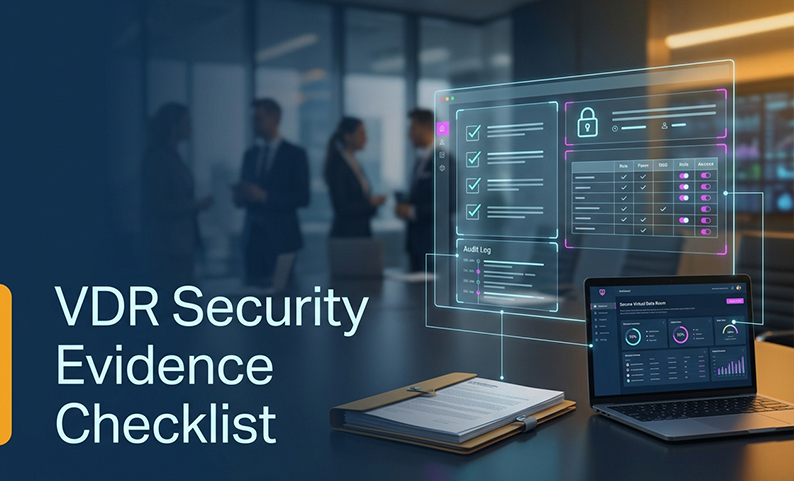
A weak virtual data room does more than slow a deal down. It can expose sensitive documents, create insider-trading risk, leave no defensible audit trail, and force your team to reconstruct decisions from email after the fact.
That is why merchant bankers need a Secure Deal Room Evidence Checklist, not a feature tour. The right test is simple: can the platform protect data, enforce identity and access, preserve evidence, support incidents, and keep the merchant banker in regulatory control?
This article gives you that checklist. Use it to shortlist a secure document sharing platform for investment banking quickly, without wasting time on demos that cannot stand up to SEBI scrutiny.
What makes a transaction VDR different from generic file sharing?
A deal room is not just storage with a login. It is a controlled evidence and collaboration environment built for due diligence, disclosure, and close-out.
That means you should verify controls that generic cloud tools often blur together:
- Document-level permissions
- View, download, print, and share rules
- Watermarking
- Q&A traceability
- Version history
- Access analytics
- Controlled external invitations
- Transaction close-out and retention
This matters because a buyer can infer encryption from a storage brand, but not regulator-facing evidence. If you are evaluating an ISO 27001 certified VDR, ask for the actual certificate scope, entity, and service coverage. Do not assume the logo tells you enough.
The 10-point Secure Deal Room Evidence Checklist
1. Can the provider demonstrate regulatory fit and shared responsibility?
Before a demo becomes a project, confirm who owns what. In a SEBI-regulated transaction, the merchant banker stays accountable even when the platform is vendor-hosted.
Check for:
- The merchant bank’s SEBI category, data classes, and transaction-specific obligations
- A shared-responsibility matrix covering customer configuration, provider platform, identity integration, endpoints, backups, subprocessors, and incident response
- Subcontractor flow-down terms, audit rights, forensic access, confidentiality, notification, and exit clauses
- Current certifications, audit reports, security policies, and penetration or VAPT summary under NDA
- A clear answer on whether the VDR can support the five-year public-issue evidence requirement
Fail fast if: the provider says SEBI responsibility transfers to it, cannot name subprocessors, or refuses evidence access during an incident.
2. Is data protected in transit, at rest, and through its entire lifecycle?
Encryption is necessary. It is not enough by itself.
Verify:
- Protection for browser and app traffic, APIs, stored files, databases, indexes, temporary files, replicas, and backups
- Key generation, KMS or HSM handling, rotation, revocation, and destruction
- Whether keys and key-management operations can remain in India
- Whether BYOK or customer-controlled keys are available
- What happens when a key is disabled
Also test the edges:
- Export
- Download
- Preview cache
- Offline copy
- Restore
- Deletion
A platform can say it uses encryption and still leave weak spots around support data, telemetry, or exports. That is not enough for a high-stakes mandate.
3. Is MFA enforced for every sensitive identity?
MFA should not be optional for privileged access.
Require it for:
- Room owners
- Administrators
- Internal deal staff
- External reviewers
- Support access
- Recovery operations
Prefer phishing-resistant cryptographic methods for privileged users. Treat SMS and email as fallback, not as the main control.
Also make sure the platform does not rely on shared accounts. Every invitation should be unique, and every sensitive event should create an audit trail.
4. Are permissions granular, least-privilege, and reviewable?
This is where many rooms get sloppy. A real transaction VDR should support granular role-based permissions at folder and file level, not just a broad membership model.
Check for:
- Deny-by-default access
- Separate rights for view, edit, upload, download, print, copy, share, invite, answer, and administer
- Expiry dates
- Group-based assignment
- Inherited-permission visibility
- Dual approval for privilege changes
- A complete access review report
Run a joiner-mover-leaver test. Invite a user, change the role, remove the user, revoke active sessions, and confirm the access really ends.
Fail fast if: everyone gets the same “member” role, inherited access is hidden, or the platform cannot produce a current permission report.
5. Can the room control devices, networks, and sessions?
Identity alone is not enough. A merchant banker also needs device and session control.
Verify:
- Device-level approval or unique device mapping
- IP restrictions or allowlists
- Session timeout
- Concurrent-session visibility
- Token revocation
- Policies for unmanaged devices
Then test real-world conditions:
- New device
- Revoked device
- Changed IP
- VPN
- Mobile hotspot
- Expired session
- Lost phone
A serious room should let you remove access quickly without waiting on vendor support.
6. Do DRM, watermarking, and download controls match the threat model?
This is where the product should separate protection from visibility.
Test:
- No-download
- View-only
- No-print
- No-copy/paste
- No-share
- Expiry
- Remote revocation
- Document-level exceptions
Then verify what happens after download. Ask whether files remain encrypted or rights-managed, whether access can be revoked, and whether print or download attempts are logged.
Watermarking should also be tested in the real world. Check previews, downloads, printed pages, and mobile screens. If the platform claims to stop screenshots entirely, be skeptical. No system can honestly guarantee that.
7. Will the audit trail support SEBI evidence and investigation?
The audit trail is where a deal room becomes defensible.
Look for logs that show:
- Who
- Which role
- What action
- Which object
- When
- From which IP, device, or session
- Whether it succeeded
For permissions and Q&A, also preserve:
- Before and after rights
- Invitation and approval history
- Question and answer
- Attachment and version
- Responder identity
- Status
- Notification
- Closure time
The log should be searchable, exportable, and tamper-evident. It should also be possible to correlate VDR events with identity-provider, endpoint, and network logs.
8. Can the provider support an incident, outage, or forensic request?
A deal room is only as useful as its support model during a problem.
Ask for:
- 24×7 contact details
- Named escalation owners
- Severity definitions
- Response and containment targets
- Evidence-preservation process
- Breach-notification workflow
- Restore-test evidence
- Disaster declaration process
- RTO and RPO detail
For merchant bankers, this is not a theoretical exercise. You need a named incident path, a way to preserve logs, and cooperation during forensic or regulator-directed review.
9. Does the room keep collaboration and document intelligence inside the control plane?
You want to reduce email, not recreate it in a second workspace.
Prefer:
- Controlled Q&A
- Comments
- Annotations
- Notifications
- Version history
- Secure deposit links
- Document-request workflows
If AI is offered, ask the hard questions:
- Are customer documents used to train a shared model?
- Where are prompts and results processed?
- How is access isolated?
- What is the retention model?
- Is human review required?
- How are redaction errors handled?
Treat AI as assistance, not as a legal conclusion.
10. Can the team prove, close, and exit the room safely?
The last test is not setup. It is exit.
Before live use, run a controlled pilot with representative folders and at least two external groups. Save the approved role matrix, configuration baseline, test results, certificate or report scope, contract, subprocessors, data map, and incident contacts in the deal file.
At close, revoke:
- Users
- Devices
- Links
- Tokens
- Temporary administrators
Then preserve the required evidence, apply litigation holds where needed, and delete residual data only according to contract and law.
If the vendor can pass features but not evidence, accountability, and exit, it is not ready for a high-stakes mandate.
How to shortlist in one working session
If you need to move fast, use a simple gate process.
- Send a standard evidence request before the demo.
- Certificate or report scope
- Architecture
- Encryption and key management
- Identity
- Role matrix
- DRM matrix
- Audit sample
- Hosting and subprocessors
- Incident SLA
- DR test
- Retention and deletion
- Support contacts
- Keep only providers that answer every mandatory gate in writing.
- Run a 30 to 60 minute scripted pilot with synthetic confidential files and two external groups.
- Have IT, security, compliance, legal, the deal owner, and vendor-risk owner sign the acceptance record.
- Revisit the matrix at each transaction stage: preparation, active diligence, investor access, signing, filing, and archive.
Implementation roles and responsibility matrix
Security only works when ownership is clear.
| Activity | Deal owner | IT/security | Compliance/legal | Vendor | External advisers |
|---|---|---|---|---|---|
| Data classification and folder design | A/R | C | A/C | C | C |
| Identity, MFA and device policy | C | A/R | C | R/C | I |
| Role matrix and Chinese-wall review | A/R | C | A | C | C |
| Encryption, hosting and subprocessors | C | A/R | A/C | R | I |
| Q&A and due-diligence evidence | A/R | I | A/R | C | R |
| Monitoring and incident triage | C | A/R | A/R | R | I |
| Repository filing and retention | A/R | C | A/R | C | I |
| Restore and DR exercise | C | A/R | C | R | I |
| Close-out, revocation, and deletion certificate | A/R | R | A | R | I |
A is accountable, R is responsible, C is consulted, and I is informed. One person can hold more than one role in a small merchant bank, but maker-checker control should stay independent for privilege changes and evidence approval.
Common failures to catch early
Most failed evaluations come down to the same patterns.
- Certification-logo fallacy: the certificate has the wrong entity, broad exclusions, or no VDR service in scope
- “AES-256” as the whole story: the provider cannot explain keys, backups, exports, or support access
- Optional MFA: administrators or external reviewers can bypass it
- Role sprawl: everyone gets download or admin rights because it is faster
- DRM overpromise: the vendor claims screenshots are impossible
- Incomplete logs: views appear, but failed logins, permission changes, or Q&A do not
- Email side channel: answers and revised files leak outside the room
- Cloud-responsibility gap: the contract says little about subprocessors, forensics, region, keys, or breach timing
- Retention conflict: the room auto-deletes even though legal hold or SEBI retention still applies
- No restore rehearsal: uptime marketing is treated as recovery proof
These are not edge cases. They are common failure modes in deal rooms that were set up too quickly.
How this fits into a broader control strategy
Treat the VDR as one control layer inside a larger transaction system.
That means you should review:
- Access reviews on schedule
- Dormant-account removal
- Leaver deprovisioning
- Privileged-action approvals
- Anomalous downloads
- Log-source completeness
- Evidence export accuracy
- Incident detection-to-escalation time
- Restore-test RTO and RPO
- Vendor-risk findings
Over time, the goal is not just speed. It is repeatable control. Every mandate should follow the same cycle: template, configure, test, monitor, review, preserve, revoke, and learn.
Summary
For investment banking teams, the right VDR checklist is not about features in isolation. It is about proving that the room can protect data, enforce identity and privilege, preserve evidence, support incidents, and keep regulatory control where it belongs.
The highest-priority action is simple: before you upload a single sensitive file, run a scripted pilot and demand written evidence for encryption and key custody, enforced MFA, granular role-based permissions, device and DRM controls, complete audit export, cloud accountability, incident support, recovery, and secure exit. If any critical gate is still an assertion instead of a tested control, keep the provider conditional.
FAQ
Is AES-256 enough to choose a VDR?
No. It covers only one part of confidentiality. You still need to verify transport protection, key custody, backups, identity controls, DRM, logging, support, and secure deletion.
Does ISO 27001 mean the whole VDR is certified?
No. Certification is scoped to a specific entity, service, and management system for a defined period. Ask for the actual certificate and scope.
Can a VDR stop screenshots and phone photographs?
No provider should promise that. DRM can restrict printing, copying, downloading, and viewer actions, while watermarks help deter and trace redistribution. Human and endpoint capture still remain.
Which MFA should an investment bank require?
Enforce MFA for every user, administrator, recovery path, and sensitive integration. Prefer phishing-resistant methods for privileged access, and treat SMS or email as fallback.
How granular should VDR permissions be?
At minimum, separate roles and separate folder or file rights for view, edit, upload, download, print, copy, share, invite, Q&A, and administration. Require expiry, review, maker-checker approval, and a report of effective permissions.
What should an audit trail contain?
Actor, role, action, object, timestamp, timezone, IP, device or session, result, permission changes, invitations, downloads, prints, exports, Q&A, and administrative events. It should be searchable, exportable, protected from tampering, and retained for the applicable period.
Must every VDR server be physically in India?
Not as a blanket rule. Ask about primary data, backups, keys, support access, logs, and subprocessors, then document the legal conclusion for your transaction.
Who is responsible if the VDR is in the cloud?
The regulated entity remains accountable for the cloud service it adopts. The vendor supports controls and evidence, but not regulatory ownership.
What support evidence should be requested before a live IPO?
Ask for a named 24×7 contact, severity and response targets, incident-notification workflow, evidence preservation, forensic cooperation, RTO and RPO, restore-test evidence, maintenance notice, and exit or deletion process.
Want to see how a secure deal room can support your next transaction?
https://www.dcirrus.com/ to walk through permissions, document protection, audit visibility, collaboration, and support readiness against this investment-banking checklist. Ask the DCirrus team to demonstrate the controls on representative IPO or M&A workflows and provide the evidence your compliance and technology reviewers require.
Latest Posts
How Long It Takes to Launch a VDR for an IPO Mandate
August 06, 2026
VDR Features Merchant Bankers Need for IPO and M&A Execution
August 05, 2026
Top Deal Management Features to Look for in a VDR
August 03, 2026