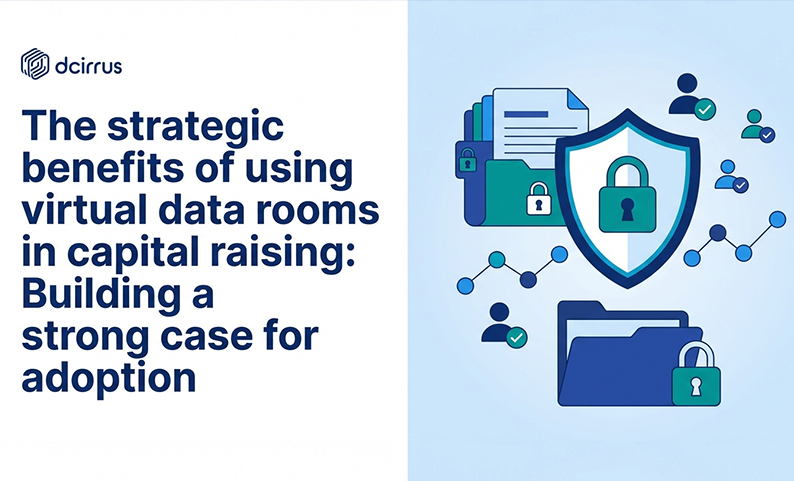
The strategic benefits of using virtual data rooms in capital raising: Building a strong case for adoption
Capital raising is a trust exercise under time pressure. You’re asking investors to underwrite your story, your numbers, and your risk. Often across multiple stakeholders. Bankers, counsel, auditors, internal teams who all need different levels of access to sensitive materials.
A virtual data room (VDR) becomes more than secure storage in this context. In fundraising and investment rounds, a VDR can reduce execution risk and speed up the due diligence process. It demonstrates the operational discipline that investors increasingly expect, especially when diligence cycles are stretching longer. One source notes an increase from 124 to 203 days on average over the past decade.
What is a Virtual Data Room?
A virtual data room is a secure online environment built for high-stakes transactions. Fundraising, IPO preparation, M&A due diligence, private equity processes. Anywhere confidential documents must be shared with multiple external parties without losing control.
Unlike basic cloud storage, a VDR is designed around transaction governance. Encryption, granular permissions, watermarking, audit trails, and structured workflows that keep sensitive materials protected and traceable.
In a capital raise, a VDR acts as the controlled single source of truth for investor diligence. Your team uploads core materials (pitch deck, financials, cap table, contracts, legal agreements, IP documentation). Access is granted on a need-to-know basis, often through role-based permissions. Different investors see the appropriate depth at the right time.
Investor questions are handled through Q&A management modules, keeping context tied to documents and answers consistent. Activity tracking shows which parties are engaged and where diligence may be stalling. Audit trails provide a defensible record for compliance and accountability.
How do VDRs improve security and compliance during capital raising?
Fundraising diligence concentrates your most sensitive information in one place. Customer data, revenue details, pricing, product plans, IP, employment agreements. A VDR reduces exposure by making security enforceable (not just policy).
Strategic security capabilities include encryption for data at rest and in transit, two-factor authentication, granular permissions at folder and file level, watermarking to discourage leakage, comprehensive audit trails, and auto-redaction for sensitive identifiers.
On compliance, VDRs support a “prove it” posture. Granular access controls and audit trails are widely recognized as critical for meeting expectations tied to frameworks like GDPR, HIPAA, SOC 2, and ISO 27001. For capital raising teams operating across borders, features like data localization can matter when investors or regulators require regional data residency.
Worth documenting this early.
Can VDRs actually speed up due diligence timelines?
Speed in capital raising isn’t just convenience. It’s leverage. The longer diligence drags, the more opportunities for doubt, distraction, or shifting market conditions.
A VDR accelerates diligence by enabling parallel review, searchable repositories, and structured workflows. Fast retrieval through OCR and metadata search reduces back-and-forth requests. Version control limits confusion when updated financials are uploaded. Centralized Q&A management reduces duplicated questions and inconsistent answers.
One published benchmark claims VDRs can reduce due diligence time by up to 40% compared to physical data rooms. Modern VDRs compress timelines further with AI-powered document intelligence (smart indexing, clause recognition, AI-assisted redaction). Teams spend less time hunting and more time resolving substantive issues.
How do VDRs improve collaboration and investor confidence?
Capital raising involves multiple parties who don’t share systems, time zones, or context. A VDR improves collaboration while keeping control with the deal owner.
Key drivers include secure real-time collaboration with controlled access, Q&A workflows that capture answers once and reuse them consistently, and activity tracking that helps deal teams see momentum and prioritize follow-ups. Real-time reporting can help management identify and prioritize engaged investors during fundraising.
Most importantly, a clean, well-organized data room signals readiness. If your diligence materials are chaotic, investors may assume your internal controls are too.
What cost savings do VDRs provide compared to traditional methods?
Cost reduction isn’t just about replacing printing and travel. It’s also about reducing time sinks and administrative overhead during investment rounds.
A VDR can lower costs by eliminating physical data room expenses and logistics, reducing printing and travel, cutting administrative work through bulk upload and automated reporting, and minimizing rework caused by version confusion.
One source estimates VDRs reduce costs associated with physical data rooms, printing, travel, and security by approximately 30%. For CFOs and deal leads, this supports a practical argument: the platform pays back through fewer hours burned and lower third-party logistics costs.
How do you quantify ROI when building an internal business case?
To build a credible internal case, frame ROI around four measurable levers. Time, labor, risk, and decision clarity.
Estimate time-to-close impact using a baseline from your last raise. One source claims up to 40% faster diligence versus physical rooms. Calculate internal labor savings by estimating weekly hours spent on document requests and version control, then multiply by blended hourly cost. Include external cost avoidance like printing and travel (approximately 30% cost reduction versus physical data rooms). Track risk reduction through leading indicators like fewer unauthorized shares and better auditability.
A simple executive summary: “We’re buying speed, control, and auditability. Not storage.”
What challenges should you expect during VDR adoption?
Many VDR rollouts face predictable challenges. Deal teams default to email attachments, inconsistent folder structures make navigation difficult, and permission management becomes a bottleneck.
Overcome this by assigning a single data room owner (often deal ops, finance ops, or legal ops), standardizing a folder template for fundraising rounds, creating permission groups for common roles, and setting clear rules like “No diligence answers by email—use Q&A management.”
Run a 30-minute onboarding for internal users and provide a short investor navigation guide. The VDR only creates strategic advantage when it becomes the default workflow. Not an afterthought.
What should you look for when evaluating VDR vendors?
When evaluating a VDR for capital raising, focus on capabilities that protect outcomes. Not just features.
Key questions: Does it support encryption, 2FA, watermarking, and DRM controls? How granular is permission management? Are audit trails comprehensive and exportable? Does it include Q&A management, notifications, and version control? Can it support data localization and cross-border compliance? How strong is search functionality, and are AI features available?
Implementation speed matters. Look for solutions that deploy in hours or days, not weeks.
How should you structure your capital raising data room?
Strong structure reduces diligence churn. Organize by what investors ask for and how they evaluate risk.
For initial investor review, include pitch deck, high-level KPIs, historical P&L, burn rate, and cap table summary. During deep diligence, add full financials, cohort metrics, LTV, CAC, payback period, and detailed projections. For legal and risk review, provide contracts, legal agreements, corporate governance, and employee agreements. For defensibility assessment, share IP documentation and security posture overviews you’re comfortable disclosing.
For IPOs or regulated raises, expect heavier governance and audit documentation. For PE funding, focus on unit economics and cash conversion.
How do you manage access for different stakeholders?
Permissions are where strategy becomes real. The goal is to share enough to move fast without exposing unnecessary risk.
Use role-based access aligned to diligence phase. Keep the default on least privilege (need-to-know basis), then expand intentionally. Apply watermarking broadly for sensitive materials. Limit downloads where possible, and use DRM controls to restrict printing and copying for critical files. Review audit trails regularly to spot unusual access patterns.
Say an investor shares access credentials with a third party outside your approved list. That’s detectable.
What role does AI play in modern VDRs?
AI is changing what “ready for diligence” means. AI-powered document intelligence can auto-categorize and index large uploads, identify key clauses in contracts, improve retrieval with metadata search and smarter tagging, and reduce exposure through AI-assisted redaction.
Strategically, this shifts diligence support from reactive (answering requests) to proactive (making key information easier to find and safer to share).
Automation is becoming the governance layer for fundraising. Automated audit trails create continuous, exportable compliance evidence. Real-time activity analytics show who is engaging and where reviews are stuck. Alerts and notifications reduce silent delays that stretch deal timelines.
Over time, these signals help you run better rounds by revealing which materials create confidence, which raise repeated questions, and where your narrative needs tightening.
Frequently Asked Questions
What is a virtual data room and how does it differ from traditional data storage?
A virtual data room is a secure, purpose-built platform for high-stakes transactions like capital raising. Unlike general cloud storage, VDRs offer encryption, granular permissions, watermarking, audit trails, and Q&A management designed specifically for due diligence and regulatory compliance.
How do virtual data rooms improve due diligence and deal speed in capital raising?
VDRs enable parallel review by multiple stakeholders, searchable document repositories with OCR, version control, and centralized Q&A management. These features can reduce due diligence time by up to 40% compared to physical data rooms.
What security and compliance features do VDRs offer to protect sensitive fundraising information?
VDRs provide encryption for data at rest and in transit, two-factor authentication, granular access controls, watermarking, DRM restrictions, auto-redaction, and comprehensive audit trails that support compliance with GDPR, HIPAA, SOC 2, and ISO 27001.
How can AI-powered features in virtual data rooms accelerate capital raising processes?
AI-powered document intelligence enables smart indexing, automated clause recognition, metadata search, and AI-assisted redaction. These capabilities reduce manual document review effort and help legal and finance teams identify critical insights faster.
What are common challenges companies face when adopting a VDR and how can they be overcome?
Common challenges include teams defaulting to email, inconsistent folder structures, and permission bottlenecks. Overcome these by assigning a data room owner, standardizing folder templates, creating role-based permission groups, and establishing clear usage rules with brief onboarding sessions.
Conclusion: Making the Case for VDR Adoption in Capital Raising
A virtual data room is a strategic control system for capital raising. It helps protect sensitive information with encryption, 2FA, watermarking, and granular permissions. It accelerates due diligence with search, Q&A management, version control, and reporting. And it strengthens investor confidence by demonstrating operational discipline under scrutiny.
If you’re building an internal business case, anchor it to measurable outcomes. Faster diligence (up to 40% versus physical rooms), lower execution costs (approximately 30% versus physical rooms), and reduced governance risk through auditability and controlled access.
Ready to secure your transactions?
Book a free demo of DCirrus Virtual Data Room today and experience enterprise-grade data protection with encryption, access controls, and compliance-ready localization.
Latest Posts
Buyer Engagement Analytics in a VDR: What Deal Teams Can Track
August 17, 2026
12 VDR Features Required for IPO Preparation in India
August 13, 2026
What Bankers and Auditors Need From an IPO VDR in India
August 12, 2026