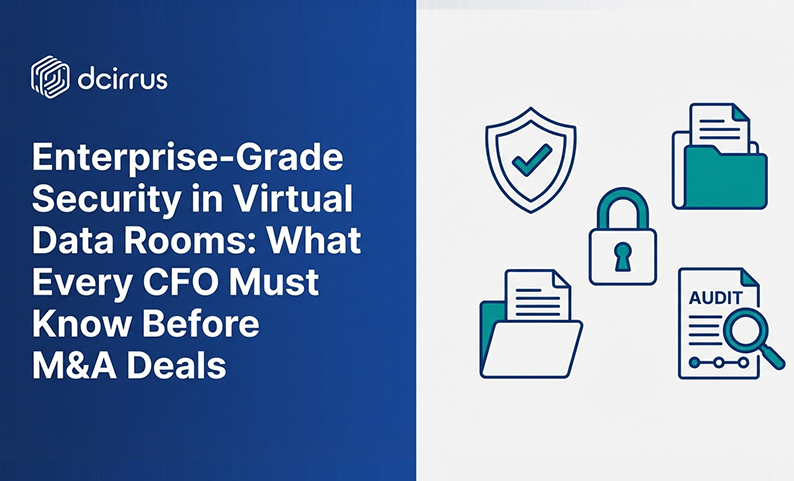
Enterprise-Grade Security in Virtual Data Rooms: What Every CFO Must Know Before M&A Deals
When you’re leading an M&A process, your virtual data room becomes the control center for sensitive financial, legal, and strategic information. If that data is exposed or misused, the consequences can alter deal leverage, create legal liability, and damage trust with buyers, investors, and boards.
Enterprise-grade security in a virtual deal room isn’t a single feature—it’s a layered security posture. Encryption, granular permissions, document-level controls, auditability, compliance alignment, and governance throughout the transaction lifecycle. This guide breaks down what to demand and which risks to prioritize.
Understanding enterprise-grade security in virtual data rooms
Enterprise-grade VDR security is about preventing unauthorized access and limiting what authorized users can do. Also proving what happened and when, while meeting legal expectations without slowing due diligence.
For CFOs, the bar is higher than “secure file sharing.” You’re responsible for protecting value-critical information while keeping the transaction moving on board timelines.
What does “enterprise-grade security” actually mean for M&A CFOs?
In an M&A context, enterprise-grade security typically includes:
- Strong encryption for data at rest and in transit (commonly AES 256-bit and modern TLS)
- Granular permissions and role-based access across folders and files
- Multi-factor authentication (MFA) and robust user authentication controls
- Document protection like dynamic watermarking, redaction, and digital rights management
- Comprehensive audit trails with real-time activity tracking and reporting
- Alignment with relevant compliance regimes (ISO 27001, SOC 2, GDPR, and others depending on industry)
- Administrative controls and governance workflows that work under deal pressure
These features are foundational to platforms built on secure cloud infrastructures. Worth noting early.
Why CFOs should prioritize security before M&A deals
CFOs prioritize VDR security because the downside is asymmetric. One mistake can create outsized deal harm. The most common CFO-facing exposures include:
- Confidentiality breaches that weaken negotiating position or impact valuation
- Unauthorized sharing of forward-looking financials, pricing, margin data, or customer concentration information
- Regulatory and contractual consequences tied to privacy or financial controls
- Disputes about “who knew what when” (especially if diligence questions arise later)
- Operational disruption if poor controls force a shutdown or re-upload during critical windows
Security is also a trust signal. Buyers and their advisors interpret a well-governed data room as a sign of operational maturity.
Critical security features CFOs should demand in a VDR
When comparing VDRs, don’t treat security features as a checklist where every item has equal weight. The CFO question is: which controls measurably reduce the highest-probability, highest-impact deal risks?
Robust encryption to protect sensitive financial data
Encryption is foundational. It reduces the risk that data can be read if intercepted or improperly accessed. CFO-relevant expectations include:
- Encryption at rest to protect stored documents
- Encryption in transit to protect documents during access and upload/download
- Modern secure connection protocols (commonly TLS 1.2/1.3)
- Clear documentation of how keys and cryptographic controls are managed
Not every vendor makes this transparent.
Granular access controls and permission management
In M&A, “authorized access” is not a single category. Different parties need different visibility: strategic buyers, financial sponsors, lenders, external counsel, auditors, and internal executives. Granular permissions help you enforce that reality (and fast).
What to look for:
- Role-based access at both folder and file levels
- Time-bound access for specific phases
- MFA to reduce the risk of compromised credentials
- Controls that limit access by device or network context when appropriate
- Fast administration so your team can adjust permissions as the bidder list evolves
The CFO goal? Reduce “blast radius.” If a credential is compromised or a user oversteps, the damage should be contained.
Digital rights management and dynamic watermarking
Document protection matters because many deal leaks happen through ordinary behavior. Downloads, forwarding, screenshots, and casual sharing.
Controls that commonly reduce this risk include:
- DRM that can restrict printing, copying, and sharing
- Expiry settings on downloaded files to limit long-tail exposure
- Dynamic watermarking that ties a viewed or downloaded file to a specific user and context (timestamp and IP address)
- View-only protections to reduce casual capture
Solutions offering device-level approvals and customizable watermarking help CFOs enforce strict data control during high-pressure deal phases (when people are tempted to cut corners).
Activity auditing, real-time user tracking, and audit trails
If encryption and permissions are preventive controls, audit trails are your accountability layer. They help you answer:
- Which bidder accessed the latest forecast model?
- Who viewed sensitive HR or customer lists?
- What documents were downloaded, when, and by whom?
- Did anyone attempt abnormal access patterns?
For CFOs this supports deal transparency, audit readiness for internal controls, and dispute mitigation if parties later disagree about disclosure timing. That’s the theory. In practice it’s your defense in a heated dispute.
Compliance certifications and regulatory standards
Certifications don’t guarantee perfect security. But they can reduce vendor risk and speed up internal approvals—especially when procurement, IT security, and legal all need comfort quickly.
Depending on your deal profile, ask how the VDR aligns with:
- ISO 27001 and ISO 27701 for security and privacy management practices
- SOC 2 and SOC 3 reporting for controls assurance
- GDPR and other data privacy regulation requirements in relevant jurisdictions
- Industry expectations like HIPAA, FINRA, or SOX when applicable
A CFO-friendly approach: map compliance requirements to the data you’re sharing. Not every deal needs every standard, but every deal needs clarity on which standards matter.
How should CFOs prioritize security threats and liability?
CFOs don’t just “want security.” You need to prioritize threats that can change financial outcomes or trigger disclosure costs.
Insider threats and credential compromise
Two realities of M&A diligence are easy to overlook:
- Not all “insiders” are employees (external advisors and consultants often have access)
- Credential compromise is common, and high-value transactions are attractive targets
Mitigations to pressure-test in your VDR:
- MFA for all external users, not just admins
- Role-based permissions that default to least privilege
- Device-level approval or conditional access controls for high-risk roles
- Fast user offboarding when deal teams change
- Alerting and reporting that makes unusual activity visible
From a CFO standpoint the question is: if a single account is compromised, how quickly can we detect it and prove what was accessed?
Data leakage and unauthorized sharing risks
Leakage isn’t always a “hack.” It’s often a downloaded file forwarded outside the approved circle. Or a screenshot of a sensitive page. Or a well-meaning advisor saving materials in an uncontrolled location (happens more than you’d think).
VDR controls that reduce leakage risk:
- DRM restrictions on printing/copying
- View-only modes
- Dynamic watermarking that ties access to identity (creating deterrence and traceability)
- Clear audit trails of downloads and prints
- Redaction workflows for personally identifiable information and other sensitive fields
CFO impact? Leakage can change bid dynamics, create reputational exposure, and trigger notification obligations depending on the data type.
Cross-border data residency and compliance conflicts
Cross-border M&A introduces a common tension. The people who need access may sit in one country, while data residency or privacy requirements may require storage in another.
CFOs should plan for:
- Where the data room will be hosted and what residency options exist
- Whether your deal involves restricted data categories
- How access is managed for advisors in other jurisdictions
- How you will document compliance decisions for later scrutiny
Multi-region data center availability can be a practical way to reduce regulatory friction, but it needs alignment with your counsel’s guidance.
Impact on insurance and liability in M&A transactions
Security decisions can affect your risk profile in ways that show up in legal exposure. CFOs often care about:
- Whether you can demonstrate reasonable controls if a dispute arises
- Whether your governance supports defensible disclosure practices
- How quickly you can produce evidence of access and actions during diligence
The goal isn’t to treat a VDR as an “insurance policy.” It’s to reduce preventable exposure and ensure you can substantiate what happened.
Can AI-powered security features enhance protection?
AI features in a VDR are often discussed as productivity tools. But CFOs can also evaluate them as security accelerators (when they improve consistency and reduce manual error).
AI-driven anomaly detection and tamper protection
In a high-volume data room manual monitoring can miss early warning signs. AI-driven approaches can help by surfacing patterns that deserve investigation:
- Unusual download spikes
- Access attempts outside expected times or geographies
- Repeated failed authentication events
- Atypical navigation patterns across sensitive folders
On tamper protection CFOs should look for practical safeguards like strong version control, so teams can distinguish the current approved file from outdated or modified copies.
Automated redaction and sensitive data identification
Redaction is a security control and a deal-enablement tool. It lets you disclose what’s needed without oversharing.
AI-assisted redaction can help find common sensitive fields (names, IDs, bank details) faster than manual scanning. Apply more consistent redaction across large document sets. Reduce the time between a buyer request and a safe disclosure. Not perfect, but far more reliable than eyeballing 800 documents under time pressure.
How do you enhance collaboration within a secure VDR environment?
Security and collaboration should not be in conflict. In well-run M&A processes collaboration features reduce chaos. And chaos is a security risk (people start using email again).
Secure Q&A management and notifications
Q&A workflows matter because they create a controlled lane for buyer diligence questions and seller responses.
Key collaboration capabilities that support both speed and security:
- Centralized Q&A tools tied to topics or folders
- Permissioning on who can ask, answer, approve, and publish responses
- Notifications that reduce “side channel” follow-ups via email
- Searchable Q&A history for consistency and audit readiness
For CFOs this also helps enforce internal review steps (finance, legal, compliance) before sensitive answers are released.
Real-time document sharing and version control
Version confusion can cause real damage in diligence. Bidders modeling off outdated numbers, advisors reviewing superseded contracts, or teams responding to questions using the wrong schedule.
Look for version control that keeps history while clearly indicating the current version. Controlled sharing workflows that don’t require duplicating documents. Activity analytics that show what’s being reviewed and where buyers are spending time. Simple stuff that prevents big mistakes.
What are the CFO best practices for preparing and governing the VDR?
A secure platform doesn’t automatically create a secure process. CFO-led governance turns VDR features into consistent deal controls.
Organize documents and set permissions before deal kickoff
Before granting bidder access set the data room up to minimize errors under pressure:
- Build a folder structure aligned to diligence categories
- Define roles upfront and map them to permission templates
- Apply least-privilege defaults and expand access only when needed
- Use redaction and staged disclosure for sensitive files
- Validate that watermarking and download rules match the sensitivity of each folder
Early preparation reduces last-minute permission scrambling (which is where many accidental exposures occur).
User training and internal security policy enforcement
Even the strongest VDR can be undermined by inconsistent behavior. CFOs don’t need to run technical security training, but you can sponsor simple, enforceable operating rules:
- Require MFA and prohibit shared accounts
- Define what can and cannot be downloaded
- Set expectations for using VDR Q&A instead of email for deal questions
- Establish an internal approval path for uploading and updating key financial documents
- Assign clear owners for permissions, content updates, and Q&A responses
This is also a culture signal. The deal is important enough to run with discipline.
Post-deal security governance and data retention compliance
Many organizations treat the data room as “done” at close. That’s a governance gap. After the transaction you may still need the VDR for audits, disputes, integration planning, or regulatory inquiries.
A CFO-friendly post-deal governance rubric includes:
- Decide what to retain, for how long, and why
- Remove access for external parties promptly and document the offboarding
- Archive required records in a controlled, auditable way
- Ensure retention and disposal practices align with data privacy regulation
- Preserve audit trails and Q&A logs as part of the deal record
Maintaining audit-ready documentation following transaction closure is critical. Automated trails and version controls in advanced data rooms support this ongoing governance.
What should CFOs look for when evaluating VDR vendors?
CFO vendor evaluation should go beyond “feature match.” You’re buying risk reduction, control execution, and reliability during high-stakes weeks.
Assessing security certifications and compliance coverage
Start with verification, not marketing:
- Ask which certifications and audit reports are available
- Clarify which parts of the service are covered
- Confirm how the vendor supports compliance with GDPR and other regional laws relevant to your deal
- Ensure you can obtain documentation your procurement and IT security teams will require
The CFO aim is to reduce vendor risk management friction and avoid late-stage approval delays.
Balancing cost against security investment and risk mitigation
Security can affect cost but the CFO decision is really about trade-offs:
- Higher-risk deals (competitive auctions, sensitive IP, regulated data) justify stronger controls like digital rights management (DRM) and strict download limits
- Lower-risk phases may allow broader access to speed review—if auditability and permissions are still strong
A practical cost-vs-security heuristic: if a feature reduces the likelihood of a high-impact leak treat it as a risk-control investment. Prefer predictable pricing models that won’t penalize you for adding the right stakeholders at the right time.
Vendor security culture, incident response readiness, and support
Certifications matter but execution matters more during a live deal. Pressure-test the vendor’s operational readiness:
- How quickly can support respond during peak diligence windows?
- What is the incident response process if suspicious activity appears?
- How are administrative actions logged and controlled?
- What onboarding help is available for permission templates?
In M&A responsiveness is part of security. Slow support can force workarounds and workarounds create risk.
Multi-region data center availability and residency options
For cross-border transactions residency options can be a deciding factor. CFOs should evaluate whether multi-region data centers are available, whether you can choose where data is hosted, how residency choices affect performance for global deal teams, and what contractual commitments exist around where data is stored.
Summary: how enterprise-grade security empowers CFOs to lead M&A deals confidently
Enterprise-grade security in a VDR is a CFO tool for controlling downside risk while preserving deal momentum. The most effective approach is layered:
- Use strong encryption and modern transport security as the baseline
- Enforce granular permissions, MFA, and constrained access
- Apply DRM, dynamic watermarking, and redaction to deter leakage
- Rely on audit trails and real-time tracking for accountability
- Plan for cross-border compliance with data residency options
- Treat post-deal retention and access removal as part of the transaction
- Evaluate vendors on verifiable compliance coverage and operational readiness
If you align these controls with disciplined preparation and CFO-led governance you reduce the odds that security becomes the reason a deal slows down. Or the reason it goes sideways.
FAQ
What makes a virtual data room enterprise-grade secure for M&A transactions?
An enterprise-grade secure VDR combines layered controls: encryption (at rest and in transit), MFA, granular role-based permissions, document protection (DRM, watermarking, redaction), comprehensive audit trails, and compliance alignment (such as ISO 27001 or SOC 2). For M&A it must also perform reliably under heavy, multi-party use.
Which security features should CFOs prioritize to protect sensitive M&A data?
Prioritize controls that reduce high-impact deal risk: granular access controls, MFA and strong user authentication, audit trails and real-time activity monitoring, DRM and dynamic watermarking, redaction workflows for sensitive fields, and data residency options for cross-border compliance needs. Not all features carry equal weight.
How does encryption safeguard financial documents during an M&A deal?
Encryption helps prevent unauthorized reading of documents if data is intercepted in transit or accessed improperly while stored. In practice CFOs look for encryption at rest (commonly AES 256-bit) and secure connections in transit (commonly TLS 1.2/1.3), backed by clear vendor documentation of key management practices.
What compliance certifications are essential for a secure VDR in M&A?
“Essential” depends on your industry and jurisdictions but commonly requested assurances include ISO 27001, SOC 2, and GDPR alignment where EU/UK personal data is involved. Some deals may also require HIPAA, FINRA, SOX, or ISO 27701 based on the data and counterparties.
How can AI features enhance security and expedite due diligence in VDRs?
AI can improve security execution by making controls faster and more consistent (such as AI-assisted redaction, sensitive data identification, and intelligent search). Some systems may also support anomaly detection to flag suspicious patterns, helping teams investigate potential misuse earlier.
What are best practices for CFOs to prepare and govern a secure VDR?
Key practices include building a diligence-aligned folder structure early, applying permission templates and least-privilege defaults, staging disclosures and using redaction for sensitive content, keeping Q&A inside the VDR with defined approval steps, training internal teams on rules for downloads and updates, and planning post-deal retention and offboarding.
How do granular access controls prevent unauthorized information leaks?
Granular access controls limit who can view, download, print, or upload specific documents based on role and need-to-know. By narrowing access and enforcing time-bound or device-specific rules where appropriate you reduce the chance that one user can expose more information than necessary.
What should CFOs look for when evaluating VDR vendors for security and compliance?
Look for verifiable security and operational readiness: relevant certifications and audit reports (ISO, SOC), strong encryption and authentication options (including MFA), document protection (DRM, watermarking, redaction), detailed audit trails and reporting exports, clear data residency options for cross-border deals, and incident response readiness with responsive support during live deals.
How does post-deal governance affect ongoing VDR security and compliance?
After close lingering access for external parties and unmanaged retention can create ongoing risk. Post-deal governance ensures access is removed, records are retained appropriately for audits and legal needs, and data is disposed of securely in line with privacy and compliance obligations.
What are common security risks CFOs need to manage in virtual data rooms?
Common risks include insider threats, compromised credentials, unauthorized downloads and forwarding, weak permissioning that exposes unnecessary documents, cross-border compliance conflicts, and poor auditability that makes it hard to prove what was disclosed and when. So what does that mean in practice? You need control. Real control.
Ready to secure your transactions?
Book a free demo of DCirrus Virtual Data Room today and experience enterprise-grade data protection with encryption, access controls, and compliance-ready localization.
Latest Posts
Buyer Engagement Analytics in a VDR: What Deal Teams Can Track
August 17, 2026
12 VDR Features Required for IPO Preparation in India
August 13, 2026
What Bankers and Auditors Need From an IPO VDR in India
August 12, 2026