Enhancing Stakeholder Confidence: Data Room Collaboration Best Practices for CFOs on Both Sides of M&A Deals
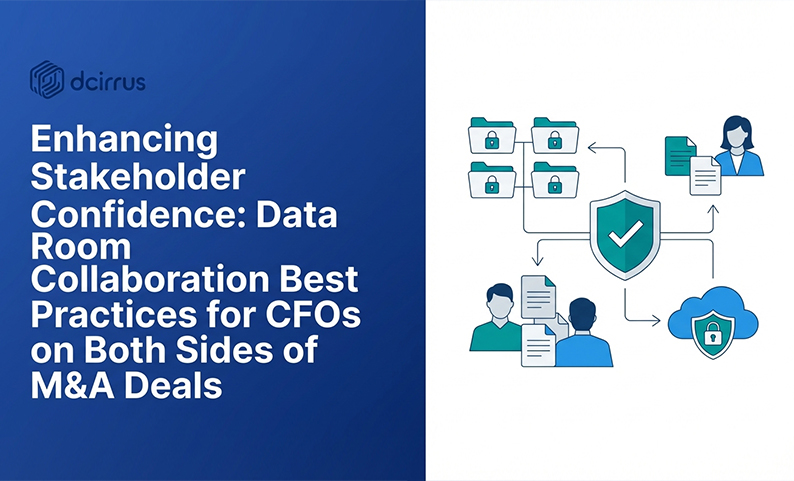
M&A is a pressure test for finance leadership. You’re expected to move fast, keep sensitive information controlled, and maintain a clear narrative for boards, investors, lenders, auditors, and regulators. In practice, stakeholder confidence is often won or lost in the Virtual Data Room: how documents are organized, how access is managed, how questions get answered, and how transparently progress is communicated.
CFO-to-CFO collaboration matters because both sides have legitimate (sometimes competing) priorities. The sell-side CFO must protect confidentiality and avoid accidental competitive exposure. The buy-side CFO must validate risk, confirm financial quality, and keep diligence on schedule. When collaboration inside the data room is structured, secure, and auditable, trust increases and friction decreases. Research from industry practitioners indicates that companies using virtual data rooms effectively can complete transactions up to 30% faster than those relying on traditional physical data rooms or scattered email-based approaches.
What role do CFOs really play in M&A data rooms?
CFOs increasingly operate as strategic partners and M&A strategists (not just controllers of financial reporting). That shift shows up in the data room. You’re not only “supplying documents”—you’re shaping how stakeholders interpret them.
On both sides the core collaboration goal is the same: create a single reliable working environment where stakeholders can verify the deal thesis without introducing avoidable risk. Typical collaboration pressure points include misaligned expectations on disclosure standards, delays from back-and-forth email threads, confusion from inconsistent folder structures, tension around permissions, and stakeholder anxiety when progress is hard to measure.
A well-run due diligence data room becomes a shared operating system for the deal team. It integrates expertise across finance, legal, tax, HR, and operations while giving the CFO the oversight needed to reassure boards and external parties that diligence is controlled.
Key collaboration features CFOs should leverage in virtual data rooms
A VDR is only as effective as the collaboration behaviors it enables. For CFOs the most confidence-building pattern is consistent: limit ambiguity, document decisions, and make activity visible without compromising confidentiality.
Granular permission controls to tailor data access
Granular access permissions are a practical trust-building tool. They let the seller share enough to keep diligence moving while protecting highly sensitive items until the right stage, approvals, or NDAs are in place. They also let the buyer coordinate internal access so only the right reviewers see the right materials.
Role-based access management directly contributes to trust between buyer and seller CFOs because it demonstrates intentional control (not blanket sharing). When the sell-side CFO can show exactly who accessed which folders and when, and the buy-side CFO can assure their board that only approved personnel reviewed sensitive forecasts, confidence in the process increases on both sides.
Common approaches CFOs use:
- Role-based access by stakeholder group (buyer finance, buyer legal, lenders, external auditors, advisors)
- Phased disclosure by deal stage (pre-deal prep, due diligence, deal structuring)
- Folder-level and file-level permissions to avoid over-sharing
- Device-level approval and IP restrictions for higher-risk materials
Treating permissions as part of the collaboration plan reduces rework, reduces disputes, and makes your disclosure logic easier to defend to boards and regulators.
Dynamic watermarking and document tracking
Dynamic watermarking and document tracking shift the tone of diligence. Instead of “trust us,” you can credibly say, “This environment is controlled and access is accountable.” Watermarking supports collaboration by discouraging unauthorized distribution without slowing legitimate review. It makes it easier to investigate concerns if leakage is suspected. And it reinforces professional standards with investors and advisors.
Tracking also gives CFOs a way to monitor stakeholder engagement patterns and anticipate where clarification may be needed before concerns escalate.
Comprehensive audit trails for transparency and compliance
Audit trails are a confidence engine because they make the process provable. A comprehensive record of uploads, views, downloads, permission changes, and Q&A activity supports:
- Audit-ready documentation for internal governance and external assurance
- Better stakeholder communication with boards and investors
- Faster dispute resolution when parties disagree on “what was shared when”
- Cleaner handoffs from diligence to integration planning
For CFOs managing multi-jurisdiction compliance or heightened scrutiny, comprehensive audit trails reduce reliance on memory and scattered email threads.
Real-time collaboration tools and Q&A management
Most deal delays come from questions that linger, get duplicated, or get answered inconsistently. Real-time collaboration tools and structured Q&A management keep the deal moving without losing control of messaging.
A strong workflow typically includes a central Q&A forum with ownership assignment per question, clear response SLAs for different question types, controlled publishing of answers so the buyer team receives consistent information, and automated notifications when new documents are uploaded or questions are answered.
Keeping stakeholder communication inside the VDR reduces the risk of version confusion. Worth documenting early.
How should you organize data room content to optimize collaboration?
Organization is collaboration. If external reviewers can’t find what they need quickly, they assume the underlying finance function is messy (even when it isn’t). A consistent shared structure reduces repetitive requests and keeps diligence focused on substance instead of navigation.
Documentation standards and folder structures that optimize multi-stakeholder collaboration include a simple predictable folder hierarchy, file naming that is consistent across periods and entities, a clear “source of truth” rule for updated documents, and defined owners for each folder area to prevent drift.
Sample folder structure template for buyer and seller CFOs
Below is a sample structure designed to be readable for both sell-side preparation and buy-side review. Adjust to deal complexity, industry, and regulatory needs.
- 00Adminand_Process
- 01Corporateand_Governance
- 02_Financials
- 03_Tax
- 04Commercialand_Revenue
- 05Customersand_Contracts
- 06Suppliersand_Procurement
- 07Peopleand_Benefits
- 08Legaland_Compliance
- 09Technologyand_Security
- 10_Operations
- 11ESGand_Sustainability
- 12ModelingandDealSupport
Naming convention example (keep it consistent): Entity_Function_DocumentType_Period_Version such as Group_Financials_AuditReport_FY2024_v1.
The goal isn’t perfection. It’s predictability. Predictability reduces friction, and reduced friction boosts stakeholder confidence.
Coordinating document updates and version control
Version control issues are one of the fastest ways to damage trust. The collaboration expectation should be explicit: reviewers should always know which file is current, why it changed, and whether prior conclusions need revisiting.
Simple operating rules that work:
- One upload owner per document category
- “Change notes” in the VDR comments or description field for material updates
- Archiving old versions rather than deleting them when audit-readiness matters
- Using a defined cadence for refreshes (weekly, biweekly, or milestone-based)
When the buyer CFO can confidently explain to their board that diligence is being conducted on controlled current information, confidence rises and timeline risk falls.
How can CFOs manage conflict and secure communication in the data room?
Even with the best tooling, deals are run by humans. CFO collaboration can become strained when timelines are aggressive, stakeholders are anxious, and each side fears disadvantage. Managing tension is part of the job—especially when the VDR becomes the focal point for requests, denials, and “why is this missing?” conversations.
CFO collaboration conflict resolution model
Use a simple repeatable model for resolving data room friction without derailing diligence. This approach keeps issues factual, time-bound, and traceable:
- Identify the issue clearly in writing (what is requested, and why it matters)
- Classify the sensitivity level (routine, sensitive, highly sensitive)
- Propose a disclosure path (redaction, delayed release, restricted group access)
- Agree on a decision owner (who approves release and under what condition)
- Document the resolution inside the VDR (so the same dispute doesn’t repeat)
This model works because it separates the relationship from the artifact. Instead of “you’re being difficult,” the conversation becomes “here is a structured way to satisfy diligence while managing risk.”
Establishing protocols for timely response and escalation
Stakeholder confidence drops when the process feels stalled. CFOs can protect momentum by setting protocols early (ideally during pre-deal preparation). Practical protocols include:
- Response time targets for Q&A categories (standard vs. complex)
- Escalation thresholds (e.g., unanswered after X business days)
- A single route for “urgent” questions to avoid side-channel pressure
- Regular cadence check-ins between buyer and seller finance leads
These protocols also protect your teams from burnout by reducing ad hoc chaos and creating a clear operating rhythm.
How does AI-powered document intelligence accelerate deal timelines?
Artificial Intelligence in a VDR is most useful when it reduces mechanical work: searching, sorting, summarizing, and identifying patterns across large volumes of files. When CFOs and deal teams can spend less time hunting for documents, they spend more time applying judgment.
Common AI-powered document intelligence use cases in diligence:
- Smart indexing and metadata search to locate key items quickly
- Automated categorization to keep the data room organized as volume increases
- Document summaries to speed first-pass review by finance and legal
- Clause recognition and risk flagging to highlight areas needing deeper review
- AI-assisted redaction to support staged disclosure
The collaboration value is shared speed with fewer errors. When both CFOs can align around faster retrieval and clearer review workflows, the deal team spends less time on administrative friction and more time on decision-quality.
Which KPIs should CFOs monitor to track collaboration success?
If you can’t measure collaboration it’s hard to manage stakeholder confidence—especially when boards ask “Are we on track?” or investors ask “What’s outstanding?” A KPI rubric gives CFOs leading indicators of diligence health before timeline risk becomes unavoidable.
A practical data room collaboration KPI rubric can include:
- Average Q&A response time
- Open Q&A volume by category (financial, tax, legal, HR)
- Document request cycle time (request to upload)
- Reopened questions count (signals unclear answers or mismatched expectations)
- Reviewer engagement patterns (views/downloads by stakeholder group)
- Permission change frequency (signals shifting disclosure boundaries)
- Volume of documents uploaded per week (and by folder area)
How to interpret collaboration metrics to drive improvements
Use metrics to improve workflow, not to “score” the other side.
If Q&A response time is rising? Add capacity or tighten ownership rules. If reopened questions increase, standardize answer formats and add supporting exhibits. If engagement is low from a key stakeholder group, verify they have correct access permissions. If permission changes spike, revisit the staged disclosure plan and document it clearly.
Boards and investors tend to trust processes that are visible and managed. A CFO who can report both lagging indicators (what’s completed) and leading indicators (what’s at risk) builds confidence even when diligence is complex.
What practices protect sensitive financial information while maintaining transparency?
CFOs must balance confidentiality and openness. Too much restriction slows diligence and raises suspicion. Too much transparency increases leakage and competitive risk.
Best practices that support both objectives:
- Two-factor authentication and strict user verification for external parties
- Encryption for data at rest and in transit
- DRM-style controls (limit printing, copying, and offline sharing where appropriate)
- Time-bound access for specific stakeholder groups
- Controlled redactions with a documented rationale
- Data localization choices for cross-border compliance needs
- Consistent watermarking for sensitive financial metrics and forward-looking materials
The confidence signal to stakeholders is simple: the process is transparent where it should be and protected where it must be.
Common pitfalls in data room collaboration and how CFOs can avoid them
Most VDR issues aren’t “technology failures.” They’re operating failures. Unclear rules, inconsistent workflows, or unmanaged tension.
Key pitfalls and practical preventions:
- Over-permissioning external users by default
- Under-communicating the disclosure plan and release timing
- Allowing parallel document sharing via email that creates version conflict
- Treating Q&A as informal rather than owned and tracked
- Uploading without naming standards leading to repeated requests
- Failing to onboard stakeholders causing confusion
- Ignoring post-close needs then scrambling for audit trails later
If your VDR is the deal’s “system of record,” everything outside it becomes a risk multiplier.
How can CFOs sustain stakeholder confidence beyond deal close?
Stakeholder confidence doesn’t end at signing or close. Integration introduces new scrutiny: whether the value case holds, whether controls remain strong, and whether obligations are being met.
Post-merger integration collaboration benefits from continuing to use the data room as a controlled reference point for audit trails and governance documentation, transition service agreements and obligation tracking, integration planning artifacts and updated policies, compliance evidence for regulators and auditors, and a shared history of decisions, assumptions, and disclosures.
Maintaining continuity also prevents the common “knowledge drop” where diligence insights get lost between the deal team and the integration team.
CFO data room collaboration readiness checklist
Use this checklist in pre-deal preparation to reduce avoidable friction once diligence accelerates.
Alignment meetings and stakeholder onboarding
- Confirm deal team roles and decision owners across both sides
- Define stakeholder groups and what each needs to see
- Set expectations for response times and working cadence
- Provide onboarding guidance for navigation, Q&A, and document requests
Folder and permission configuration
- Agree on folder structure and naming conventions
- Assign folder owners responsible for completeness and updates
- Configure role-based access and staged disclosure rules
- Enable two-factor authentication and appropriate restrictions for sensitive areas
Q&A protocols and communication guidelines
- Centralize Q&A inside the VDR and assign owners per category
- Define escalation paths for blocked or disputed requests
- Standardize answer formats for high-impact financial questions
- Keep deal-critical communications out of untracked side channels
Audit trail and compliance preparedness
- Confirm audit trail logging is enabled and retained appropriately
- Document key permission changes and rationale for restricted items
- Maintain version history for critical documents and models
- Align on any data localization or regulatory requirements early
Final thoughts: Empowering CFOs to drive confident M&A collaboration
CFOs on both sides of an M&A transaction build stakeholder confidence by turning the data room into a disciplined collaboration environment. Controlled access. Clear structure. Auditable communication. Measurable progress.
When those basics are executed well, diligence becomes less adversarial and more decision-focused (exactly what boards, investors, and regulators want to see).
FAQ
What are the essential data room features that CFOs must use to enhance collaboration during M&A deals?
The most collaboration-critical features typically include granular access permissions, dynamic watermarking, comprehensive audit trails, and structured Q&A management with real-time notifications. Together they help CFOs manage confidentiality while keeping diligence transparent and on pace.
How can CFOs securely manage document access and permissions on both sides of a transaction?
Use role-based access aligned to stakeholder groups, apply phased disclosure by deal stage, and enforce strong authentication such as two-factor authentication. For highly sensitive materials add device/IP restrictions, limit download/print rights, and document permission decisions to avoid repeated disputes.
What conflict resolution approaches can CFOs adopt to maintain effective communication in data room collaboration?
A structured model works best: define the specific request, classify sensitivity, propose a disclosure path (redaction or restricted access), assign a decision owner, and record the resolution inside the VDR. This keeps disagreements factual and reduces relationship-driven escalation.
Which KPIs should CFOs monitor to evaluate the success of data room collaboration and stakeholder confidence?
Track operational metrics like Q&A response time, request-to-upload cycle time, reopened questions, engagement activity by stakeholder group, and permission change frequency. These provide leading indicators of whether diligence is flowing smoothly or becoming a confidence risk.
How can AI-powered document intelligence tools improve M&A deal timelines for CFOs?
AI features like smart indexing, automated categorization, advanced search, document summaries, and assisted redaction can reduce manual effort and speed review. The practical result? Faster retrieval of key information and fewer avoidable errors during high-volume diligence.
Ready to secure your transactions?
Book a free demo of DCirrus Virtual Data Room today and experience enterprise-grade data protection with encryption, access controls, and compliance-ready localization.
Latest Posts
Buyer Engagement Analytics in a VDR: What Deal Teams Can Track
August 17, 2026
12 VDR Features Required for IPO Preparation in India
August 13, 2026
What Bankers and Auditors Need From an IPO VDR in India
August 12, 2026