Mitigating Data Redundancy and Maintaining Audit Trails in Post-Merger VDR Environments
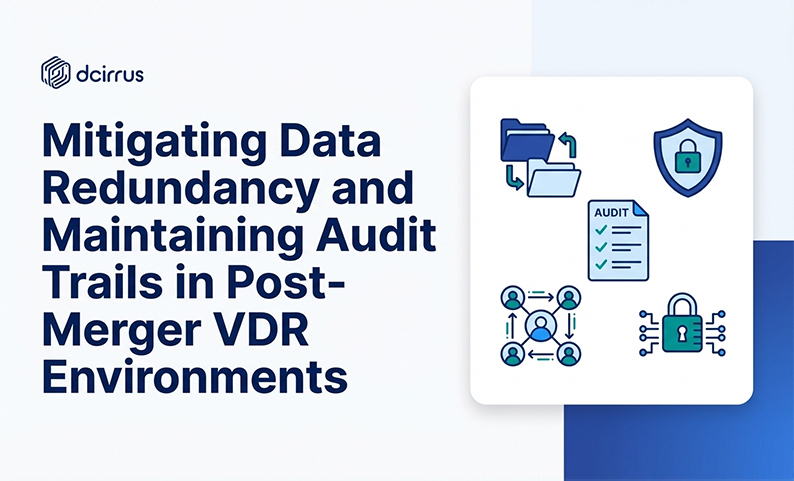
Post-merger integration is where good deals can turn messy fast, especially inside the virtual data room (VDR). Two problems tend to show up at the same time:
- Data redundancy: duplicate data, redundant documents and repeated uploads that make it hard to know what’s current.
- Audit trail gaps: missing or inconsistent audit logs when documents and users move across systems, teams and jurisdictions.
In a post-merger environment you’re combining people, processes and often multiple secure document repositories. That creates a real risk of losing a single source of truth right when finance, legal and compliance teams need it most. This article walks through the root causes, the operational impact and the practical VDR configurations that help you reduce data duplication while keeping audit trails complete and defensible.
What causes data redundancy in post-merger virtual data rooms?
In a VDR context, data redundancy is more than “extra copies.” It’s any duplication that increases confusion or risk (the same contract uploaded in multiple folders, multiple versions with unclear ownership, or parallel “final” files that aren’t actually final).
Post-merger redundancy is uniquely challenging because consolidation typically happens under time pressure with a growing list of stakeholders who all need access but don’t share a filing system or naming conventions.
Data duplication in a post-merger VDR environment usually comes from a few predictable sources:
- Two (or more) legacy data rooms being combined: Each company may have maintained its own folder structures, document taxonomies and retention rules.
- Overlapping document sets: The acquirer and target often store similar items like policies, templates, vendor contracts and financial statements that look alike but aren’t identical.
- Re-uploads driven by uncertainty: When users can’t find a file quickly they upload “another copy” rather than asking the VDR administrator.
- Email-to-VDR behavior: Teams still working from email attachments often re-upload files repeatedly during fast-moving integration phases.
- Version conflicts across departments: Legal, finance, HR and IT may each maintain their own “final” version, creating parallel threads of truth.
- Vendor and advisor workflows: External counsel, auditors and bankers may upload their own working sets, sometimes duplicating what internal teams already shared.
When you merge VDRs without a clear governance model, redundancy becomes a natural outcome. Many well-intended people trying to move quickly.
How does redundancy affect post-merger operations?
Redundant documents aren’t just an annoyance (they affect operational speed, decision quality and compliance posture).
You’ll typically see slower due diligence and integration work because reviewers must compare duplicates to confirm which is current. There’s also higher risk of decisions made on outdated information, especially when “finalv3″ and “finalreally_final” both exist. Add in unnecessary storage and administrative overhead including manual cleanup and repeated questions from stakeholders, plus more complicated access management since permissions may be applied inconsistently across duplicates.
The biggest issue? Audit and compliance risk. It becomes harder to show what was shared, when it was shared and which version was relied upon.
In short: redundancy undermines the exact outcomes the VDR is meant to support. Clarity, speed and controlled sharing.
How do you establish a unified audit trail framework across merged VDRs?
An audit trail (audit logs, activity tracking, tamper-proof logs and compliance records) is your system of record for who did what in the data room environment. Post-merger, audit trails matter even more because stakeholders multiply and governance changes quickly.
The biggest challenge is continuity. If you move documents from one platform to another or consolidate multiple VDR instances, your audit trail can become fragmented unless you design for it.
A post-merger VDR audit trail should capture enough detail to satisfy internal controls, external auditors and regulators without requiring manual reconstruction. At a minimum, aim for audit logs that record:
- User identity and role (and ideally the organization they belong to)
- Authentication events (logins, failed attempts, MFA usage)
- Document events (view, download, upload, delete, rename, move)
- Permission changes (who granted access, changed roles or altered user privileges)
- Timestamps with consistent time handling, including time zone clarity
- Version history (what changed, when and by whom)
- Exportable reporting for audit evidence and stakeholder updates
The goal is not “more logs.” The goal is defensible traceability, a clear chain of custody for sensitive documents during merger integration.
What’s the best way to merge and synchronize audit logs?
When you consolidate merged VDRs treat audit logs as first-class assets. A practical approach is to define a “unified audit trail framework” before you migrate anything:
- Define the audit scope: Which repositories, time windows and document sets must remain traceable from pre-merger through integration?
- Map identities across companies: Decide how you’ll represent users (email, unique IDs) so the same person doesn’t appear as two different actors across systems.
- Preserve legacy logs: If you must move content, keep the original audit logs accessible for the retention period required by policy or regulation.
- Standardize event taxonomy: Align event types (e.g., “view” vs. “open”) so reports remain interpretable after consolidation.
- Document migration events explicitly: If files are transferred the migration itself should be logged as an administrative event with time, operator and scope.
- Validate completeness: After migration test whether you can reconstruct key narratives. Who accessed a board deck? Who downloaded a financial model? Who changed permissions?
This is where enterprise-grade VDR platforms can help. For example, platforms such as DCirrus are designed to track user activity through comprehensive audit trails while supporting controlled access and secure collaboration, capabilities that become especially relevant when you’re trying to maintain continuity across a combined environment.
What regulatory rules affect post-merger audit trails?
Post-merger audit trail requirements vary by industry and geography but the recurring theme is accountability. The organization must be able to demonstrate appropriate handling of sensitive information.
Common compliance considerations that affect audit trail design include:
- SOX-aligned controls: For many organizations audit logs support internal control evidence around financial reporting and approval workflows.
- GDPR and privacy obligations: Access tracking, purpose limitation and data minimization increase the need for clear logs and controlled retention.
- Regional data protection laws and localization: Cross-border mergers may require audit logs and documents to be stored or processed in specific regions.
If your integration spans jurisdictions you’ll need to think about data localization and retention rules early. VDR infrastructure with multi-region availability and configurable hosting locations can reduce friction when compliance requirements differ across entities.
What are the best practices to reduce redundancy and protect audit trails post-merger?
You don’t eliminate redundancy with one cleanup sprint. You reduce it by combining governance, workflow design and VDR configuration so duplication becomes harder to create and easier to detect.
How can AI help with document deduplication?
AI-powered document intelligence is useful in post-merger cleanup because it helps you scale review beyond manual spot checks. In practical terms AI document analysis can support:
- Automated indexing and categorization to normalize filing across merged teams
- Similarity detection to flag likely duplicates or near-duplicates (for example two versions of the same policy with minor edits)
- Metadata search to locate overlapping documents across departments
- Clause recognition to identify contracts that are effectively the same template or contain the same key terms
- AI-assisted redaction to standardize sensitive-field handling when sharing across broader post-merger stakeholder groups
The operational win is speed and consistency. AI-driven content identification helps you find redundant documents earlier, reduce re-uploads and streamline review cycles while keeping decisions anchored to fewer better-controlled versions.
Why granular access controls matter in merged VDRs
Access controls are not only about preventing leaks. In a post-merger VDR granular permissions also reduce redundancy by limiting who can upload, edit or reorganize content.
A practical post-merger permission design typically includes:
- Role-based access aligned to integration workstreams (finance, legal, HR, IT, executive) rather than legacy company boundaries.
- Folder and file-level permissions so high-risk documents don’t get copied into “general” areas just to enable review.
- Controlled upload rights to prevent well-meaning users from creating duplicate uploads across multiple folders.
- Device-level approvals so access is tied to approved devices, reducing uncontrolled downloads and re-sharing.
- IP address restrictions where appropriate, especially for high-sensitivity workstreams or regulated environments.
- Two-factor authentication (2FA/MFA) to harden access while keeping audit logs tied to verified identities.
Advanced VDR solutions often include device approvals and IP restriction features specifically to ensure only authorized stakeholders access sensitive merged documents, helping protect audit trail integrity during a period when org charts and responsibilities are changing.
A simple permission template you can apply is:
- Admins: full control including user provisioning and reporting exports.
- Workstream owners: upload/edit within assigned areas, approve publishing to “single source of truth” folders.
- Reviewers: view and Q&A/comment, limited download where required.
- External parties: least-privilege access, time-bound where possible with strict download/print controls.
VDR administrators should monitor user activity consistently by reviewing audit logs weekly during active integration phases. Check for unusual download patterns, permission drift or repeated failed login attempts. Automated alerts for high-risk events (bulk downloads, off-hours access, access from unexpected locations) help maintain audit readiness without manual oversight.
How version control prevents duplicate uploads
Version conflicts are a major driver of redundant documents. The fix is not “tell people to be careful.” The fix is to design workflows where versioning is explicit and collaboration happens in the secure document repository, not in disconnected email threads.
Strong VDR practices here include:
- Document versioning rules: one canonical file per topic with controlled version history rather than parallel uploads.
- Check-in/check-out or controlled editing processes where applicable to avoid simultaneous edits creating multiple “final” files.
- Centralized Q&A and discussion forums so clarifications live next to the document set they reference.
- Automated notifications for uploads and changes, reducing “I didn’t know it was updated” re-upload behavior.
- Commenting and annotations to keep feedback attached to the document rather than creating revised copies for every reviewer.
Real-time collaboration features (simultaneous editing and collaborative workflows) can prevent duplicate uploads by making it easier for teams to work from one controlled artifact instead of circulating copies.
Using watermarking and DRM to control document spread
Digital Rights Management (DRM) and watermarking help when redundancy intersects with security, especially in post-merger phases where broader access increases the risk of uncontrolled distribution.
Useful controls include:
- DRM restrictions on printing, copying and sharing to reduce “offline duplication.”
- Download expiry so files don’t persist indefinitely outside the VDR.
- Dynamic watermarking that includes identifiers such as user information, IP address and timestamps to discourage unauthorized redistribution.
- Document tracking to tie viewing and downloads back to specific users in audit logs.
These controls don’t just deter leaks. They also reinforce audit trail trustworthiness by aligning access activity with enforceable document behavior.
What security risks come from redundancy and weak audit trails?
Redundancy and audit trails are tightly linked to security outcomes. Problems typically show up during merger integration like this:
- Expanded attack surface: More duplicate files means more places where sensitive information might be exposed through misconfiguration.
- Permission drift: Duplicate documents may inherit different user privileges across folders, causing inconsistent access.
- Harder incident response: If data is duplicated containment is slower because you must locate every copy and determine who accessed each one.
- Reduced confidence in compliance records: If audit logs are incomplete or split across systems it becomes harder to prove what happened and when.
- Tampering risk: Without tamper-resistant logging and controlled admin privileges it can be difficult to demonstrate audit log integrity.
The practical takeaway? Treat redundancy reduction as part of your security program. Fewer better-governed documents are easier to secure, easier to monitor and easier to audit.
To mitigate security risks:
- Implement centralized document governance with clear ownership and approval workflows for “final” versions.
- Use automated monitoring to detect unusual access patterns or permission changes across duplicate files.
- Require admin-level actions (permission changes, bulk deletions, user provisioning) to be logged and reviewed regularly.
- Establish incident response playbooks that account for multi-location document scenarios.
- Enforce tamper-proof audit logging with read-only exports stored outside the VDR for forensic purposes.
Managing access for multiple stakeholders post-merger requires balancing security with usability. You now have legal teams, financial advisors, auditors, integration consultants and executives from both companies needing access (often across time zones and jurisdictions). The solution is a tiered access model that segments users by role and need, applies time-bound permissions where appropriate and uses automated provisioning/deprovisioning tied to integration milestones to prevent access creep.
How do you evaluate VDR capabilities for post-merger data governance?
If you’re selecting a VDR or reassessing your current setup after a merger, use a governance lens. Can the platform help you reduce duplication while maintaining continuous exportable compliance-ready audit logs?
Use this checklist to evaluate whether a data room environment is built for post-merger reality:
- Comprehensive audit logs with exportable reports
- Role-based access and granular permissions down to folder and file level
- Device-level approvals and IP address restrictions
- Strong authentication including 2FA/MFA
- Document versioning with clear version history
- AI-powered document intelligence for indexing, categorization and faster identification of redundant or outdated files
- Watermarking and DRM controls to reduce uncontrolled distribution
- Collaboration tools like Q&A, commenting and notifications to keep work inside the VDR
- Data localization options for cross-border compliance needs
For cross-border mergers technical requirements include multi-region data center availability (AWS or Azure regions), configurable data residency to meet local storage mandates, encryption standards (256-bit AES at rest and in transit) and the ability to generate region-specific audit reports that satisfy local regulatory frameworks.
The best feature set is the one that supports your operating model. Who needs access? Who is allowed to publish “final” files? How is audit evidence produced?
Key questions to ask VDR vendors
When you’re evaluating vendors (or validating your current VDR against post-merger needs) these questions uncover whether redundancy and auditability are truly supported:
- How do audit logs capture user actions across view, download, upload, permission changes and version history?
- Are audit logs tamper-resistant and what controls exist around administrator actions?
- Can we export audit reports in formats our auditors can use without manual rework?
- How does the platform handle document versioning to prevent parallel “final” uploads?
- What capabilities exist for identifying duplicates or near-duplicates (manual, automated, AI-assisted)?
- Can we restrict uploads or limit who can create new folders to reduce uncontrolled duplication?
- Do you support device-level approvals, IP restrictions and MFA, and are these logged clearly?
- What data localization options exist and how do they affect audit trail retention and access?
- What controls apply to downloaded documents (expiry, DRM, watermarking) and how are downloads logged?
These questions force clarity on the practical workflows that matter during integration, not just generic security claims.
How do you measure success for redundancy and audit trails?
You can’t manage what you don’t measure. Post-merger consider tracking KPIs that reflect both cleanliness of the repository and audit readiness:
- Duplicate file ratio (duplicates identified vs. total files)
- Redundant folder count (folders with overlapping purpose or content)
- Average time to find key documents (a practical proxy for indexing quality and redundancy)
- Version conflict rate (instances where multiple “current” versions exist)
- Audit log completeness (coverage of required event types across all workstreams)
- Permission review cadence compliance (whether user privileges are reviewed on schedule)
- Download volume by role (to spot high-risk patterns)
- Unusual activity alerts (spikes in downloads, access from unexpected locations, repeated failed logins)
Worth noting: KPIs don’t need to be perfect to be useful. The point is to establish early signals that the VDR is becoming a cleaner single source of truth, not a bigger dumping ground.
Building a secure single source of truth with reliable audit trails
Post-merger VDR environments fail when they become a patchwork of duplicates and disconnected logs. They succeed when you intentionally build a single source of truth, supported by governance, document intelligence and controls that keep collaboration inside the platform.
If you focus on (1) reducing redundant documents through smarter workflows and AI-assisted identification and (2) maintaining continuous exportable audit trails across merged repositories, you get faster integration work, fewer compliance surprises and better confidence in what’s “final.”
Ready to secure your transactions?
Book a free demo of DCirrus Virtual Data Room today and experience enterprise-grade data protection with encryption, access controls, and compliance-ready localization.
Latest Posts

Buyer Engagement Analytics in a VDR: What Deal Teams Can Track
August 17, 2026
12 VDR Features Required for IPO Preparation in India
August 13, 2026
What Bankers and Auditors Need From an IPO VDR in India
August 12, 2026