Insider-Trading and Leakage Risk as Compliance: 5 Deterrence Controls and the Proof They Should Leave Behind
Insider trading and information leakage are often discussed as “bad outcomes.” In real transactions, they’re also a compliance design problem: how do you limit exposure to material non-public information (MNPI), make misuse harder, and make the risk feel real enough that people think twice?
That’s what deterrence is about. Not only catching wrongdoing after the fact. It’s about shaping behavior before anything happens (especially when multiple parties are moving fast in M&A, IPO, fundraising, or due diligence).
This article defines five practical deterrence controls and the proof artifacts each control should leave behind so compliance teams, legal counsel, and auditors can verify that the controls existed, operated consistently, and were enforceable.
Understanding Insider Trading and Leakage Risks in Financial Transactions
Insider trading generally refers to trading on material non-public information, buying or selling securities (or advising others to do so) based on inside information that the broader market does not have.
Leakage risk is the broader exposure problem: MNPI or deal-sensitive documents escape controlled channels. Leakage can be intentional (a malicious insider) or accidental (a negligent insider). In both cases it can trigger investigations, reputational damage, and deal disruption.
In high-stakes transactions, leakage pathways multiply. Many stakeholders need access. Bankers, lawyers, auditors, consultants, investor groups. Documents change quickly, versions and redlines and financial models. Communication spreads across tools like email, chat, personal devices. Timelines compress, which increases shortcuts.
Deterrence controls aim to reduce both the opportunity and the perceived safety of misusing MNPI.
Why is Insider Trading Prevention a Top Compliance Priority?
Insider trading and leakage aren’t just “security issues.” They sit at the intersection of market integrity, fiduciary duties, and regulatory expectations. The costs extend beyond fines: firms can face loss of trust, deal delays, employee discipline challenges, and long-term reputational harm.
Deterrence matters because insider trading often involves calculated risk. If someone believes they won’t be detected or that evidence will be weak, temptation rises. A 2021 Harvard Law School study found that enforcement actions can reduce insider trading profitability by approximately 7.9% over 180 days. That suggests credible enforcement and credible controls change behavior, not just outcomes.
Regulatory Frameworks and SEBI Compliance Requirements
Different jurisdictions use different rule structures, but the themes are consistent:
- Define inside information / MNPI clearly
- Restrict access on a need-to-know basis
- Maintain surveillance and monitoring appropriate to the risk
- Preserve evidence (auditability) to support investigations and audits
- Demonstrate governance through policies, training, accountability, and escalation paths
For SEBI-regulated contexts, the practical compliance challenge is often not only “do you have a policy?” but “can you prove control operation and chain-of-custody when questioned?” That’s where evidentiary proof becomes part of compliance, not an afterthought.
Common Challenges in Detecting Insider Trading and Leakage
Detection is hard because signals are fragmented. Trading activity may occur outside the firm’s systems. Communication may be unstructured (calls, chats, screenshots). Access is legitimate until it isn’t. Many users do need MNPI for their work.
Leakage might happen through “normal” actions. Download, print, forward. Actions that look routine without context.
That’s why deterrence controls must do two things: reduce unnecessary exposure to MNPI and create reliable, forensic-quality proof when access and handling occur.
The 5 Essential Deterrence Controls to Prevent Insider Trading and Leakage
Deterrence works best as a system. If you implement only one control (for example, training), people may still find easy ways around weak technical boundaries. If you implement only technical restrictions without culture and oversight, you can create workarounds or blind spots.
Below are five controls that work together, each designed to both change behavior and produce proof.
1. Granular Access Controls and Least Privilege Enforcement
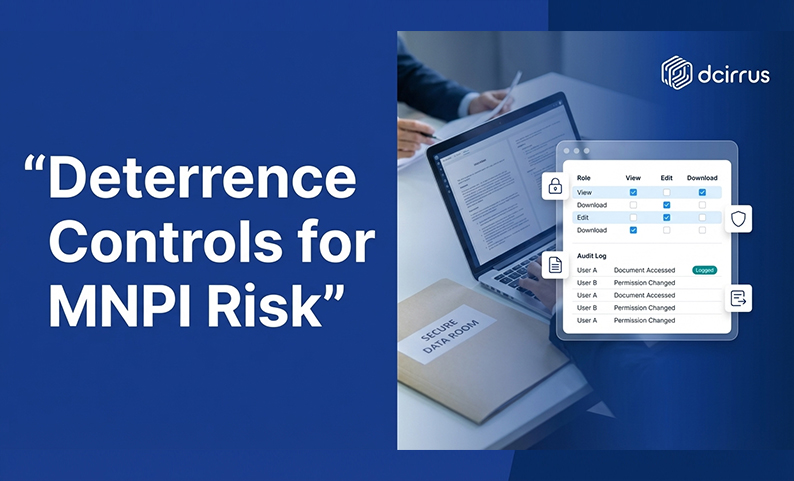
Least privilege means every person gets the minimum access needed for the minimum time needed. In transaction settings that requires role-based access controls down to folder and file levels, plus practical constraints like device approval, IP restrictions, and multi-factor authentication.
Operationally, this control includes:
- Separate workstreams (legal, finance, regulatory, investor) with distinct permission sets
- Time-bound access for external parties
- Controlled onboarding and offboarding as the deal evolves
- Tight permissions for highly sensitive items (financial projections, board materials, price-sensitive drafts)
A secure virtual data room environment centralizes documents and enforces consistent permissions instead of relying on email threads and uncontrolled copies.
Worth documenting permissions early. Say an employee asks on a Friday afternoon for access to a pricing model. You’ll want a clear approval trail showing who granted access, when, and why.
2. Robust Audit Trails and Continuous Access Logging
Deterrence improves when people know their actions are recorded and reviewable. But “we log things” is not enough. Logs must be complete, tamper-resistant, and detailed enough to reconstruct events.
Continuous access logging should cover:
- Authentication events (logins, failed attempts, MFA challenges)
- Document events (view, download, print, upload, delete, rename)
- Permission events (role changes, invites, revocations)
- Administrative events (policy changes, watermark settings, DRM changes)
This is the backbone of audit readiness. If an allegation arises, the audit trail is often the first structured evidence showing who accessed what, when, and from where.
3. How Do Digital Rights Management (DRM) and Customized Watermarking Reduce Leakage?
Access controls decide who can open information. DRM and watermarking influence what they can do with it and how traceable it becomes afterward.
Deterrence value comes from restricting actions that create uncontrolled copies (printing, copying, sharing) and making any distributed copy traceable back to a user, device, time, and context.
Digital Rights Management (DRM) can include prohibitions or limitations on printing/copying/sharing, plus controls like expiration dates on downloaded files. Customized watermarking embeds viewer identity and session information (such as username, IP address, timestamps) into documents viewed, downloaded, or printed. That discourages leaks because the source is easier to attribute.
Not foolproof, but far more traceable than sending a PDF by email.
4. Behavioral Monitoring and AI-Powered Document Intelligence
Insider risk is not only “someone accessed a file.” It’s patterns. Unusual timing, unusual volume, unusual interest in specific documents, or shifts in behavior during sensitive periods.
Behavioral monitoring includes:
- Monitoring for unusual downloads or access spikes
- Reviewing access to the most sensitive MNPI repositories
- Watching for privilege misuse (admins, deal leads, key approvers)
- Correlating signals with deal milestones (e.g., pre-announcement windows)
AI-powered document intelligence supports deterrence by improving visibility and classification. When documents are automatically categorized, searchable, and flagged for sensitive clauses or terms, compliance teams can identify what is truly MNPI within a large dataset, apply stricter controls to higher-risk content, and reduce “accidental leakage” caused by poor organization or mislabeling.
These capabilities help controls scale across thousands of files without manual review bottlenecks.
5. Culture, Training, and Executive Oversight
Technology can limit opportunity, but culture influences intent and judgment. People are more likely to follow controls when expectations are clear, leaders model ethical behavior, reporting channels are safe, and consequences are consistent.
This control includes:
- Insider trading prevention training with scenario-based examples
- Regular policy acknowledgments tied to role and access level
- Executive oversight (named owners, compliance sign-off, governance cadence)
- Whistleblowing or confidential reporting channels that protect psychological safety
Culture is where deterrence becomes “felt.” When employees see that leadership cares, monitors fairly, and acts consistently, the perceived risk of misconduct rises and shortcuts become less socially acceptable.
The Proof These Controls Should Leave Behind: Evidence for Audit and Forensics
Deterrence controls only help compliance if you can show they existed, were used, and produced reliable evidence. Think of proof artifacts as the records that let an auditor or investigator answer: What controls were in place? Who had access, and why? What actions occurred? What happened after alerts were raised?
Access Logs and User Activity Records
Forensic-quality access logs should be time-stamped and attributable. At minimum they should support reconstruction of a narrative:
- User identity and role at the time of access
- Device identifiers and IP address
- Authentication method (including MFA)
- Document ID/path and action taken (view/download/print/upload)
- Session timing and duration
Comprehensive audit trails reduce disputes about whether someone saw a document, downloaded it, or changed access settings.
Watermark and DRM Metadata
Watermarking and DRM should leave behind evidence that is both technical and human-readable:
- The watermark rules applied (what fields, what placement, which documents)
- The watermark content generated per event (viewer identity, timestamp, IP where relevant)
- DRM policy settings (download allowed or not, expiry dates, offline access rules)
- Evidence that policy changes were controlled (who changed settings, when, why)
These metadata artifacts matter because they can establish traceability even if a document leaves the platform. A leaked page with embedded identifiers can become a direct investigative lead.
Behavioral Analytics Reports and Alerts
Monitoring programs should generate reviewable outputs, not only raw telemetry:
- Alert records with rule logic or trigger criteria
- Risk scoring summaries with explainable factors
- Case management notes documenting review decisions
- Evidence of escalation when thresholds are met
This is also where privacy and proportionality matter. The proof should show responsible governance: monitoring aligned to risk, documented justifications, and controlled access to sensitive outputs.
Training Attendance and Compliance Acknowledgments
Culture controls need documentation too. Useful proof artifacts include training completion records by role and date, policy acknowledgments tied to specific insider trading / MNPI requirements, evidence of periodic refreshers (not one-time training only), and records of disciplinary actions or remediation steps (handled with appropriate confidentiality).
The goal is to demonstrate that the organization didn’t rely on “awareness” alone but built a repeatable program with accountability.
Comprehensive Audit Trail Integration for SEBI and Global Regulators
A common failure mode is having logs scattered across tools with inconsistent retention. For audit readiness, integrate proof artifacts into a coherent evidence package:
- A defined logging standard (what is logged, where, retention period)
- Chain-of-custody practices for exported logs and investigation bundles
- Access controls around audit data itself (audit logs must be protected)
- Data localization and residency documentation where required by regulations
When auditors ask for evidence, speed and completeness matter. The most defensible posture is producing consistent records quickly with minimal manual stitching.
Aligning Deterrence Controls with SEBI and International Compliance Frameworks
A practical way to align these controls with compliance frameworks is to map each control to three layers: policy (what rules exist and who owns them), process (how the rules operate during a deal lifecycle), and evidence (what proof is generated and retained).
This mapping helps you show not only that controls exist but that they are operational and auditable.
Cross-Jurisdictional Compliance Considerations
Cross-border deals often introduce conflicting requirements around privacy, data residency, and monitoring. Key alignment practices include:
- Define which jurisdiction’s insider trading standards apply to which participants
- Document lawful basis and internal approvals for monitoring and retention
- Use data localization options where required and document the chosen hosting region
- Standardize evidence export formats so investigations don’t stall across entities
Platforms that support multi-region data center availability and localization simplify adherence to regional laws like India’s Digital Personal Data Protection Act 2023, GDPR, and SEBI requirements.
Best Practices for Evidence Management and Retention
Evidence loses value if it can’t be trusted or retrieved. Strong programs treat evidence as a protected asset:
- Define retention schedules for logs, Q&A records, and access reports
- Restrict who can export, delete, or modify evidence repositories
- Record investigation workflows and approvals to preserve chain-of-custody
- Periodically test retrieval (tabletop exercises) to ensure audit readiness
The point is not to “collect everything forever” but to keep what’s necessary, keep it secure, and keep it usable.
How to Balance Rigor, Deal Speed, and User Productivity
Deterrence controls fail when they are so painful that teams work around them. The best implementations reduce friction while increasing certainty and proof.
Scalability and Integration with Existing Compliance Systems
To scale across multiple deals and teams, standardize permission templates by transaction type and stakeholder group. Use consistent naming, indexing, and document classification so controls can be applied predictably. Integrate evidence workflows with compliance review rhythms (weekly access reviews, milestone-based permission resets). Ensure exports can be pulled in formats auditors and internal stakeholders can work with.
Platforms that combine access control, audit trails and continuous access logging, DRM, watermarking, and collaboration reduce the need to stitch together proof across tools.
Managing User Experience and Minimizing Operational Friction
You can often increase compliance while improving usability. Provide simple onboarding instructions for external parties. Keep collaboration inside controlled tools (for example, structured Q&A forums) to reduce email sprawl. Use time-bound access rather than perpetual access to reduce future clean-up. Communicate “why” in plain language: deterrence is about protecting everyone involved, not assuming bad intent.
A fair monitoring posture is also part of user experience. Clear expectations and governance reduce fear and rumors, which helps adoption.
Summary Checklist: 5 Deterrence Controls and Their Proof Artifacts
Use this as a quick audit-prep reference:
1. Granular access controls and least privilege
Proof artifacts: role/permission matrices, invite and revocation history, MFA/device/IP policy settings, access review records
2. Robust audit trails and continuous access logging
Proof artifacts: immutable user activity logs, admin change logs, document event logs, export reports with timestamps and identifiers
3. DRM and customized watermarking
Proof artifacts: DRM policy configurations, watermark templates and applied settings, watermark event records, evidence of policy change approvals
4. Behavioral monitoring and AI-powered document intelligence
Proof artifacts: alert logs, anomaly reports, investigation case notes, document classification outputs, sensitivity tagging records
5. Culture, training, and executive oversight
Proof artifacts: training completion reports, policy acknowledgments, governance meeting records, escalation and remediation documentation
Frequently Asked Questions
What are the 5 specific deterrence controls companies should implement to prevent insider trading and information leakage?
The five controls are granular access controls with least privilege enforcement, robust audit trails and continuous logging, digital rights management (DRM) plus customized watermarking, behavioral monitoring with AI-powered document intelligence, and culture/training with executive oversight. The strongest programs implement all five as a system (not standalone initiatives) because each control addresses different aspects of deterrence: technical barriers, traceability, behavior surveillance, and ethical culture.
What types of proof or records should each deterrence control generate for regulatory audits?
At minimum: permission and access records showing who had access and when (control 1). Detailed audit logs of document and administrative actions with timestamps and user identifiers (control 2). DRM policy configurations, watermark metadata, and watermark event records that establish traceability (control 3). Monitoring alerts, anomaly reports, and investigation case notes documenting review decisions (control 4). Training completion reports, policy acknowledgments, and governance meeting records (control 5). Auditors typically look for evidence that controls were active during the relevant period and that evidence is retrievable and protected from tampering.
How do these controls support insider trading compliance with SEBI and other jurisdictions?
They support compliance by limiting MNPI exposure to need-to-know participants, increasing traceability of every access and distribution event, and enabling audit-ready evidence packages. They also provide a structured way to demonstrate governance, monitoring, and chain-of-custody (core expectations across regulators). For SEBI contexts specifically, these controls help organizations meet requirements for access restriction, surveillance, audit trails, and evidence preservation. Data localization capabilities can address India’s Digital Personal Data Protection Act 2023 requirements.
What challenges might organizations face when implementing these deterrence controls?
Common challenges include managing many external stakeholders with varying access needs, avoiding productivity-killing friction that drives workarounds, preventing tool sprawl that scatters evidence across platforms, balancing monitoring with privacy and dignity expectations, and maintaining consistent retention and chain-of-custody for logs and records. Organizations also struggle with defining “least privilege” in fast-moving deal contexts and ensuring leadership commitment to culture-based controls when deal pressure is high.
How can leadership and culture influence the effectiveness of insider trading prevention programs?
Leadership sets the “real” standard. What gets enforced, what gets ignored, and whether reporting channels feel safe. When executives consistently model ethical behavior, support training, and back compliance decisions (even under deal pressure), deterrence becomes credible and employees are less likely to rationalize risky shortcuts. Culture also determines whether people see controls as protective guardrails or bureaucratic obstacles. Organizations with strong ethical cultures report higher compliance, faster incident reporting, and lower rates of insider threat incidents.
Ready to secure your transactions?
Book a free demo of DCirrus Virtual Data Room today and experience enterprise-grade data protection with encryption, access controls, and compliance-ready localization.
Latest Posts

Buyer Engagement Analytics in a VDR: What Deal Teams Can Track
August 17, 2026

12 VDR Features Required for IPO Preparation in India
August 13, 2026

What Bankers and Auditors Need From an IPO VDR in India
August 12, 2026