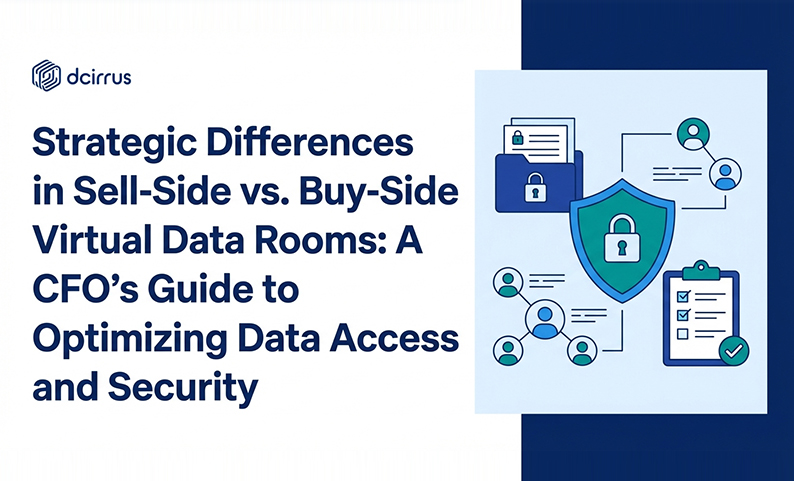
Strategic Differences in Sell-Side vs. Buy-Side Virtual Data Rooms: A CFO’s Guide to Optimizing Data Access and Security
Introduction: The CFO’s Role in Managing Virtual Data Rooms for M&A Success
As a CFO, you’re juggling two goals that don’t always play nice together during M&A: pushing diligence forward quickly while keeping sensitive information from spreading beyond the right people. A virtual data room (VDR) sits right in the middle of that tension.
Here’s the thing. “A data room” doesn’t mean the same thing on both sides of a deal. A sell-side VDR is an externally facing environment where you control disclosure to multiple potential buyers. A buy-side VDR? That’s typically an internal workspace where the acquiring company and its advisors dig into documents, test assumptions, and flag risk.
That difference changes everything. How you structure folders. How you apply permissions. Which document security controls matter most. How you use Q&A and what you monitor in audit logs.
This guide breaks down those strategic differences and turns them into configuration and governance choices you can actually use.
What are sell-side and buy-side virtual data rooms?
At a high level, sell-side and buy-side VDRs differ in control philosophy:
- Sell-side is “showcase then restrict.”
- Buy-side is “unlock for evaluation” (internally) while still protecting sensitive data.
This isn’t academic. It impacts whether your VDR is optimized for competitive tension and clean external disclosure or for internal collaboration, version tracking, and disciplined due diligence workflows.
Sell-Side VDRs: Controlled Document Presentation and Confidentiality Management
On the sell-side, the selling company (often with sell-side advisory support) uses the VDR to present a curated story to many external parties without losing control of who sees what and when.
CFO priorities on sell-side typically include:
- Information governance that supports staged disclosure (teaser, CIM, then detailed diligence)
- Strong confidentiality controls to deter leaks and reduce reputational risk
- Tight external permissions for buyers, lenders, and third-party consultants
- Visibility into bidder behavior to manage follow-ups and maintain momentum
Because the VDR is an extension of your deal process, the “presentation layer” matters too. Clear indexing, consistent naming, and a workflow that keeps the process fair across bidders.
Buy-Side VDRs: Collaborative Tools for Internal Due Diligence and Risk Assessment
On the buy-side, the acquirer uses the VDR differently. Instead of showcasing, the buyer is interrogating: validating the target’s financials, stress-testing risks, preparing negotiation positions and post-merger integration planning.
CFO priorities on buy-side typically include:
- Internal collaboration among finance, legal, tax, operations, and buy-side advisory teams
- Tools that support deep review (annotation, version tracking, structured Q&A management)
- A way to centralize documents, notes, and decisions to avoid “spreadsheet sprawl”
- Governance that maintains a clean audit trail of what was reviewed and when
Buy-side due diligence often involves reviewing three to five years of audited financial statements with attention to revenue growth, EBITDA margins, working capital, and leverage metrics. That volume raises the bar for searchability, categorization, and keeping reviewers aligned.
Key CFO Security and Access Control Considerations
Security and access control aren’t just IT concerns in a transaction. They’re CFO controls that directly influence value, deal velocity, and risk exposure. The same feature (like watermarking) can serve different goals depending on whether you’re the seller controlling disclosure or the buyer coordinating internal diligence.
Nearly 35% of organizations remain extremely concerned about cloud security. That’s why transaction teams typically prefer purpose-built VDR controls over general file-sharing tools for M&A workflows.
Granular Permission Settings: Dynamic Role-Based Access Across Deal Phases
A CFO-grade VDR setup uses granular permissions and changes them on purpose as the deal progresses. “Set it and forget it” is where most access mistakes happen.
Sell-side permission approach often looks like:
- Default to least privilege for external users (buyers and their advisors)
- Use group-based permissions so every bidder gets the same baseline access at each stage
- Create clear gates for sensitive folders (pricing, customer concentration, IP, HR)
- Expand access only when a bidder reaches a defined milestone (IOI/LOI, exclusivity)
Buy-side permission approach often looks like:
- Broader internal access but still role-based (finance, legal, integration leads)
- Separate workstreams by folder permissions (financial review vs legal assessment vs integration planning)
- Controlled access for external advisors to avoid overexposure internally
- Structured escalation paths when additional reviewers need access quickly
A platform with multi-level access controls, device-level approval, IP restrictions, and multi-factor authentication supports this type of phase-based governance when deal teams and advisors change quickly.
Digital Rights Management: Watermarking, Expiry, and Download Controls
Digital rights management (DRM) is where CFO intent becomes very visible. On sell-side, DRM is a deterrent and a containment tool. On buy-side? DRM is often about controlling downstream circulation inside a large deal team and ensuring sensitive content doesn’t escape into unmanaged channels.
Sell-side DRM emphasis typically includes:
- Dynamic watermarking on view and download to discourage redistribution
- Tight download permissions with view-only settings for highly sensitive documents
- Expiry controls on downloaded files to limit long-term exposure
- Restrictions on printing and copying for external parties
Buy-side DRM emphasis often includes:
- Allowing downloads for internal modeling where needed while applying expiry and watermarking
- Using watermarking and auditability to reduce uncontrolled sharing between internal groups
- Differentiating restrictions by document type (contracts vs financial exports vs HR files)
Where possible, align DRM rules to content sensitivity rather than applying one blanket policy. A blanket “no downloads” policy can slow diligence. A blanket “downloads allowed” policy can inflate leakage risk.
Audit Trails and Compliance Certifications: Meeting Regulatory Demands
CFOs usually care about audit trails for two reasons. They support governance (who accessed what, when, and what changed). And they support compliance and defensibility if questions arise later.
On sell-side, audit logs help you track bidder engagement, identify what documents drive questions, and investigate suspicious behavior. On buy-side? Audit logs help prove diligence was performed, maintain continuity across team members, and support internal controls if the acquisition later faces scrutiny.
From a platform evaluation standpoint, CFOs often look for compliance signals and reporting readiness (for example, SOC reports and ISO-aligned controls) plus the ability to support regional privacy requirements like GDPR and other local regulations. In cross-border transactions, data localization options can also become a gating requirement.
How can CFOs optimize data access and workflow efficiency?
Security alone doesn’t close deals. CFOs need secure speed. A way for the right people to access the right documents with minimal friction without losing control.
The most effective VDR governance combines three elements: a clean structure that makes it hard to “get lost,” a collaboration model that reduces email and version confusion, and a monitoring cadence that catches issues early.
Leveraging AI-Powered Document Intelligence for Faster Due Diligence
AI-powered document intelligence can be valuable when used to reduce manual effort, not to replace judgment. For CFOs, the practical win is faster navigation across large volumes of contracts, policies, and financial artifacts.
Typical AI-enabled uses include:
- Smart indexing and automated categorization to keep the data room organized as volume grows
- Metadata search to locate key documents quickly during live Q&A
- Clause recognition to speed legal and financial review alignment
- AI-assisted redaction to reduce the risk of exposing unnecessary sensitive details
In a CFO workflow, this matters differently by side. Sell-side teams can use faster categorization and redaction to publish cleaner disclosures without delays. Buy-side teams? They can use search and clause recognition to accelerate review cycles and focus time on risk evaluation rather than file hunting.
Worth noting. Leveraging AI-powered document intelligence alongside granular access controls helps CFOs maintain confidentiality while keeping diligence moving. Often compressing timelines that might otherwise stretch weeks into days.
Managing Multi-Stakeholder Access: Balancing Transparency and Control
Most M&A friction isn’t caused by missing documents. It’s caused by uncertainty about who can access what, where the “latest” version lives, and how questions are handled.
CFO practices that reduce multi-stakeholder friction include:
- Establish a single Q&A system inside the VDR to reduce email threads and lost context
- Set naming conventions that make versioning obvious (especially for financial models and updated schedules)
- Time-box uploads so bidders or internal reviewers aren’t reacting to constant document churn
- Use notifications for uploads and Q&A responses to reduce “status meeting” overhead
- Assign ownership by folder so every area has a responsible internal reviewer
Sell-side teams also benefit from consistency across bidders. If you allow one buyer to access a sensitive folder early you may need a clear policy for whether and when that access is extended to other parties.
Integrating VDR with Financial and Deal Management Systems
CFOs often want the VDR to fit into existing finance operations, not create a parallel world. While integrations vary by platform and deal setup, the governance goal is consistent: reduce manual rework and keep reporting defensible.
Common CFO-aligned integration patterns include:
- Exporting indexes and activity reporting into spreadsheet formats for deal tracking and internal reporting
- Connecting VDR document sets to internal financial modeling workflows so assumptions trace back to source documents
- Using controlled exports for audit readiness including downloadable logs and structured file indices
Even without deep technical integration a disciplined export and reporting routine can help your team reconcile deal progress, diligence status, and stakeholder engagement without relying on informal updates.
Common mistakes with sell-side and buy-side VDRs
The risks differ by side because the incentives differ. Sellers are managing external disclosure under competitive pressure. Buyers are managing internal coordination under time pressure.
Sell-Side Challenges: Information Overload and Buyer Mistrust
On sell-side two common failure modes appear together: over-disclosure too early (increasing leakage risk) and under-disclosure or inconsistent disclosure (reducing buyer trust).
CFO mitigations include:
- Stage disclosure intentionally with a documented logic for what is released and when
- Keep a “single source of truth” for financial exhibits to avoid conflicting numbers
- Use watermarking, download restrictions, and expiry dates for highly sensitive materials
- Monitor engagement analytics and audit logs to detect unusual access patterns
A practical governance tactic? Treat the sell-side VDR like an external financial statement. Curated, internally reconciled, released under controlled approval.
Buy-Side Challenges: Version Control and Data Consolidation Bottlenecks
On buy-side, delays usually come from coordination breakdowns: multiple reviewers saving separate copies of the same file, comments and questions spread across email, chat and documents, and financial and legal workstreams operating on different document versions.
CFO mitigations include:
- Enforce version control and keep commentary inside the VDR where possible
- Use clearly separated folders for “source documents” versus “work product” (models, summaries)
- Assign review owners and deadlines by diligence area
- Centralize questions in the VDR Q&A to preserve context and support later defensibility
This is also where strong search and indexing matter. If your finance lead can’t quickly retrieve supporting materials during a negotiation call your leverage suffers.
Insider Threats and Unauthorized Sharing: CFO Controls and Policies
Not every leak is external. Insider risk can come from well-meaning behavior (forwarding a file for speed) or from misaligned incentives (sharing beyond authorized circles).
CFO controls that reduce insider risk include:
- Apply least-privilege access by default and review permissions on a schedule
- Use dynamic watermarking to deter casual sharing by making documents attributable
- Restrict printing, copying and downloads for the most sensitive categories
- Monitor audit trails for anomalies such as bulk downloads or repeated access attempts
- Require multi-factor authentication and consider device-level approval for high-risk users
Governance matters as much as tooling. A short written VDR policy for your deal team and advisors (what’s allowed, what’s prohibited, escalation steps) prevents “informal exceptions” from becoming systemic risk.
How should CFOs evaluate and customize VDR security features?
A CFO evaluation framework should connect platform capabilities to deal-side needs. The question isn’t “does it have features?” It’s “can we configure these features in a way that matches sell-side control and buy-side collaboration without slowing the deal?”
Security Feature Evaluation Criteria
Use these criteria to assess fit for both sell-side and buy-side deployments:
- Encryption for data at rest and in transit
- Granular permissions at folder and file levels
- Multi-factor authentication and controls such as IP restrictions or device approvals
- DRM capabilities including dynamic watermarking, print/copy controls, and expiry on downloads
- Audit logs that are detailed, exportable and easy to review
- AI-assisted redaction and strong search to reduce manual handling of sensitive content
- Collaboration tools like Q&A forums, annotations and version tracking
- Multi-language support and data localization options for cross-border requirements
- Compliance posture signals (for example SOC reporting and ISO-aligned data center controls)
Top security feature sets in the market commonly include encryption, dynamic watermarking, granular multi-level permissions, audit logs and multi-language support. So your differentiation should come from how well the platform supports your governance model, not just whether it checks a box.
Cost and Budgeting Considerations Aligned with Deal Type
Cost modeling differs depending on whether you’re running a competitive sell-side process or a single buy-side diligence effort.
Key budgeting questions to pressure-test:
- Is pricing aligned to projects/deals, users, storage or usage?
- Do external bidders create cost spikes on sell-side due to user volume?
- Does internal collaboration on buy-side require many users with different permission levels?
- Can the platform scale across multiple concurrent transactions without forcing separate toolsets?
A CFO-friendly approach is to budget based on the most likely “peak” period (sell-side: multiple bidders; buy-side: full internal review team plus advisors) so you don’t end up changing process midstream due to unexpected overages.
Dynamic Permission Change Workflow Template Across Deal Phases
Dynamic permissioning works best when you pre-plan the phases and define what changes at each step. Here’s a practical template you can adapt.
Phase 1: Pre-marketing / early evaluation
Sell-side: limited folder set, strict view-only, tight external access
Buy-side: internal workspace setup, role-based access by function, initial advisor access
Phase 2: Active due diligence
Sell-side: expand access by bidder stage, open Q&A, allow limited downloads for approved groups
Buy-side: broaden internal access to specialized reviewers, enable annotations and version control, increase search and review workflows
Phase 3: Negotiation / confirmatory diligence
Sell-side: restrict highly sensitive folders to late-stage bidders, tighten DRM on key documents
Buy-side: limit access to negotiation-sensitive work product, maintain clear audit trail of final reviewed materials
Phase 4: Signing and close
Sell-side: lock final versions, preserve audit logs, prepare controlled exports for record retention
Buy-side: preserve diligence artifacts, create controlled integration access for operational integration planning
Phase 5: Post-close / integration planning
Sell-side: retain access only as required for obligations and records
Buy-side: segment access for integration teams, limit visibility into sensitive HR/legal items by need-to-know
This approach supports the core CFO mandate: predictable control that adapts as deal risk changes.
What’s next for VDR technology?
CFOs aren’t just buying a tool for one transaction. You’re setting a repeatable governance pattern for multiple deals, jurisdictions and stakeholder mixes.
Future-proofing usually comes down to three areas: better analytics, more adaptive security and compliance-ready infrastructure.
AI Document Analytics and Risk Detection Enhancements
Beyond search, AI document analytics can help highlight patterns that deserve attention, especially when you’re dealing with thousands of files and many users.
CFO-relevant capabilities may include:
- Engagement insights to see which documents are heavily accessed
- Faster identification of missing materials based on indexing patterns
- Signals that support risk review workflows when teams are large and timelines tight
Used well, analytics can improve your ability to prioritize responses and keep diligence focused on what materially affects valuation and risk.
Dynamic Watermarking and Adaptive Security Controls
Dynamic watermarking is evolving from a static stamp into a more flexible deterrent that can reflect user identity details (such as timestamps) and follow documents through different modes (view, download, print).
CFO best practices for adaptive controls include:
- Increase DRM strictness automatically for high-sensitivity folders
- Use expiry dates on downloads to reduce long-tail exposure
- Pair watermarking with audit trail review so deterrence is backed by monitoring
The goal isn’t to block work. It’s to keep the convenience of digital sharing while preserving accountability.
Integration with Cross-Jurisdictional Compliance and Data Localization
Cross-border deals introduce a practical reality. Where data is stored and how it is accessed can become a compliance requirement, not a preference.
CFO considerations that often differ by side:
- Sell-side: controlling where bidder access comes from, limiting exposure of regulated datasets, maintaining defensible disclosure records
- Buy-side: enabling global internal and advisor teams while respecting data residency constraints for sensitive materials
Look for VDR capabilities that support data localization choices and compliance-aligned operations, especially when GDPR or other regional data protection laws apply.
Summary checklist: essential sell-side vs buy-side VDR configuration settings for CFOs
Use this checklist to align your configuration with deal intent:
- Define whether the VDR is sell-side (external showcase) or buy-side (internal collaboration) before building structure
- Build a folder taxonomy that matches diligence workstreams and reporting needs
- Apply least-privilege access by default and expand access intentionally by deal phase
- Use group-based permissions to ensure consistent external access across bidders on sell-side
- Separate “source documents” from “work product” on buy-side to reduce confusion and protect negotiation materials
- Enable DRM controls appropriate to sensitivity: watermarking, print/copy restrictions, download controls and expiry
- Centralize Q&A inside the VDR to reduce email-based leakage and preserve context
- Enforce version control for models, schedules and key exhibits
- Review audit logs on a defined cadence and investigate anomalies quickly
- Confirm compliance posture and cross-jurisdiction readiness including data localization needs
- Establish a short written VDR governance policy for internal users and external advisors
Frequently Asked Questions (FAQ)
What are the primary security differences between sell-side and buy-side virtual data rooms?
Sell-side VDR security is typically stricter for external users because the seller is controlling disclosure to multiple bidders and aiming to prevent leaks. Buy-side VDR security often emphasizes safe internal collaboration with controls that prevent uncontrolled internal sharing while still enabling fast review.
How should CFOs configure access permissions differently for sell-side vs buy-side VDRs?
Sell-side permissions usually start tight and expand in stages as bidders progress (often using bidder groups and gated folders). Buy-side permissions are broader for internal teams but segmented by workstream with controlled access for advisors and restricted areas for negotiation-sensitive materials.
What role do audit trails and compliance certifications play in VDR management?
Audit trails provide defensible records of access and activity supporting governance, internal controls and post-deal accountability. Compliance certifications and reports help validate that the platform’s security controls align with recognized standards, which can be important for regulated industries and cross-border transactions.
How can AI-powered VDR features support more efficient due diligence?
AI-powered document intelligence can speed up indexing, categorization, search and redaction. That reduces manual workload and helps teams find critical information faster. For CFOs the value is faster diligence cycles without sacrificing control over sensitive data.
What are common sell-side and buy-side data room management pitfalls CFOs should avoid?
Sell-side pitfalls include inconsistent disclosure across bidders, over-disclosure too early and weak DRM on sensitive documents. Buy-side pitfalls include poor version control, fragmented communication across email and chat, and unclear ownership of diligence workstreams.
How can CFOs integrate VDR data with existing financial and deal management systems?
Many teams start with structured exports such as downloadable indexes and activity reporting for deal tracking and audit readiness. CFOs can also align VDR document sets to financial models by maintaining clear references to source documents and using controlled reporting outputs to reduce manual reconciliation.
What dynamic permission strategies work best across different M&A deal phases?
The most effective strategy is phase-based permissioning. Tight access early, expanded access during active diligence, narrowed access during negotiation and controlled preservation at close. Pre-defining these phases prevents ad hoc access decisions under pressure.
How do multi-jurisdictional data privacy laws impact buy-side vs sell-side VDR setups?
They can dictate where data is stored, who can access it and what safeguards must be applied. Sell-side teams often focus on controlled external access and defensible disclosure logs while buy-side teams focus on enabling cross-border internal collaboration without violating data residency or privacy requirements.
What best practices enhance collaboration while maintaining strict data security?
Use a centralized Q&A system. Enforce version control. Apply role-based permissions. Keep audit monitoring consistent. Combine that governance with DRM controls like watermarking and expiry so collaboration stays fast but accountable.
How can CFOs measure and report VDR usage to stakeholders and auditors effectively?
Rely on audit logs and usage reporting to summarize who accessed which categories of information, when key documents were reviewed and how Q&A progressed. A consistent reporting cadence can support investor updates, board oversight and audit readiness.
Ready to secure your transactions?
Book a free demo of DCirrus Virtual Data Room today and experience enterprise-grade data protection with encryption, access controls, and compliance-ready localization.
Latest Posts
Buyer Engagement Analytics in a VDR: What Deal Teams Can Track
August 17, 2026

12 VDR Features Required for IPO Preparation in India
August 13, 2026

What Bankers and Auditors Need From an IPO VDR in India
August 12, 2026