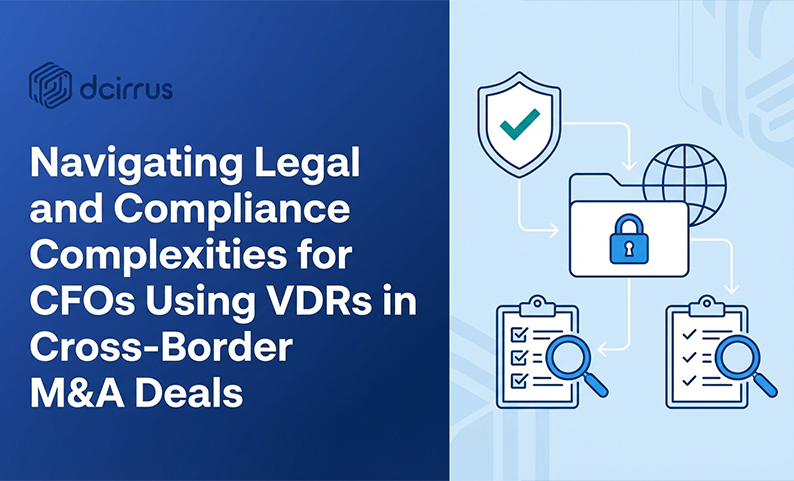
Navigating Legal and Compliance Complexities for CFOs Using VDRs in Cross-Border M&A Deals
Cross-border M&A can unlock rapid growth. But it also multiplies legal compliance and control risk. As CFO, you’re not just validating the numbers—you’re protecting the integrity of the deal process. Who can see sensitive data? Where is that data stored? How does it move across borders, and how will you prove every key step to auditors, regulators, and the board?
A modern Virtual Data Room (VDR), a secure cloud-based repository purpose-built for transactions, can become your control center for cross-jurisdictional deals. Done right, it supports regulatory compliance, faster due diligence, cleaner investor communication, and audit-ready evidence. No more relying on email chains and uncontrolled file copies.
Understanding legal and compliance challenges in cross-border M&A from the CFO perspective
Cross-border dealmaking pushes finance leaders into a blended role: part financial steward, part risk manager, part process governor. You’re expected to keep the deal moving while ensuring the organization doesn’t accidentally violate data sovereignty laws, foreign investment controls, antitrust requirements, or financial reporting obligations.
Research suggests M&A outcomes have improved significantly. Up to 70% of transactions may be considered successful today versus far lower rates decades ago, often credited to stronger risk assessment and compliance discipline. But due diligence gaps still contribute to roughly 60% of failed deals, putting extra pressure on CFO-led transaction vetting and documentation controls. (Sources: https://www.idealsvdr.com/blog/ma-reviews/ and https://www.idealsvdr.com/blog/ma-due-diligence-all-you-have-to-know/)
What are the biggest legal and regulatory headaches CFOs face?
In international mergers and acquisitions, CFO risk spans approvals, disclosures, tax exposure, and operational constraints that change by jurisdiction.
Key categories you’ll typically orchestrate across counsel, tax advisors, compliance, and deal teams:
- Antitrust laws and merger control: Competition laws can require pre-close notifications, waiting periods, and remedies that affect forecasting and integration planning
- Foreign investment controls: FDI restrictions like CFIUS in the U.S. and ownership caps in China can gate or reshape transactions (Source: https://www.phoenixstrategy.group/blog/cross-border-regulatory-challenges-in-manda)
- Tax complexities: Transfer pricing risk, withholding tax exposure, VAT/GST considerations influence purchase price mechanics and post-close cash planning
- Sector-specific regulation: Financial services, healthcare, telecom, critical infrastructure—all carry special licensing and data handling obligations
- Regulatory change risk: Rules can shift mid-deal. Static checklists and scattered files allow compliance posture to drift
Your CFO takeaway? The “legal workstream” isn’t separate from finance. Regulatory challenges directly affect valuation, timing, and investor confidence in your disclosures.
How do multi-jurisdictional data privacy and localization laws impact financial compliance?
Most cross-border deals now hinge on how you handle information. Not just contracts and financial statements, but customer records, employee information, and operational datasets regulated by data sovereignty laws.
Key CFO-level risks:
- Cross-border transfer restrictions: Laws like GDPR (EU), PIPL (China), and LGPD (Brazil) impose conditions on transferring personal data outside national boundaries
- Data localization regulations: Some jurisdictions require certain data types stored locally or processed under specific safeguards, directly influencing where your VDR is hosted and how access is granted
- Onward-transfer concerns: Even lawful sharing for due diligence may require controls preventing further downloading or uncontrolled copying
CFOs must align three things simultaneously: legal basis for sharing information, technical controls that enforce intended use, and evidence that controls were actually applied. That’s the theory. In practice, it’s messier.
Industry commentary notes that rising data sovereignty expectations are shaping a “new standard” for cross-border M&A. Capabilities like geo-fencing and strong audit trails become practical requirements, not nice-to-haves. (Source: https://www.caplinked.com/blog/cross-border-ma-and-the-new-vdr-standard-secure-collaboration-amid-rising-data-sovereignty-laws/)
What are CFO responsibilities in compliance governance and financial reporting accuracy?
While legal and compliance teams interpret laws, CFOs commonly own the governance that makes compliance provable.
Your mandate typically includes:
- Internal controls over financial information: Maintaining reliable, version-controlled disclosure materials and models aligned with SOX and GAAP requirements
- Audit readiness: Demonstrating who accessed which documents, what changed, when, and why
- Board and investor assurance: Creating defensible records that disclosures were controlled and sensitive information shared on a least-privilege basis
- Cross-functional coordination: Integrating finance, legal, compliance, IT security, HR, and local advisors into a single operating rhythm
Your job isn’t to “know every regulation.” It’s to build a system where the right experts can act quickly and evidence is captured automatically (worth documenting this early).
How do Virtual Data Rooms empower CFOs to navigate compliance and legal complexities?
A VDR is more than file storage. In well-run deals, it becomes a compliance technology layer: enforcing access rules, recording every action, structuring due diligence, keeping sensitive communications inside the deal perimeter.
For CFOs managing global dealmaking, that means fewer uncontrolled data exports, fewer version disputes, and a clearer path to audit-ready reporting.
What compliance and security features should CFOs prioritize in VDR solutions?
If your deal spans multiple jurisdictions and external parties, prioritize VDR controls that map to real compliance obligations. Not generic file sharing.
Look for capabilities like these:
- Granular access controls: Role-based permissions at folder and file levels applying least-privilege access by workstream, bidder, advisor, geography
- Multi-factor authentication (MFA/2FA): Strong authentication is baseline when sensitive financial and legal materials are involved
- Device-level approval and IP restrictions: Practical ways to reduce account sharing and limit access to approved environments
- Encryption: 256-bit AES encryption for data at rest and in transit protects deal materials across distributed teams
- Digital rights management (DRM): Controls restricting printing, copying, sharing—with expiration dates on downloaded documents
- Dynamic watermarking: Visible deterrence tying potential leaks back to specific users and access events
Treat these as control mechanisms, not feature checkboxes. Ask yourself, “What specific risk does this reduce, and how will we prove it worked?”
How do AI-powered VDR capabilities enhance compliance and due diligence efficiency?
AI-enabled data rooms can reduce time spent on manual tasks and lower the chance of missing critical issues. They don’t change your underlying compliance obligations (you still own those).
AI features most valuable to CFO workflows:
- Smart indexing and automated categorization: Maintains order as documents arrive from different countries, subsidiaries, advisors
- Metadata search: Speeds retrieval of key evidence during diligence and later audits
- Clause recognition: Surfaces common risk themes—change-of-control clauses, indemnities, exclusivity terms—across contracts so finance can quantify exposure earlier
- AI-assisted redaction: Supports privacy-by-design by reducing temptation to share “too much”
These tools help finance teams stay responsive while keeping deals on track. Especially when timelines are tight, when teams are distributed, when stakes are high.
Why do robust audit trails and reporting matter for meeting regulatory and investor expectations?
CFOs rarely get challenged on intent. They get challenged on evidence.
Audit trails help you demonstrate:
- Who accessed what and when: Critical for confidentiality disputes, regulatory inquiries, internal investigations
- What changed and why: Supports version control for disclosure schedules, financial models, final signing packs
- Whether controls were applied: If regulators or auditors ask how you restricted access to personal data or sensitive projections, logs and permission reports matter
This is where investor confidence rises. A well-run digital deal room signals professionalism—controlled disclosure, faster response cycles, fewer surprises.
How do you implement a CFO-focused governance framework for cross-border VDR usage?
Technology alone won’t solve compliance risk. CFOs get best outcomes when VDR usage is governed like a control environment (not a shared folder).
What are best practices for managing multi-stakeholder access and permissions?
Cross-border M&A can involve acquirers, PE sponsors, lenders, multiple law firms, tax advisors, local counsel, auditors, internal teams. Speed matters, but not at the cost of oversharing.
Implement permission practices like:
- Role-based access by stakeholder type: Separate groups for bidders, counsel, tax, auditors, internal reviewers
- Jurisdiction-aware access: Apply constraints to sensitive folders based on where users are located and applicable laws
- Time-bound access: Remove access automatically when phases end to reduce lingering exposure
- Segregation of duties: Ensure upload, approval, permission changes aren’t controlled by one person without oversight
- Standardized naming and indexing: Consistency reduces misfiling and accidental disclosure
CFO rule of thumb: if you can’t explain why someone needs a document, they shouldn’t have it.
How can you integrate dynamic regulatory change monitoring with VDR configuration updates?
Regulatory change management is usually underbuilt in deal execution. Tighten this by linking “what changed” to “what we adjusted” inside the VDR.
Create a lightweight cadence (say a weekly regulatory checkpoint):
- Weekly check: Local experts and compliance leads flag changes in data transfer requirements, foreign investment controls, filing timelines
- VDR control review: Confirm permissions, geo-fencing selections, DRM settings, watermarking rules still match current requirements
- Documentation snapshot: Export permission reports and audit-trail summaries at defined milestones—LOI, exclusivity, signing, closing
- Exception handling: Route urgent disclosures through tracked approval paths documenting who approved, what was shared, under what conditions
This keeps you agile without losing control. Treat configuration updates as part of compliance operations, not buried IT tasks.
What training and change management help maximize VDR adoption and compliance?
Even the best VDR can fail if teams revert to email attachments and offline spreadsheets under pressure (it happens).
Build compliance discipline by focusing training on real behaviors:
- Deal-room etiquette: Where questions go, where answers go, what “final” means for documents
- Q&A workflow: How to respond in-platform so discussions and commitments stay auditable
- Redaction and disclosure rules: When to redact, who approves, how to validate the redacted version is shared
- Permission hygiene: How to request access changes and review timelines
Make “working outside the VDR” the exception requiring justification. That’s how you keep the record clean.
How do you evaluate the business case for investing in compliance-driven VDRs?
CFOs often need to defend VDR investment as more than a “deal tool.” The strongest business case connects costs to risk reduction, cycle-time improvement, fewer resource drains on finance and legal teams.
How do you quantify risk reduction through enhanced security and compliance controls?
Common value levers include:
- Reduced probability of data leakage: DRM, watermarking, access restrictions, MFA lower chances of uncontrolled distribution
- Lower exposure to regulatory penalties: Better control over personal data and cross-border transfer rules reduces non-compliant sharing likelihood
- Fewer deal delays from compliance rework: When evidence is missing, teams pause to reconstruct what happened. Audit trails reduce that scramble
- Reduced post-close cyber risk: Research suggests 68% of private equity firms report increased cyber risks after closure—reinforcing the CFO mandate to treat transaction data as high-risk (Source: https://www.idealsvdr.com/blog/ma-reviews/)
Your framing to the board? The VDR is a control system reducing the chance of costly, reputation-damaging mistakes.
What operational efficiencies and accelerated deal timelines do VDRs enable?
Efficiency ROI is easier to defend because it directly touches internal labor and deal velocity.
A compliance-ready VDR can reduce friction through:
- Faster document retrieval: Search, indexing, consistent organization reduce time hunting for evidence
- Parallel review: Multiple stakeholders review and comment without creating duplicate files
- Single source of truth: Version control avoids reconciliation across emailed attachments
- Centralized Q&A: Keeps diligence questions, answers, follow-ups in one system, reducing cycle time
Note the market direction: surveys indicate 85% of business owners see cross-border deals as a top priority. More cross-border activity means more pressure to standardize compliant transactions. (Source: https://www.websiteclosers.com/resources/legal-challenges-in-cross-border-mergers-and-acquisitions/)
What cost control strategies balance advanced features with budget constraints?
You don’t need every feature at maximum settings for every user. CFO-friendly cost control comes from aligning controls to risk.
Practical strategies:
- Tier permissions by phase: Early-stage bidders get limited access. Expand after seriousness is proven
- Right-size user provisioning: Give access to teams, not whole firms; remove inactive users regularly
- Standardize templates: Use consistent folder structures and disclosure checklists to reduce setup time
- Prioritize compliance-critical features: MFA, encryption, audit trails, DRM, data localization matter more than cosmetic customization
- Plan for export and retention: Ensure clean log, index, evidence export at close—avoid costly reconstruction
The best cost-benefit story: “spend a predictable amount to avoid unpredictable exposure.”
How does compliant VDR usage enhance stakeholder confidence and regulatory assurance?
A controlled, auditable process doesn’t just reduce risk. It changes how counterparties experience your deal. Investors and regulators care about governance signals—a compliant VDR setup is one of the clearest signals you can send.
How do integrated Q&A and real-time reporting tools support transparent investor communication?
Investors want responsiveness and consistency. When Q&A happens across emails and meetings, you risk conflicting answers and lost context.
Using integrated Q&A and in-platform communication:
- Keeps answers consistent: Finance-approved responses are visible and searchable
- Creates auditable records: Documents what was asked, answered, when
- Reduces “shadow diligence”: Stakeholders don’t forward documents and questions outside the controlled environment
For CFOs, this supports both compliance and valuation defense. Fewer misunderstandings. Fewer last-minute renegotiations. Fewer doubts about disclosure quality.
How do you prepare for external audits and regulatory reviews using VDR-generated documentation?
Regulatory reviews often hinge on documentation completeness. VDRs help by generating structured evidence from normal deal activity.
Build audit readiness into workflows:
- Export audit trails at milestones: LOI, signing, closing, major disclosure events
- Capture permission reports: Demonstrate least-privilege controls and access governance
- Preserve versions of key financial artifacts: Models, QoE reports, final statements, material updates
- Maintain clear retention policies: Align retention and deletion with legal hold requirements and applicable regulations
CFO outcome: if someone challenges your process, you can show your process.
How can you monitor emerging legal risks and leverage VDR analytics for proactive compliance?
CFOs can use VDR usage patterns as early-warning systems:
- Unusual access behavior: Unexpected download spikes, repeated access to sensitive folders, access from unrecognized locations
- Stalled diligence areas: Low engagement in key risk folders may signal incomplete transaction vetting
- Repeated questions on same topics: Indicates unclear disclosure, missing documents, potential misalignment between jurisdictions
This turns the VDR into more than compliance storage. It becomes a management dashboard for deal risk and stakeholder focus.
Summary: Empowering CFOs to lead cross-border M&A compliance with advanced VDR solutions
Cross-border M&A forces CFOs to balance speed, confidentiality, regulatory compliance across multiple legal regimes. The most resilient approach combines local expert guidance with a strong governance model and a VDR that enforces technical controls: granular permissions, encryption, DRM, audit trails, data localization options.
When you treat the VDR as a financial control environment (not just a document repository), you improve due diligence quality, reduce compliance risk, build stronger investor and regulator confidence in your process integrity.
FAQ
What are the primary legal and compliance challenges CFOs face in cross-border M&A?
CFOs commonly face antitrust and merger control requirements, foreign investment controls (FDI restrictions and national security screenings like CFIUS), tax complexities (transfer pricing, withholding tax, VAT/GST), and multi-jurisdictional data privacy laws (GDPR, PIPL, LGPD). The added challenge is proving compliance through documentation and audit-ready evidence while deal timelines stay aggressive.
How do virtual data rooms help CFOs ensure multi-jurisdictional compliance during due diligence?
VDRs centralize sensitive information in secure repositories with least-privilege permissions, encryption, documented access records. They support compliance workflows like controlled Q&A, version control, configurable restrictions that reduce accidental over-disclosure across jurisdictions.
What specific VDR features are critical for managing financial compliance and confidentiality?
CFOs should prioritize granular access controls, multi-factor authentication, 256-bit encryption at rest and in transit, DRM controls (restrict printing/copying/sharing), dynamic watermarking, tamper-resistant audit trails. For cross-border deals, data localization options and jurisdiction-aware access restrictions are especially important.
How can CFOs implement effective governance frameworks to oversee VDR usage in international deals?
Start with clear role definitions (who uploads, approves, changes permissions), standardized folder structures, controlled Q&A processes. Add regular access reviews, time-bound permissions, milestone-based exports of audit trails and permission reports. Tie VDR configuration changes to documented regulatory change management cadences.
What is the expected ROI for CFOs investing in compliance-focused VDR solutions?
ROI typically comes from reduced risk of leaks and compliance missteps, fewer delays from missing documentation, faster diligence cycles due to better organization and centralized collaboration. CFOs often model ROI using internal time savings, reduced rework, risk-avoidance scenarios rather than universal benchmarks.
How do audit trails in VDRs support regulatory reporting and investor confidence?
Audit trails provide defensible records of document access, downloads, edits, Q&A history. That evidence supports internal controls, external audits, regulator inquiries. For investors, it signals disciplined governance and reduces doubts about whether disclosures were controlled and consistent.
What cybersecurity protocols should CFOs require from VDR providers for cross-border transactions?
CFOs should require multi-factor authentication, strong encryption (at rest and in transit), role-based permissions, device/IP restrictions, DRM, dynamic watermarking, comprehensive activity logs. Also request recognized security assurances (SOC reports, ISO certifications) and confirm how providers support data localization and incident response.
How can CFOs stay agile amid evolving global regulations using VDR capabilities?
Pair weekly regulatory check-ins (with local counsel and compliance leads) with VDR control reviews. When regulations shift, update permissions, sharing rules, localization/hosting selections, redaction standards, and document those changes through exported reports and audit logs at key milestones.
What best practices improve CFO team adoption and compliance discipline with VDR workflows?
Train teams on specific behaviors: keep diligence Q&A in-platform, enforce version control, use approved redaction processes, follow formal access-change workflows. Reinforce that working outside the VDR is an exception requiring justification, so compliance records stay complete and auditable.
Ready to secure your transactions?
Book a free demo of DCirrus Virtual Data Room today and experience enterprise-grade data protection with encryption, access controls, and compliance-ready localization.
Latest Posts
Buyer Engagement Analytics in a VDR: What Deal Teams Can Track
August 17, 2026
12 VDR Features Required for IPO Preparation in India
August 13, 2026
What Bankers and Auditors Need From an IPO VDR in India
August 12, 2026