What Regulators and Auditors Typically Ask About Deal Process and the Evidence Each Question Expects
Introduction: Importance of Audit and Regulatory Questions in Deal Processes
Regulators and auditors don’t just review your numbers. They evaluate how a deal was run. In M&A, IPOs, and fundraising, they want to see that decisions were authorized, disclosures were controlled, risks were assessed, and sensitive information was protected. The fastest way to lose time (or confidence) in a transaction? Scrambling for audit evidence after questions arrive.
Most inquiries boil down to two themes:
- Was the deal process governed and controlled? Approvals, segregation of duties, access controls, audit trails.
- Can you prove it with audit documentation? Dated records, clear ownership, consistent versioning, and complete supporting evidence.
Managing audit evidence inside a secure, centralized environment also makes these questions easier to answer because you can show who had access, what changed, and when. Without relying on scattered emails and local file copies.
What Questions Do Regulators and Auditors Ask During Deal Processes?
Below are the questions that commonly surface across the deal lifecycle. The exact wording and emphasis will vary by jurisdiction and transaction type, but the intent is consistent: demonstrate control, traceability, and completeness.
Common Questions at Pre-Deal Stage
- Who approved initiating the transaction process and under what authority?
- What governance model was established for the deal (roles, responsibilities, escalation paths)?
- How did you identify and manage conflicts of interest and related-party considerations?
- What confidentiality measures were put in place before information sharing began?
- What criteria were used to select advisors, and how was independence considered?
- What was the initial scope of financial due diligence and legal due diligence, and who owned the plan?
- What document retention and communication standards were defined for deal workpapers?
Common Questions During Due Diligence
- Is the due diligence request list complete, and how do you know all required items were received?
- How did you validate the accuracy and integrity of key financial statements and management reports?
- What sampling methods were used to test transactions, balances, or controls?
- What were the major financial red flags identified, and how were they investigated?
- How did you control access to sensitive documents (permissions, authentication, segregation)?
- Can you prove that only authorized parties accessed specific files and that access was time-bound?
- How were questions, clarifications, and responses tracked to avoid off-platform agreements?
- How did you ensure the latest versions of documents were reviewed (version control)?
- What controls exist to limit unauthorized copying, forwarding, or leakage of confidential information?
- How did you track disclosure decisions and ensure consistency across drafts?
Common Questions at Deal Closing and Post-Closing
- What final approvals were obtained before signing and closing?
- What evidence supports critical contractual representations and warranties?
- Were there material changes between final diligence and closing, and how were they documented?
- What is the plan for post-close integration and control handover?
- What incident response procedures were in effect during the deal?
- How will deal records be retained, secured, and produced later if needed?
How Do Buy-Side and Sell-Side Audit Questions Differ?
Buy-side focus: How you validated the target’s claims and protected your decision-making process.
Sell-side focus: How you controlled disclosures, ensured consistency, and avoided selective sharing or undocumented side conversations.
Buy-side questions often probe the sufficiency of investigation—scope of financial due diligence, sampling methods, how red flags were resolved, and how conclusions tie to valuation. Sell-side questions often probe information governance: who got access to what, when, and how you maintained one source of truth for disclosure packages and Q&A.
What Evidence Types and Documentation Do Auditors Expect for Each Question?
Auditors and regulators look for audit evidence that is easy to trace, dated, attributable, and consistent. The most persuasive audit documentation usually combines a record of the decision, who approved it, what information was available at that time, and who accessed or changed deal materials.
Documentary Evidence Examples
| Typical question | Evidence that commonly satisfies it |
| Who authorized the deal process and key milestones? | Board resolutions, committee minutes, approval memos, signed delegations of authority |
| What was the diligence scope and plan? | Diligence plan, request lists, project timeline, roles and responsibilities, advisor engagement letters |
| How were financial claims validated? | Financial due diligence reports, supporting schedules, tie-outs to audited statements, reconciliation workpapers |
| How were red flags handled? | Issue logs, risk registers, follow-up requests, written management responses, revised deal terms tied to findings |
| What was disclosed, to whom, and when? | Controlled disclosure package list, dated draft histories, disclosure checklists, sign-off records |
Access and Control Evidence
| Typical question | Evidence that commonly satisfies it |
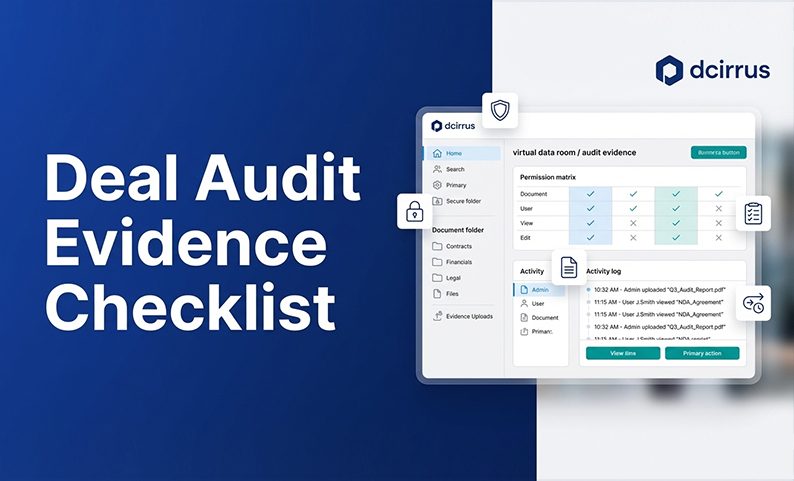
| Who had access to the data room and why? | User lists, role definitions, access request/approval tickets, permission matrix |
| How did you enforce authentication and prevent unauthorized access? | Authentication settings, 2FA enforcement records, device approval logs, IP restrictions |
| How did you restrict high-risk actions (download, print, copy)? | DRM settings, watermarking configurations, policy acknowledgements, restricted permission groups |
| How did you ensure only current stakeholders retained access? | Provisioning and deprovisioning logs, date-bounded access approvals, offboarding checklists |
The key? Demonstrating user management as a controlled process. Not an ad hoc activity handled via informal requests.
Audit Trails and Logs
Activity logs can become as important as the documents themselves because they show how information moved and how decisions were supported.
| Typical question | Evidence that commonly satisfies it |
| Can you prove who opened, downloaded, or shared a specific file? | Data room activity records, download logs, view logs, document-level tracking reports |
| Can you prove what changed between versions? | Version histories, change logs, comparison notes, controlled file naming, approval workflow history |
| How were Q&A and clarifications handled? | Q&A transcripts, timestamps, question ownership, response approvals, resolved/open status logs |
| How do you show completeness of the audit file? | Index exports, document registers, evidence maps linking questions to supporting evidence |
Compliance and Incident Response Documentation
| Typical question | Evidence that commonly satisfies it |
| What policies governed confidentiality and information sharing? | Confidentiality policies, NDAs, training acknowledgements, communications guidelines |
| What is your incident response posture during the deal? | Incident response plan, escalation procedures, breach response playbooks, incident tickets |
| How do you ensure business continuity for deal-critical systems? | Business continuity plans, backup/recovery documentation, continuity testing evidence |
How Should You Organize and Manage Deal Evidence for Audit Readiness?
Audit readiness is less about producing more documents and more about building a reliable system for evidence: where it lives, how it’s labeled, who owns it, and how changes are controlled.
Structure Your Audit Evidence Repositories
A practical evidence repository structure typically aims to make three things obvious: context, ownership, and retrieval.
Single-level structure example (adapt to your deal):
- Governance and approvals
- NDA and confidentiality
- Diligence request lists and trackers
- Financial due diligence workpapers
- Legal due diligence workpapers
- Q&A and correspondence logs
- Drafts and disclosure packages
- Contracts and definitive agreements
- Closing deliverables
- Post-close integration and handover
- Compliance and incident response
To reduce time spent in audits, add an evidence index that maps common regulator/auditor questions to the exact location of supporting evidence. Worth the effort up front.
Maintain Document Integrity and Version Control
Auditors care about whether a document can be trusted as the version relied upon. A few operational habits make that easier:
- Use consistent file naming conventions tied to date/version
- Keep drafts and finals separated with explicit “final” designation rules
- Record who approved final versions and when
- Preserve superseded versions rather than overwriting them
Digital signatures and immutable audit logs can strengthen confidence, but the baseline is simple. No ambiguity about which document version supported which decision.
Implement Granular Access Controls and User Management
Access controls are not only an IT topic in deals. They are audit evidence. To demonstrate controlled sharing:
- Define roles (internal, external counsel, auditors, bankers, investors) and map them to permissions
- Require approvals for access changes and keep those records
- Apply least-privilege access: give users only what they need when they need it
- Run periodic access reviews during long deal cycles and keep the results as audit documentation
Outsourcing parts of diligence does not outsource accountability. Regulators and auditors still expect you to show internal ownership of access decisions and evidence management.
Use Automated Audit Trails and Q&A Logs to Support Transparency
A common audit gap in transactions? “We discussed it over email/calls.” That creates a documentation problem because key deal interpretations and commitments can become untraceable.
When Q&A and key clarifications are captured in a structured log, you can show what was asked, who answered, when it was answered, whether the answer was reviewed/approved, and whether the question was resolved before closing. This improves transparency and reduces rework when auditors later test whether diligence was performed consistently.
What Makes Deal Process Evidence Strong or Weak?
Not all audit evidence is equally persuasive. A simple rubric helps you self-check whether your records will hold up under regulator or auditor scrutiny.
Relevance: Evidence is relevant when it directly answers the question being tested. A practical approach? Restate the auditor’s question in one sentence, attach the one or two records that prove it, and add a short note explaining what in the document supports the answer.
Reliability: Reliable evidence is easier to trust because it is attributable and harder to dispute. Signals of reliability include clear source and ownership, independent support where available, system-generated logs rather than manually reconstructed timelines, and watermarking that shows provenance.
Timeliness: Deals move fast. Regulators and auditors often test whether controls operated throughout the lifecycle, not only at closing. Timeliness means evidence is dated and aligns to deal milestones, records are available during the process (not created after-the-fact), and changes are captured as they happen.
Completeness: This is where many deal teams get surprised—especially when evidence is split across inboxes, chats, shared drives, and personal devices. To reduce gaps: maintain a single evidence index and update it weekly during peak diligence, ensure every key approval has a record, ensure every high-impact Q&A item is captured and closed out with supporting documents, and ensure retention rules are defined so nothing critical is deleted.
How Do Virtual Data Rooms and Digital Tools Help Manage Audit Evidence?
A virtual data room is often used to share documents, but from an audit readiness perspective its bigger value is controlled access and defensible audit documentation. Document-level controls and automated audit trails help establish clear ownership and access history. That reinforces the credibility of evidence presented to auditors and regulators.
Secure Document Storage and Controlled Access
A VDR can support audit readiness by centralizing sensitive deal materials in one controlled repository and enabling role-based permissions at folder and file levels, strong authentication options (such as multi-factor authentication), controls that limit risky behaviors like download/print/copy, and tracking of user activity as supporting evidence.
Real-Time Collaboration With Audit Trail Support
Deal teams often lose audit documentation in the collaboration layer—emails, chat threads, and offline notes. Digital platforms that keep collaboration close to the documents can reduce that risk by supporting integrated Q&A discussion forums, secure messaging and notifications, commenting and annotations tied to specific documents, and automatic capture of timestamps and user actions for audit trails.
When the collaboration history is preserved auditors can test what happened without asking the team to reconstruct it.
Compliance-Ready Localization and Data Residency
In multi-jurisdiction deals, data residency and localization requirements can shape how you store and share deal documentation. A platform that supports choosing data center locations can help align your evidence repository with regional data protection expectations. For teams operating under SEBI or other regulators the practical benefit is the same: you can demonstrate where the data was hosted, how access was controlled, and how records were retained.
What Are Common Pitfalls and Audit Findings Related to Deal Evidence Gaps?
Most deal audit issues are not about a single missing document. They’re about patterns that suggest weak control or weak traceability.
Fragmented Documentation and Lack of Centralized Evidence
When evidence lives in multiple places teams commonly face incomplete audit files because key records were never captured, inconsistent versions of the same document circulating across stakeholders, delays responding to auditors because nobody knows the system of record, and higher risk of missing or contradictory disclosures.
Centralization reduces these risks by making indexing and retrieval part of normal operations.
Insufficient Access Control and Missing Audit Logs
Two common problems trigger tough questions: access was granted informally without approvals or periodic reviews, and there is no reliable audit trail showing who accessed what and when. When that happens teams may struggle to prove confidentiality controls—especially if a dispute arises or if regulators question information handling during the transaction.
Poor Version Control and Loss of Document Integrity
Auditors often challenge evidence when the “final” version is unclear, drafts were overwritten, key exhibits changed without a traceable approval record, or supporting schedules don’t tie to the version used in negotiation or disclosure.
Strong version histories and approval workflows reduce these issues by making document integrity demonstrable rather than assumed.
FAQ: Addressing Common Reader Questions on Audit Readiness for Deal Processes
What are the most common questions regulators and auditors ask about the deal process?
They typically ask about governance (who approved what), execution (how diligence was planned and performed), control (how access and confidentiality were enforced), and traceability (what evidence proves actions happened when claimed). They also probe how red flags were identified and resolved and whether disclosures stayed consistent through drafts and final documents.
What types of evidence do auditors expect to see for each typical regulator question?
They usually expect audit documentation that is dated, attributable, and easy to verify: board minutes and approvals, due diligence plans and workpapers, financial due diligence schedules and tie-outs, issue logs, Q&A transcripts, version histories, access logs, and compliance/incident response documentation. The best evidence directly maps to the question and can be retrieved quickly via an index.
How do audit questions differ between buy-side and sell-side deals?
Buy-side questions lean toward demonstrating the sufficiency of investigation (scope, sampling methods, how conclusions were reached, and how red flags affected terms). Sell-side questions lean toward demonstrating controlled and consistent disclosure (who got access to what, how drafts were governed, and whether communications were captured in records).
What are best practices to organize and maintain deal evidence for audit readiness?
Maintain one evidence repository, use a consistent structure, create an evidence index that maps questions to documents, enforce version control, document approvals, and keep an issue/Q&A log. Most importantly treat audit readiness as continuous—update evidence as the deal progresses rather than trying to rebuild the story after closing.
How can virtual data rooms help in managing audit trails and document control during deals?
A VDR can centralize deal materials, enforce granular access controls, and automatically capture audit trails such as views/downloads, version histories, and Q&A activity. Utilizing document collaboration tools and integrated Q&A logs within secure platforms can significantly reduce manual effort in gathering audit evidence and ensure transparency during regulator inquiries.
Take Action: Enhancing Your Deal Audit Readiness Today
If you want smoother diligence and fewer last-minute audit scrambles focus on one practical shift: treat every key deal activity as something you may need to prove later. Build your audit files and supporting evidence as you go—approvals, access decisions, Q&A, version histories, and closure of red flags—so regulators and auditors can follow the story without gaps.
Ready to secure your transactions?
Book a free demo of DCirrus Virtual Data Room today and experience enterprise-grade data protection with encryption, access controls, and compliance-ready localization.
Latest Posts
Buyer Engagement Analytics in a VDR: What Deal Teams Can Track
August 17, 2026
12 VDR Features Required for IPO Preparation in India
August 13, 2026
What Bankers and Auditors Need From an IPO VDR in India
August 12, 2026